Give us feedback!


 See all
Our philosophy is simple. We want to encourage you to dream. BIG! Then we help you plan your trip, get the most out of it while you're traveling and help you share your experience with friends.
Join Now It's FREE
Dream Packages
Duration: 2 days
Price: $331.50
Price: $331.50
Duration: 12 hours
Price: $124.49
Price: $124.49
Duration: 9 hours
Price: $135.68
Price: $135.68
Duration: 2 days
Price: $335.27
Price: $335.27
Dreams Still To Do
Checked-Off Dreams
Dreams Still To Do
Checked-Off Dreams
Advertisement
Explore Ancient Places & Ruins
-
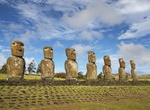
See Moais at Ahu Akivi, Easter Island, Chile
Ahu Akivi is a particular sacred place in Rapa Nui (or Easter Island) in the Valparaíso Region of Chile, looking out towards the Pacific Ocean. The site has seven moai, all of equal shape and size, and is also known as a celestial observatory that was set up around the 1500s. The site is located inland, rather than along the coast. Moai statues were consid... -
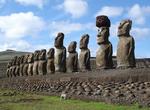
See Moais at Ahu Tongariki, Easter Island (UNESCO site)
Ahu Tongariki is the largest ahu on Rapa Nui/Easter Island (a Chilean island in the Pacific). Its moai were toppled during the island's civil wars and in the twentieth century the ahu was swept inland by a tsunami. It has since been restored and has fifteen moai including an 86 tonne moai that was the heaviest ever erected on the island. Ahu Tongariki is one kilometer... -
Visit Aigai (Vergina), Greece (UNESCO site)
Archaeologists were interested in the hills around Vergina as early as the 1850s, supposing that the site of Aigai was in the vicinity and knowing that the hills were burial mounds. Excavations began in 1861 under the French archaeologist Leon Heuzey, sponsored by the Emperor Napoleon III. Parts of a large building that was considered to be one of the palaces of Antig... -
Visit Ain Tounga, Testour, Tunisia
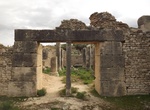
Thignica's stone ruins are called Aïn Tounga, located southwest of Testour, Tunisia. They are very extensive and cover the summit and slopes of a series of hills. One inscription calls the town "Civitas Thignicensis" (the city of Thignica) and states that it was divided into three parts, another that it became a municipium at the beginning of the 3rd century unde... -
See Ajanta Caves, India (UNESCO site)
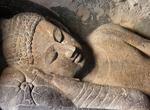
The Ajanta Caves in Maharashtra, India are 31 rock-cut cave monuments which date from the 2nd century BCE. The caves include paintings and sculptures considered to be masterpieces of both Buddhist religious art (which depict the Jataka tales) as well as frescos which are reminiscent of the Sigiriya paintings in Sri Lanka. The caves were built in two phases starting ar... -
Visit Ajina Tepe, Bokhtar, Tajikistan (UNESCO site)
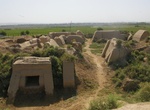
Ajina Tepe is a Buddhist monastery cluster located 12 kilometers east of the city of Bokhtar, Tajikistan. Buddhism in Tokharistan is said to have enjoyed a revival under the Western Turks. Several monasteries dated to the 7th-8th centuries display beautiful Buddhist works of art, such as Kalai Kafirnigan, Ajina Tepe, Khisht Tepe or Kafyr Kala, around which Turkic nobi... -
Visit Aksum (Axum), Ethiopia (UNESCO site)
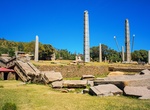
Axum or Aksum is a city in northern Ethiopia which was the original capital of the eponymous kingdom of Axum. Axum was a naval and trading power that ruled the region from ca. 400 BC into the 10th century. The kingdom was also arbitrarily identified as Abyssinia, Ethiopia, and India in medieval writings. In 1980, UNESCO added Axum's archaeological sites to its list of... -
Visit Al-Azlam Fort (Alozlam Castle), Saudi Arabia
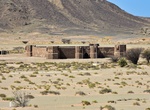
Al-Azlam Fort, also known as Alozlam Castle is located at Wadi Al Aznam, 100 kilometres north of Al Wadj and 45 kilometres south of Duba in north-western Saudi Arabia. It is one of the stations of the Egyptian pilgrimage route during the Mamluk era and the Ottoman era. It was built in the era of the Mamluk Sultan Muhammad ibn Qalawun (684 e (1285 - 741 AH / 1341). -
Visit Al-Balid (Al-Baleed) Archaeological Park, Ṣalālah, Oman (UNESCO site)
Al-Baleed Archaeological Park is located in Ṣalālah, Oman. You can either walk around them or take the golf cart shuttle. The signs are in Arabic and English. The Frankincense Trail is a site in Oman on the Incense Road. The site includes frankincense trees and the remains of a caravan oasis, which were crucial to the medieval incense trade. The Frankincense Trail h... -
Visit Al Bidya Mosque, Fujairah, United Arab Emirates
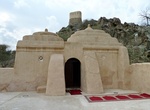
Al-Bidya Mosque (Arabic: مَسْجِد ٱلْبِدْيَة, romanized: Masjid Al-Bidyah, sometimes transliterated as Al-Bidiyah (ٱلْبِدِيَة) or Al-Badiyah (ٱلْبَدِيَة)) is a historical mosque in the Emirate of Fujairah, the United Arab Emirates. It was the oldest known mosque in the country, prior to the discovery in September 2018 of the ruins of a 1000-year-old mosque dating ... -
See Al Deir (The Monastery), Petra, Jordon
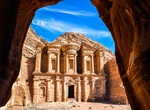
Al Deir (The Monastery) is a monumental building carved out of rock in the ancient Jordanian city of Petra. Built by the Nabataeans in the 1st century and measuring 50 meters wide by approximately 45 meters high, architecturally the Monastery is an example of the Nabatean Classical style. It is the second most visited building in Petra after Al Khazneh. -
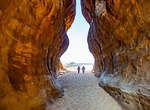
Visit Al Diwan (The Siq), Madain Salih, Saudi Arabia
In the middle of the Jebel Ithlib is a natural slit that measures 40 m (131 feet), called the Siq, after a similar corridor at Petra. At its entrance, to the right, is a square chamber containing three stone benches that served as a triclinium for sacred feasts. Today, the chamber is known as al-Diwan (court). -
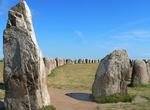
See Ale's Stones (Ales Stenar), Sweden
Ale's Stones (Ales stenar) is a megalithic monument in Scania in southern Sweden. It consists of a stone ship 67 meters long formed by 59 large boulders of sandstone, weighing up to 1.8 tonnes each. According to Scanian folklore, a legendary king called King Ale lies buried there. The carbon-14 dating system for organic remains has provided seven results at the site. ... -
Visit Al-Faw, Saudi Arabia
Lying at a strategic point of the ancient trade routes of the Arabian Peninsula, the property was abruptly abandoned around the 5th century CE. Nearly 12,000 archaeological remains have been found, spanning from prehistoric times to the Late pre-Islamic era, testifying to the successive occupation of three different populations and their adaptation to the evolving env... -
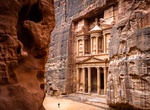
See Al Khazneh (The Treasury), Petra, Jordan
Al Khazneh is one of the most elaborate temples in the ancient Jordanian city of Petra. As with most of the other buildings in this ancient town, including the Monastery, this structure was also carved out of a sandstone rock face. It has classical Greek-influenced architecture, and it is a popular tourist attraction. Al Khazneh was originally built as a mausoleum and...

Price: $267.70