Give us feedback!
Our philosophy is simple. We want to encourage you to dream. BIG! Then we help you plan your trip, get the most out of it while you're traveling and help you share your experience with friends.
Join Now It's FREE
Related Categories
Dreams Still To Do
Checked-Off Dreams
Dreams Still To Do
Checked-Off Dreams
Advertisement
Explore Main UNESCO Sites
-
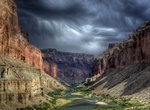
Explore Grand Canyon National Park, Arizona (UNESCO site)
The Grand Canyon, carved by the Colorado River over millions of years, is located in the USA’s desert Southwest. The gorge averaging 4,000 feet deep for its entire 277 miles. It is 6,000 feet deep at its deepest point and 18 miles at its widest. The Grand Canyon National Park is divided by the river into the North Rim and South Rim. Visitors viewing the magnific... -
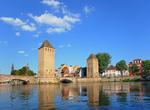
Visit Grande île (Strasbourg), France (UNESCO site)
Grande Île, the historic centre of Strasbourg, France, is an island in the Ill River. Literally "Grand Island", Grand Île was named a UNESCO World Heritage Site in 1988. At the time, the International Council on Monuments and Sites noted that Grand Île is "an old quarter that exemplifies medieval cities". Aside from the Strasbourg Cathedral—the... -
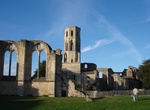
Visit Grande-Sauve Abbey, France (UNESCO site)
Grande-Sauve Abbey or Sauve-Majeure Abbey is a former Benedictine monastery near the present village of La Sauve in the department of the Gironde, in a region once heavily forested. Although now in ruins, the remains of the abbey are still of great interest in terms of Romanesque architecture, especially because of the many sculpted capitals still surviving. In 1998 t... -
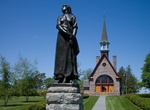
Visit Grand-Pré National Historic Site, Nova Scotia, Canada (UNESCO site)
Grand-Pré National Historic Site is a park set aside to commemorate the Grand-Pré area of Nova Scotia as a centre of Acadian settlement from 1682 to 1755, and the deportation of the Acadians which began in 1755 and continued to 1762. The original village of Grand Pré extended four kilometres along the ridge between present-day Wolfville and Horton... -
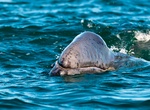
See Gray Whales in Laguna Ojo de Liebre (Scammon's Lagoon), Baja, Mexico (UNESCO site)
The El Vizcaíno Biosphere Reserve, created in 1988, is located in Mulegé Municipality in northern Baja California Sur, at the center of the Baja California Peninsula between the Pacific Ocean and Sea of Cortez (or Gulf of California). With a landmass of over 55,555 square-mile (143,600 square km) it is the largest wildlife refuge in all of Latin America ... -
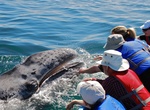
See Gray Whales in Laguna San Ignacio, Baja California Sur, Mexico (UNESCO site)
Each winter from December through April gray whales go on the longest known mammal migration to San Ignacio lagoon in Baja California, Mexico. Not only is San Ignacio lagoon a gray whale sanctuary, but it is the last and only undeveloped nursery and breeding ground in the world of the Pacific Gray Whale. The El Vizcaíno Biosphere Reserve, created in 1988, is lo... -
Visit Graz, Austria (UNESCO site)
Graz is the second-largest city in Austria and has a long tradition as a student city: its six universities have more than 44,000 students. Its "Old Town" is one of the best-preserved city centres in Central Europe. Politically and culturally, Graz was for centuries more important for Slovenes than Ljubljana, the capital of Slovenia, and still remains influential. Egg... -
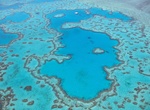
Explore Great Barrier Reef, Australia (UNESCO site)
The Great Barrier Reef presents incredible ecological variety and unsurpassed beauty off the north-east coast of Australia. The world's most extensive stretch of coral reefs stretches over 2,600 kilometers, contains 900 islands and cays and is most likely the richest area in terms of regional animal diversity in the world reflecting the evolution of the northeastern A... -
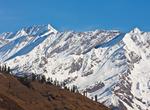
Explore Great Himalayan National Park, India (UNESCO Site)
The Great Himalayan National Park (GHNP) is the newest addition to India's national parks, located in Kullu region in the state of Himachal Pradesh. The park was built in 1984. The park is spread over an area of 1,171 km2 that lies between an altitude of 1500 to 6000m. The Great Himalayan National Park is a habitat to numerous flora and more than 375 fauna species tha... -
See Great Mosque and Hospital of Divriği, Turkey (UNESCO site)
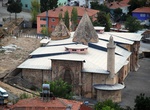
Divriği Great Mosque and Hospital is an ornately decorated mosque and medical complex built in 1299 in the small eastern Anatolian mountain town of Divriği, now in Sivas Province in Turkey. The architect was Hürremshah of Ahlat and the mosque was built on the order of Ahmet Shah, ruler of the Beylik of Mengücek. The inscriptions contain words of praise ... -
See Great Mosque of Djenné, Mali (UNESCO site)
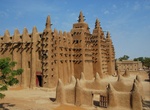
The Great Mosque of Djenné is the largest mud brick or adobe building in the world and is considered by many architects to be the greatest achievement of the Sudano-Sahelian architectural style, with definite Islamic influences. The mosque is located in the city of Djenné, Mali on the flood plain of the Bani River. The first mosque on the site was built ... -
Explore Great Smoky Mountains National Park, Tennessee & North Carolina (UNESCO site)
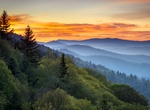
Great Smoky Mountains National Park is the most important natural area in the eastern United States, the most visited National Park in the USA, a UNESCO World Heritage Site and an International Biosphere Reserve. The park is frequently cited as a shining example of a temperate deciduous hardwood forest. With 130 species of tree found in the park, it has almost as many... -
Walk on the Great Wall, China (UNESCO site)
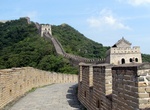
The Great Wall, known to the Chinese as the “Long Wall of Ten Thousand Li”, is a magnificent defensive structure built to ward off invasions of the Celestial Empire by barbarians. The roots of the fortification’s construction stretch back nearly 3,000 years. Approximately 2,300 years ago the Emperor, Qin Shi Huang, instigated the linking and restorat... -
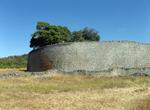
Visit Great Zimbabwe National Monument, Zimbabwe (UNESCO site)
Great Zimbabwe is a ruined city that was once the capital of the Kingdom of Zimbabwe, which existed from 1100 to 1450 AD during the country’s Late Iron Age. The monument, which first began to be constructed in the 11th century and which continued to be built until the 14th century, spanned an area of 722 hectares (1,784 acres) and at its peak could have housed u... -
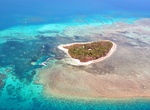
Explore Green Island National Park, Queensland, Australia (UNESCO site)
Green Island National Park is a protected area declared over a small (12 ha) coral cay known to the local Gungganyji Aboriginal peoples asDabuukji. The Gungganyji people used the island as an initiation ground. It is 27 km offshore from Cairns (1394 km northwest of Brisbane), Queensland, can be accessed by a choice of boats leaving daily from Cairns, and is reput...