Give us feedback!


 See all
Our philosophy is simple. We want to encourage you to dream. BIG! Then we help you plan your trip, get the most out of it while you're traveling and help you share your experience with friends.
Join Now It's FREE
Dream Packages
Duration: 3 hours
Price: $140.53
Price: $140.53
Duration: 4 days
Price: $589.26
Price: $589.26
Duration: 4 hours
Price: $520.24
Price: $520.24
Duration: 2 days
Price: $337.00
Price: $337.00
Dreams Still To Do
Checked-Off Dreams
Dreams Still To Do
Checked-Off Dreams
Advertisement
Explore Religious Places
-
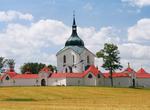
See Pilgrimage Church of St John of Nepomuk, Czech Republic (UNESCO site)
The Pilgrimage Church of St John of Nepomuk at Zelená Hora (Gruneberg) in Žďár nad Sázavou, near the border between Bohemia and Moravia, is the final masterpiece of Jan Santini Aichel, a maverick Bohemian architect who combined the Borrominiesque Baroque with references to Gothic elements in both construction and decoration. In 1719, when the... -
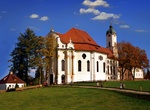
See Pilgrimage Church of Wies, Germany (UNESCO site)
The Pilgrimage Church of Wies is an oval rococo church, designed in the late 1740s by Dominikus Zimmermann, who for the last eleven years of his life lived nearby. It is located in the foothills of the Alps, in the municipality of Steingaden in the Weilheim-Schongau district, Bavaria, Germany. In 1738, tears were seen on a dilapidated wooden figure of the Scourge... -
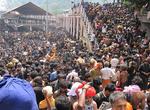
Attend Pilgrimage to Sabarimala, India
Sabarimala is a Hindu pilgrimage center located in the Western Ghat mountain ranges of Pathanamthitta District in Kerala. It is the largest annual pilgrimage in world with an estimated 45–50 million devotees visiting every year. Sabarimala is believed to be the place where the Hindu God Ayyappan meditated after killing the powerful demoness, Mahishi. Ayyappan's ... -
Visit Pio Monte della Misericordia & The Seven Works of Mercy, Naples, Italy
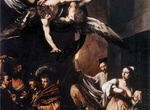
The Pio Monte della Misericordia is a church in the historic center of Naples, southern Italy. It is famous for its art works, including Caravaggio's The Seven Works of Mercy. A charity brotherhood (Pio Monte della Misericordia meaning "Pious Mount of Mercy" in Italian) was founded in August 1601 by seven young nobles, who met every Friday at the Hospital for Incurabl... -
Visit Písac, Peru
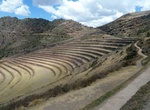
Písac is a Peruvian village in the Sacred Valley on the Urubamba River. The village is well-known for its market every Sunday, Tuesday, and Thursday, an event which attracts heavy tourist traffic from nearby Cusco. One of its more notable features is a large pisonay tree which dominates the central plaza. The sanctuary of Huanca, site of a sacred shrine, is als... -
Visit Piuskirche Meggen, Switzerland
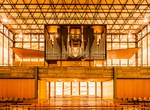
Catholic church in Meggen, Switzerland -Must see inside -
See Poblet Monastery, Spain (UNESCO site)
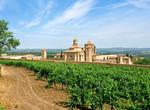
The Royal Abbey of Santa Maria de Poblet is a Cistercian monastery, founded in 1151, located at the feet of the Prades Mountains, in the comarca of Conca de Barberà, in Catalonia (Spain). It was founded by Cistercian monks from France on lands conquered to the Saracens. The main architect was Arnau Bargués. This monastery was the first of three sister mo... -
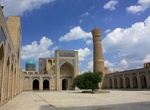
Visit Po-i-Kalyan, Bukhara, Uzbekistan
Po-i-Kalan, or Poi Kalan ("At the Foot of the Great One"), is an Islamic religious complex located in Bukhara, Uzbekistan. The complex consists of three parts, the Kalan Mosque (Masjid-i Kalan), the Kalan Minaret (Minâra-i Kalân) to which the name refers to, and the Mir-i-Arab Madrasah. The positioning of the three structures creates a square courtyard in ... -
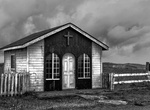
See Point Saint George Chapel, Tolowa Dunes State Park, California
This little chapel is located at Point Saint George in Tolowa Dunes State Park. -
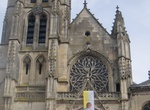
Visit Pontoise Cathedral, France
Pontoise Cathedral is a Roman Catholic cathedral and national monument of France. It's located in the town of Pontoise on the outskirts of Paris, in the Val d'Oise. -
See Pope Leo XIV’s Childhood Home, Dolton, Illinois
Pope Leo XIV’s Childhood Home is located Dolton, one of Chicago’s south suburbs. Since the pope’s election, the small, two-story house on E. 142nd Place in Dolton, Illinois – around 20 miles south of the Windy City - has gained national attention, drawing visitors and attracting those interested in the leader’s early life. -
See Popocatépetl Monasteries, Mexico (UNESCO site)
The Monasteries on the slopes of Popocatépetl World Heritage Site is a series of fourteen 16th century monasteries which were built by the Augustinians, the Franciscans and the Dominicans in order to evangelize the areas just south and east of the Popocatépetl volcano in central Mexico. These monasteries received their recognition from UNESCO in 1994, be... -
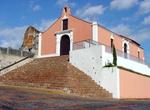
See Porta Coeli, Puerto Rico
Porta Coeli ("Gateway to Heaven") Convent church, or El Convento de Santo Domingo de Porta Coeli in Spanish, is one of the oldest church structures in the western hemisphere located in San Germán, Puerto Rico. In 1609, the Dominican Order built the Convento de Porta Coeli at the crest of a hill in what is now San Germán Historic District. During the 18th... -
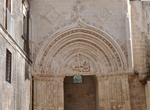
See Portale di San Giorgio, Ragusa, Sicily, Italy
The Portal of San Giorgio is the symbolic monument of the city of Ragusa, it was built in Gothic-Catalan style in the first half of the XIII century as part of the church of San Giorgio now disappeared. Portal survived the earthquake of 1693. One of the few remains in the area before that year. Built with blocks of soft limestone, with a light pink color. The lunett... -
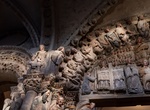
See Portico of Glory, Santiago de Compostela Cathedral, Santiago de Compostela, Galicia, Spain
The Portico of Glory (Galician: Pórtico da Gloria) of Santiago de Compostela Cathedral is a Romanesque portico and the cathedral's main gate created by Master Mateo and his workshop, on the orders of King Ferdinand II of León. The king donated to Mateo one hundred maravedís annually between 1168 and 1188. To commemorate the work's completion in 11...

Price: $873.68