Give us feedback!
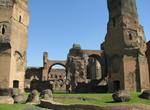 The walk starts in the "Terme de Caracalla", one of the world most impressive Roman ruins. Before going back in the historic centre, enjoy a romantic garden of Roses that offers a nice view on the Palatine hill. Successively you'll discover the so popular "Mouth of the Truth", the romantic island on the Tiber, the surprising "Teatro Marcello" (with medieval houses built on the ruins of the Roman theatre), the Church of the "Gesù" first baroque-style building ever, the aera sacra Argentina, the market Campo de'Fiori, the "Palazzo Farnese" to finally arrive on the "Piazza Navona". Rome monuments are either Roman or Christians. Here are some interesting facts on the Roman empire. More detailed informations are available in the guides bundle "Rome walking tour". A huge empire: in 192, the Roman empire includes the existing Italy, France, England, Spain , Portugal, Belgian, Austria, Greece, Romania, Turkey, part of the Germany, Israel, all the North coast of the African continent and large parts of the Middle-East including the rivers "Tiger" and "Euphrates". "Barbarians" lives at the North of the empire (Gemany,...): the so called Goths, Vandals, Teutons, Lombards. At the East, lives the Scythes and the Parthia on the territories of the former empire of Alexander the Great. The "Pax Romana" (Roman Peace: -27 to 192) is quite stable as the emperor Augustus has been able to tamed civil wars in all the Roman territories and Roman invaders are well accepted in the conquered territories. Most famous Roman emperors include:
1. Julius Caesar: he won the Gallic wars conquering the existing France (former Gauls) and decreased the power of the senate to gain more power and become the first Roman dictator. He was killed in-44. 2. Octavius (-44 to -14), also named Augustus, was a member of the family of Julius Caesar who governed the existing Europe during the second triumvirate. Actually, the Roman empire was divided in three region (Triumvirate), Octave governed the existing Europe, Marcus-Antonius the Orient, Lepidus the African part. The marriage of Marcus-Antonius with Cleopatra (who is the last pharaoh of Egypt and a descendant of one of the Alexandre the Great's generals) generate a scandal in Rome and a war between Octavius and Marcus Antonius. Octavius won the war against Marcus-Antonius who committed suicide. Cleopatra knowing she would had to walk in front of the Romans as a war booty also killed herself following the tradition, by mean of an asp bite. 3. Nero: the first emperor to organize massacres of the Christians, including St. Peter and St. Paul.
The walk starts in the "Terme de Caracalla", one of the world most impressive Roman ruins. Before going back in the historic centre, enjoy a romantic garden of Roses that offers a nice view on the Palatine hill. Successively you'll discover the so popular "Mouth of the Truth", the romantic island on the Tiber, the surprising "Teatro Marcello" (with medieval houses built on the ruins of the Roman theatre), the Church of the "Gesù" first baroque-style building ever, the aera sacra Argentina, the market Campo de'Fiori, the "Palazzo Farnese" to finally arrive on the "Piazza Navona". Rome monuments are either Roman or Christians. Here are some interesting facts on the Roman empire. More detailed informations are available in the guides bundle "Rome walking tour". A huge empire: in 192, the Roman empire includes the existing Italy, France, England, Spain , Portugal, Belgian, Austria, Greece, Romania, Turkey, part of the Germany, Israel, all the North coast of the African continent and large parts of the Middle-East including the rivers "Tiger" and "Euphrates". "Barbarians" lives at the North of the empire (Gemany,...): the so called Goths, Vandals, Teutons, Lombards. At the East, lives the Scythes and the Parthia on the territories of the former empire of Alexander the Great. The "Pax Romana" (Roman Peace: -27 to 192) is quite stable as the emperor Augustus has been able to tamed civil wars in all the Roman territories and Roman invaders are well accepted in the conquered territories. Most famous Roman emperors include:
1. Julius Caesar: he won the Gallic wars conquering the existing France (former Gauls) and decreased the power of the senate to gain more power and become the first Roman dictator. He was killed in-44. 2. Octavius (-44 to -14), also named Augustus, was a member of the family of Julius Caesar who governed the existing Europe during the second triumvirate. Actually, the Roman empire was divided in three region (Triumvirate), Octave governed the existing Europe, Marcus-Antonius the Orient, Lepidus the African part. The marriage of Marcus-Antonius with Cleopatra (who is the last pharaoh of Egypt and a descendant of one of the Alexandre the Great's generals) generate a scandal in Rome and a war between Octavius and Marcus Antonius. Octavius won the war against Marcus-Antonius who committed suicide. Cleopatra knowing she would had to walk in front of the Romans as a war booty also killed herself following the tradition, by mean of an asp bite. 3. Nero: the first emperor to organize massacres of the Christians, including St. Peter and St. Paul.
 View on map›
Make this a dream›
Flag as inappropriate
›
View on map›
Make this a dream›
Flag as inappropriate
›
Walking Tour: Rome - third day
- Dream: Visit Rome, Italy (UNESCO sites) ›
- Destination: Rome walking tour, third day
See more at:
View on map›
Make this a dream›
Flag as inappropriate
›