Give us feedback!
 4.6363635 from partner site
Private Tour All Inclusive-3-Day of Xi'an and Beijing from Shanghai by Air
Package Details
Main Destination:
Xi'an, Shaanxi, China
Other Destination(s):
Shanghai, China
Duration: 3 days
Price:
$1490.00
Details & Booking at viator.com
Like & Rate this package!
4.6363635 from partner site
Offered by: Viator
Make the most of your time in China on a three-day private tour of Xi'an's and Beijing’s highlights from Shanghai. See Xi'an's fabled Terracotta Army and City Wall with your private tour guide, walk along the ancient Great Wall of China at Mutianyu, dine on Peking duck in Beijing and tour the UNESCO World Heritage-listed Forbidden City,Temple of Heaven and Summer Palace. Your private tour includes flights from Shanghai to Xi’an and Beijing, private airport transfers and comfortable hotel accommodation.
Itinerary
Day 1: Shanghai-Xi'an
Stop At: Xi'an City Wall (Chengqiang), Zhongxin District, Xi'an 710001 China
The fortifications of Xi'an, also known as Xi'an City Wall, in Xi'an, an ancient capital of China, represent one of the oldest, largest and best preserved Chinese city walls. It was built under the rule of the Hongwu Emperor Zhu Yuanzhang as a military defense system. It exhibits the "complete features of the rampart architecture of feudal society". It has been refurbished many times since it was built in the 14th century, thrice at intervals of about 200 years in the later half of the 1500s and 1700s, and in recent years in 1983. The wall encloses an area of about 14 square kilometres (5.4 sq mi)
The Xi'an City Wall is on the tentative list of UNESCO's World Heritage Site under the title "City Walls of the Ming and Qing Dynasties". Since 2008, it is also on the list of the State Administration of Cultural Heritage of the People's Republic of China. Since March 1961, the Xi'an City Wall is a heritage National Historical and Cultural Unit.
Duration: 2 hours
Stop At: Muslim Quarter, West of Bell Drum Towers Square , Beilin District, Xi'an 710000 China
The Xi'an Muslim Quarter, is a relatively large Muslim enclave in Xi’an City, China. The Xi'an Muslim Quarter is located inside the city wall of Xi'an and mainly consists the area bounded by the Xida Avenue, Beiyuan Gate, Hongbu Road, and Zaoci Street. Today, the quarter comprises four neighborhoods, Huajue Xiang, Hongbu Jie, Xuexi Xiang, and Sajin Qiao. According to demographic statistics in 2003, the Muslim population living in the quarter was 32,361, 49.8% of the total Muslim population in Xi'an city. In the past two decades, Xi'an Muslim Quarter has become a well-known tourism site which is famous for its culture and food.
Duration: 2 hours
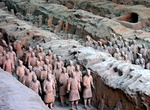
Stop At: The Museum of Qin Terra-cotta Warriors and Horses, Qinling North Road, Lintong District, Xi'an 710600 China
The Terracotta Army is a collection of terracotta sculptures depicting the armies of Qin Shi Huang, the first Emperor of China. It is a form of funerary art buried with the emperor in 210–209 BCE with the purpose of protecting the emperor in his afterlife.
The figures, dating from approximately the late third century BCE,were discovered in 1974 by local farmers in Lintong County, outside Xi'an, Shaanxi, China. The figures vary in height according to their roles, with the tallest being the generals. The figures include warriors, chariots and horses. Estimates from 2007 were that the three pits containing the Terracotta Army held more than 8,000 soldiers, 130 chariots with 520 horses, and 150 cavalry horses, the majority of which remained buried in the pits near Qin Shi Huang's mausoleum.Other terracotta non-military figures were found in other pits, including officials, acrobats, strongmen, and musicians.
Duration: 3 hours
Meals included:
• Lunch
• Dinner
Accommodation included: one night standard room in 5star hotel at Xi'an downtown area
Day 2: Xi'an-Beijing
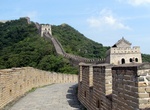
Stop At: Mutianyu Great Wall, Mutianyu Road, Huairou District, Beijing China
Mutianyu is a section of the Great Wall of China located in Huairou District within the city limits of Beijing 70 kilometres (43 mi) northeast of the center of the city. The Mutianyu section of the Great Wall is connected with Jiankou in the west and Lianhuachi in the east. As one of the best-preserved parts of the Great Wall, the Mutianyu section of the Great Wall used to serve as the northern barrier defending the capital and the imperial tombs.
Duration: 3 hours
Stop At: Summer Palace (Yiheyuan), No.19 Xinjian Gongmen Road, Haidian District, Beijing 100080 China
Summer Palace, Situated in the Haidian District northwest of Beijing, Summer Palace is 15 kilometers (9 miles) from the downtown area. Being the largest and most well-preserved royal park in China, it greatly influences Chinese horticulture and landscape with its famous natural views and cultural interests, which also has long been recognized as 'The Museum of Royal Gardens'.
Summer Palace radiates fully the natural beauty and the grandeur of royal gardens. Composed mainly of Longevity Hill and Kunming Lake, it owns over 3,000 man-made ancient structures, including pavilions, towers, bridges, corridors, etc.
Duration: 2 hours
Meals included:
• Lunch
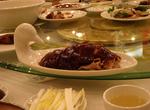
• Dinner: Pekin roast duck dinner with drinks included
• Breakfast
Accommodation included: one night deluxe suite room in 4star hotel at Beijing downtown area
Day 3: Beijing
Stop At: Tiananmen Square (Tiananmen Guangchang), West Changan Street, Dongcheng District, Beijing 100006 China
Tiananmen Square or Tian'anmen Square (天安门, Pinyin: Tiān'ānmén; Wade–Giles: Tʻien1-an1-mên2) is a city square in the centre of Beijing, China, named after the Tiananmen ('Gate of Heavenly Peace') located to its north, separating it from the Forbidden City. The square contains the Monument to the People's Heroes, the Great Hall of the People, the National Museum of China, and the Mausoleum of Mao Zedong. Mao Zedong proclaimed the founding of the People's Republic of China in the square on October 1, 1949; the anniversary of this event is still observed there.Tiananmen Square is within the top ten largest city squares in the world (440,500 m2 – 880×500 m or 109 acres – 960×550 yd). It has great cultural significance as it was the site of several important events in Chinese history.
Duration: 30 minutes
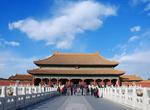
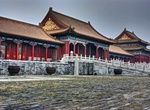
Stop At: Forbidden City-The Palace Museum, No.4 Jingshanqian Street, Dongcheng District, Beijing 100009 China
The Palace Museum is a national museum housed in the Forbidden City at the core of Beijing, China. It was established in 1925 after the last Emperor of China was evicted from his palace, and opened its doors to the public.
It's home to over 1.8 million pieces of art, mostly from the imperial collection of the Ming and Qing dynasties. The 20th century saw its expansion through new acquisitions, transfers from other museums, and new archaeological discoveries.
Duration: 3 hours
Stop At: Temple of Heaven, Tiantan Road, Dongcheng District, Beijing 100050 China
The Temple of Heaven is an imperial complex of religious buildings situated in the southeastern part of central Beijing. The complex was visited by the Emperors of the Ming and Qing dynasties for annual ceremonies of prayer to Heaven for good harvest.
Duration: 2 hours
Meals included:
• Lunch
• Breakfast: Buffet breakfast at hotel
No accommodation included on this day.
Dreams related to Package