Give us feedback!
Beijing Tiananmen & Forbidden City &Temple of Heaven Private Tour with the Lunch
Package Details
Destination:
Beijing, Beijing, China
Duration: 8 hours
Price:
$185.00
Details & Booking at viator.com
Like & Rate this package!
Offered by: Viator
Visit 3 of the most significant spiritual attractions of Beijing in one day; the Tiananmen Square, the Forbidden City and the Temple of Heaven.
Highlights:
Visit the Tiananmen Square, literally translated as the “Gate of Heavenly Peace”, and the Forbidden City
Learn about the famous Temple of Heaven, where Emperors of the Ming and Qing dynasties used to hold annual ceremonies of prayer
Highlights:
Visit the Tiananmen Square, literally translated as the “Gate of Heavenly Peace”, and the Forbidden City
Learn about the famous Temple of Heaven, where Emperors of the Ming and Qing dynasties used to hold annual ceremonies of prayer
Itinerary
This is a typical itinerary for this product
Stop At: Forbidden City-The Palace Museum, No.4 Jingshanqian Street, Dongcheng District, Beijing 100009 China
Forbidden City, also known as the Palace Museum, and Gu Gong in Chinese, lies at the city center of Beijing, and once served as the imperial palace for 24 emperors during the Ming and Qing Dynasties (1368 - 1911). It was first built throughout 14 years during the reign of Emperor Chengzu in the Ming Dynasty (1368-1644). Ancient Chinese Astronomers believed that the Purple Star (Polaris) was in the center of heaven and the Heavenly Emperor lived in the Purple Palace. The Palace for the emperor on earth was so called the Purple City. It was forbidden to enter without special permission of the emperor. Hence its name 'The Purple Forbidden City', usually 'The Forbidden City'.
Duration: 3 hours
Stop At: Tiananmen Square (Tiananmen Guangchang), West Changan Street, Dongcheng District, Beijing 100006 China
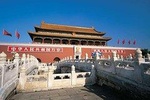
Tiananmen Square is the large plaza near the centre of Beijing named after the Tiananmen (literally translated as the “Gate of Heavenly Peace”). It sits to the city's north, separating it from the Forbidden City. As a symbol it has great cultural significance, as it was the site of several key events in Chinese history.
The Temple of Heaven, literally the Altar of Heaven, is a complex of Taoist buildings situated in south-eastern urban Beijing, known as the Xuanwu District. The complex was visited by the Emperors of the Ming and Qing dynasties for annual ceremonies of prayer to Heaven for good harvest. It is regarded as a Taoist temple, although the Chinese Heaven worship by the reigning monarch “ohe day” pre-dates Taoism. The Temple of Heaven is a must-see attraction in Beijing!
Duration: 1 hour
Stop At: Temple of Heaven, Tiantan Road, Dongcheng District, Beijing 100050 China
Tiananmen Square is the large plaza near the centre of Beijing named after the Tiananmen (literally translated as the “Gate of Heavenly Peace”). It sits to the city's north, separating it from the Forbidden City. As a symbol it has great cultural significance, as it was the site of several key events in Chinese history.
The Temple of Heaven, literally the Altar of Heaven, is a complex of Taoist buildings situated in south-eastern urban Beijing, known as the Xuanwu District. The complex was visited by the Emperors of the Ming and Qing dynasties for annual ceremonies of prayer to Heaven for good harvest. It is regarded as a Taoist temple, although the Chinese Heaven worship by the reigning monarch “ohe day” pre-dates Taoism. The Temple of Heaven is a must-see attraction in Beijing!
Duration: 1 hour