Give us feedback!

Day Trip To Luxor By Bus
Package Details
Destination:
Hurghada, Red Sea and Sinai, Egypt
Duration: 11 hours
Price:
$62.53
Details & Booking at viator.com
Like & Rate this package!
Offered by: Viator
Expect pickup early in the morning and transfer by air-conditioned coach to Luxor, a UNESCO World Heritage Site, where your guide will meet you. First, cross the Nile to the West Bank and the famous Valley of the Kings, with 63 royal tombs dating back almost 4,000 years: The elaborate art that decorates their walls gives an insight into how Egypt’s rulers lived.
Next, visit the Temple of Queen Hatshepsut at Deir el Bahari, a tribute to Egypt’s gender-bending female pharaoh, and the giant statues known as the Colossi of Memnon.
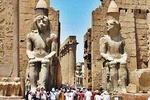
Cross back to the East Bank and relax with a traditional local lunch before you explore the vast Temple of Karnak. Finish with a visit to an alabaster factory and a papyrus bazaar before your coach drops you back at your hotel.
Next, visit the Temple of Queen Hatshepsut at Deir el Bahari, a tribute to Egypt’s gender-bending female pharaoh, and the giant statues known as the Colossi of Memnon.
Cross back to the East Bank and relax with a traditional local lunch before you explore the vast Temple of Karnak. Finish with a visit to an alabaster factory and a papyrus bazaar before your coach drops you back at your hotel.
Itinerary
This is a typical itinerary for this product
Stop At: Temple of Karnak, Karnak, Luxor Egypt
The Karnak Temple, known as the Karnak Temple, is a collection of temples, buildings and columns, where expansion and construction continued from the Pharaonic era, particularly the kings of the central state to the Roman era in Luxor in Egypt on the eastern Shatt. The temple was built for the divine trinity of Amun (Amun-Re in modern times), his wife, the goddess Mut, and their son, Khonsu; each has a temple belonging to the temple complex of Karnak. Sometimes tourists and non-specialists mean the Karnak temple only the temple belonging to Amun Ai Amun Re.
Duration: 2 hours
Stop At: Temple of Hatshepsut at Deir el Bahari, Kings Valley Rd Deir el-Bahari, Luxor 23512 Egypt
The Temple of Hatshepsut, or Mortuary Temple of Hatshepsut, is a temple from the 18th Dynasty of Egypt, the best remaining temple built some 3,500 years ago in Deir el-Bahari, Egypt. It was built by Queen Hatshepsut on the West Bank of the Nile opposite to Thebes (the capital of ancient Egypt and the seat of the cult of Amun) (Luxor today). The Temple of Hatshepsut is characterized by its unique architectural design compared to the Egyptian temples that were built on the east bank of the Nile in Thebes. The temple consists of three consecutive floors on open balconies. The temple was built of limestone, and the limestone statues of Osiris and Queen Hatshepsut were erected in front of the pillars of the second floor in a beautiful distribution. Originally, the statues were colored, and now there are only a few monuments left, and some of the statues in perfectly good shape indicate the elegance and beauty of the temple.
Duration: 2 hours
Stop At: Valley of the Kings, Luxor City, Luxor 85511 Egypt
The Valley of the Kings, also known as the "Valley of the Biban Kings", is a valley in Egypt used for 500 years during the period between the sixteenth and eleventh centuries BC to build tombs of the pharaohs and nobles of the modern state extended during the ages of the eighteenth dynasties to the Twentieth Dynasty in ancient Egypt. The valley on the west bank of the Nile in the face of Thebes (now Luxor) in the heart of the ancient funerary city of Thebes. The Valley of the Kings is divided into two valleys; the Eastern Valley (where most royal tombs are located) and the Western Valley.
Duration: 2 hours
Stop At: Colossi of Memnon, Thebes, Luxor Egypt
The Colossi of Memnon, or the Colossi of Memnon, is a huge statue, built around 1350 BC, which is all that remains of the Temple in memory of the Pharaoh (Amenhotep III), located in Thebes, Egypt. They belong to King Amenhotep III, one of the kings of the 18th Dynasty, the most powerful dynasty in ancient Egyptian history.
The statue is called "Memnon" when the eastern statue cracked and produced a voice likening it to the legendary hero "Memnon" who was killed in the wars of his Trojan and was calling his mother (Ayos), the goddess of dawn every morning. Her tears were dew.
Duration: 15 minutes