Give us feedback!
Early morning private Vatican Museums, hotel pick up and drop off, tkts Included
Package Details
Destination:
Rome, Lazio, Italy
Duration: 3 hours
Price:
$392.45
Details & Booking at viator.com
Like & Rate this package!
Offered by: Viator
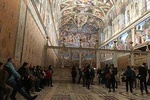
When still the large number of tourists who daily crowd the entrance to the Vatican Museums has not arrived yet, you will have the chance to enter the Sistine Chapel in absolute tranquility. You will be able to enjoy the famous stories of the Genesis and of the Last Judgment painted by Michelagelo, the greatest artist of all time. You will admire the pictorial decorations that the great masters of the end of the fifteenth century like Perugino, Botticelli, Ghirlandaio have painted on the two long sides of the papal chapel, the Stories of the life of Moses and Jesus in the two long sides of the Chapel. To end your incredible private visit we will take you to the Raphael Rooms, painted for the famous Pope Julius II at the beginning of the sixteenth century before dying young at the age of thirty-seven.
Itinerary
This is a typical itinerary for this product
Stop At: Sistine Chapel, Citta del Vaticano 1, 00120 Vatican City Italy
The Sistine Chapel takes its name from Pope Sixtus IV della Rovere (pontiff from 1471 to 1484) who had the old Cappella Magna restored between 1477 and 1480. The 15th century decoration of the walls includes: the false drapes, the Stories of Moses, the Stories of Christ and the portraits of the Popes. It was executed by a team of painters made up initially of Pietro Perugino, Sandro Botticelli, Domenico Ghirlandaio and Cosimo Rosselli. On the Ceiling Pier Matteo d'Amelia painted a starry sky. The work on the frescoes began in 1481 and was concluded in 1482. This is also the date of the following works in marble: the screen, the choir stalls (where the choristers took their places), and the pontifical coat of arms over the entrance door. On 15 August 1483, Sixtus IV consecrated the new chapel dedicating it to Our Lady of the Assumption. Julius II della Rovere (pontiff from 1503 to 1513), nephew of Sixtus IV, decided to partly alter the decoration, entrusting the work in 1508 to Michelangelo Buonarroti, who painted the Ceiling and, on the upper part of the walls, the lunettes. The work was finished in October 1512 and on the Feast of All Saints (1 November), Julius II inaugurated the Sistine Chapel with a solemn Mass. The nine central panels show the Stories of Genesis, from the Creation to the Fall of man, to the Flood and the subsequent rebirth of mankind with the family of Noah.
Duration: 30 minutes
Stop At: Vatican Museums, Viale Vaticano, 00120 Vatican City Italy
Pius Clementine Museum (Apoxyomenos, Octagonal Courtyard, Belvedere Apollo, Laocoon, Room of the Animals, Room of Muses, Belvedere Torso, Greek-cross Room) Pinecone Courtyard, Chiaramonti Gallery, Gallery of the Candelabra, Gallery of the Tapestries, Gallery of the Maps.
Duration: 1 hour 30 minutes
Stop At: St. Peter's Square, Piazza San Pietro, 00120 Vatican City Italy
Designed and built by Bernini between 1656 and 1667, during the pontificate of Alexander VII (1655-1667), the square is made up of two different areas. The first has a trapezoid shape, marked off by two straight closed and convergent arms on each side of the church square. The second area is elliptical and is surrounded by the two hemicycles of a four-row colonnade, because, as Bernini said, “considering that Saint Peter’s is almost the matrix of all the churches, its portico had to give an open-armed, maternal welcome to all Catholics, confirming their faith; to heretics, reconciling them with the Church; and to the infidels, enlightening them about the true faith.
Duration: 15 minutes
Stop At: Limousine Service in Italy, Via Domenico Vietri 20, 00149 Rome Italy
Private tour with a licensed tour guide including the hotel pick up and drop off.
Duration: 3 hours