Give us feedback!
Tour through the history of Évora
Package Details
Destination:
Sesimbra, Setúbal, Portugal
Duration: 8 hours
Price:
$100.38
Details & Booking at viator.com
Like & Rate this package!
Offered by: Viator
The city of Évora has a historical center of the best preserved and rich in monuments of Portugal and that gives it the epithet of Museum City. In 1986, the historic city center was declared a World Heritage Site by UNESCO.
The Bones Chapel, St. Francis Church and the Roman Temple are some of its main monuments to visit in Évora.
Still in Evora and following the Megalithic Circuit of the Alentejo, is the Cromlech of Almendres. Consisting of two distinct enclosures, built between the end of the 6th and 3rd millennium BC, this cromlech is one of the largest and most important megalithic monuments in the world. In its heyday, the architectural ensemble would have more than a hundred monoliths, granite stones of various sizes, arranged in circular or ellipse form. Of this hundred, ninety-five monoliths are still in perfect condition.
The Bones Chapel, St. Francis Church and the Roman Temple are some of its main monuments to visit in Évora.
Still in Evora and following the Megalithic Circuit of the Alentejo, is the Cromlech of Almendres. Consisting of two distinct enclosures, built between the end of the 6th and 3rd millennium BC, this cromlech is one of the largest and most important megalithic monuments in the world. In its heyday, the architectural ensemble would have more than a hundred monoliths, granite stones of various sizes, arranged in circular or ellipse form. Of this hundred, ninety-five monoliths are still in perfect condition.
Itinerary
This is a typical itinerary for this product
Stop At: Evora, Evora, Evora District, Alentejo
Evora
Duration: 2 hours
Stop At: Cromeleque dos Almendres, Via R. do Cromeleque village of Nossa Senhora de Guadalupe - Almendras, Evora 7000-223 Portugal
Prehistoric stone circle (cromlech) with 95 stone monoliths. It is the megalithic monument of its most important type in the Iberian Peninsula, and one of the most important in Europe, not only for its size, but also for its state of conservation.
Duration: 1 hour
Stop At: Capela dos Ossos, Praca 1 de Maio, Evora 7000-650 Portugal
Built in the 17th century on the initiative of three Franciscan friars whose purpose was to convey the message of the transience and fragility of human life. This message is passed to visitors right at the entrance, by the phrase: "We bones that we are here, for your waiting."
The walls of the Bone Chapel and its eight pillars are lined with carefully arranged human bones and skulls. The vaults are brick plastered in white and painted with motifs that symbolize or
allude to death. In addition to the bones, the Chapel of Bones is also decorated with religious statues and a Renaissance and Baroque painting.
The arches are ornamented with rows of skulls, cornices and white ships. It is estimated that there are about 5000 human skulls found there, among numerous bones, from the graves of the convent church and other churches and cemeteries in the city.
Duration: 30 minutes
Stop At: Igreja de Sao Francisco, Praca 1 de Maio, Evora 7000-656 Portugal
Church of Gothic-Manueline architecture, built between 1480 and 1510.
Duration: 30 minutes
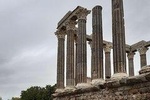
Stop At: Templo Romano de Evora (Templo de Diana), Largo do Conde de Vila Flor 4 Centro Histórico, Evora 7000-804 Portugal
It is one of the grandest and best preserved Roman temples in the Iberian Peninsula, having been considered a World Heritage Site by UNESCO in 1986.
Corinthian in style, it was built in the early 1st century AD and is located in the historic center of the city. It is the ex-libris of the city of Évora.
Despite all the modifications and destruction it has undergone, the Roman Temple of Évora retains its original plan. This majestic monument has a rectangular shape. The base (the podium), made of large blocks of granite and about 3.5 meters high, is almost intact.
On the base are still 14 of its original Corinthian columns, and many still retain their capitals. The floor, believed to have been tiled, has completely disappeared.
Duration: 30 minutes