Give us feedback!

Half Day to west bank at Luxor
Package Details
Destination:
Luxor, Nile River Valley, Egypt
Duration: 4 to 5 hours
Price:
$25.65
Details & Booking at viator.com
Like & Rate this package!
Offered by: Viator
Take a half-day private tour with a qualified Egyptologist guide exploring, Hatshepsut temple, colossi of memnon,valley of the kings
After picking you up from the hotel, Start your visit to the west bank where you can see Valley of the Kings, tour for complex of 63 tombs of pharaohs that dates back nearly 4,000 years and choose max. 3 tombs to visit, Then visit Temple of Queen Hatshepsut, one of the most successful female rulers of all time transfer to enjoy with Colossi of memnon and admire the 2massive stone statues of pharaoh and drive back to your hotel
After picking you up from the hotel, Start your visit to the west bank where you can see Valley of the Kings, tour for complex of 63 tombs of pharaohs that dates back nearly 4,000 years and choose max. 3 tombs to visit, Then visit Temple of Queen Hatshepsut, one of the most successful female rulers of all time transfer to enjoy with Colossi of memnon and admire the 2massive stone statues of pharaoh and drive back to your hotel
Itinerary
This is a typical itinerary for this product
Stop At: Valley of the Kings, Luxor City, Luxor 85511 Egypt
The ancient Egyptians built massive public monuments to their pharaohs. But they also spent time and treasure creating hidden underground mausoleums.
The most famed collection of such elaborate tombs—the Valley of the Kings—lies on the Nile's west bank near Luxor.
During Egypt's New Kingdom (1539-1075 B.C.), the valley became a royal burial ground for pharaohs such as Tutankhamun, Seti I, and Ramses II, as well as queens, high priests, and other elites of the 18th, 19th, and 20th dynasties.
The tombs evidence elaborate preparations for the next world, in which humans were promised continuing life and pharaohs were expected to become one with the gods. Mummification was used to preserve the body so that the deceased's eternal soul would be able to reanimate it in the afterlife.
Duration: 2 hours
Stop At: Temple of Hatshepsut at Deir el Bahari, Kings Valley Rd Deir el-Bahari, Luxor 23512 Egypt
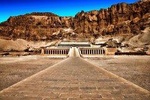
At Deir Al Bahri, the eyes first focus on the dramatic rugged limestone cliffs that rise nearly 300m above the desert plain, only to realise that at the foot of all this immense beauty lies a monument even more extraordinary, the dazzling Temple of Hatshepsut. The almost-modern-looking temple blends in beautifully with the cliffs from which it is partly cut – a marriage made in heaven. Most of what you see has been painstakingly reconstructed.
Duration: 1 hour
Stop At: Colossi of Memnon, Thebes, Luxor Egypt
The Colossi of Memnon are a pair of giant statues made of stone that are located in the Theban Necropolis in Luxor, Upper Egypt. The statues were made during the 14th century BC, during the period in ancient Egyptian history known as the New Kingdom. The best-known legend about the Colossi of Memnon is that of the ‘ Vocal Memnon ,’ in which one of the statues was reputed to ‘sing’ every morning at daw
Duration: 15 minutes