Give us feedback!
Mosaic Tiles - Guided Tour
Package Details
Destination:
Ravenna, Emilia-Romagna, Italy
Duration: 3 hours
Price:
$30.70
Details & Booking at viator.com
Like & Rate this package!
Offered by: Viator
The eternal beauty of the mosaics of some of the most famous Unesco monuments of Ravenna, in a tour that starting from Piazza San Francesco, will wind along the streets of the historic center.
Itinerary
This is a typical itinerary for this product
Stop At: Basilica San Vitale, Via San Vitale, 48121, Ravenna Italy
It is one of the most important monuments of early Christian art in Italy.
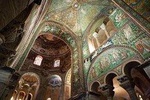
The monument is of the sixth century, of clear eastern influence, it has an octagonal plan, surmounted by a large frescoed dome.
When one enters the basilica, the gaze is captured by the high spaces, the stupendous mosaic decorations of the apse, and the extraordinary representation of the imperial couple from Byzantium, Giustiniano and Teodora, with their parades.
Duration: 30 minutes
Stop At: Basilica di Sant'Apollinare Nuovo, Via di Roma 52, 48121, Ravenna Italy
originally used as a Palatine Church of Arian cult, today it allows us to reconstruct the evolution of the Byzantine wall mosaic from the Theodoric to the Justinian age. Inside, the 26 Christological scenes make up the largest monumental cycle of the New Testament.
Duration: 30 minutes
Stop At: Archiepiscopal Museum, Piazza Arcivescovado, 48121, Ravenna Italy
inside which we will visit the Chapel of Sant'Andrea: depicting the glorification of Christ in an anti-Aryan key, the only example of an early Christian archbishop's chapel still intact today
Duration: 30 minutes
Stop At: Mausoleo di Galla Placidia, Via San Vitale, 48121, Ravenna Italy
it was built around the middle of the 5th century, at the behest of Galla Placidia, who ruled the Western Roman Empire.
This small Latin cross mausoleum, externally is very simple, while inside it has a rich mosaic decoration.
The countless stars of the dome have struck the imagination and sensitivity of visitors over the centuries, as well as outstanding personalities such as the great poet Dante Alighieri, who drew inspiration from them for the drafting of some verses of the Divine Comedy.
Duration: 10 minutes
Stop At: Battistero Neoniano (Battistero degli Ortodossi), Via Gioacchino Rasponi, 48121, Ravenna Italy
one of the oldest monuments in the city, in simple brick on the outside but rich in marble, stucco and mosaics with a clear Hellenistic-Roman influence on the inside.
Dominating the dome, commissioned by Bishop Neone in the mid-fifth century, is the scene of the Baptism of Christ surrounded by a very refined procession of the twelve Apostles that stands out against a brilliant background of blue tesserae. Inside there is still the baptismal font from the Renaissance period, which takes up the octagonal shape of the Baptistery plan and which preserves the ambo from the 5th century.
Duration: 10 minutes