Give us feedback!
(Private) 1Day Gyeongju city tour From BUSAN - UNESCO World Heritage Site
Package Details
Destination:
Gyeongju, Gyeongsangbuk-do, South Korea
Duration: 8 to 9 hours
Price:
$284.00
Details & Booking at viator.com
Like & Rate this package!
Offered by: Viator
Meet your guide at your place in Busan or Gyeongju and move to Gyeongju city.
You explore with a day trip to the culture-filled city of Gyeongju. It was once the capital of the ancient Korean Kingdom of Silla (57 BCE – 935) for about one millennium and contains a great wealth of heritage sites and relics that reflect its remarkable cultural achievements.
With the assistance of our guides, catch a glimpse of some of the traditional art & culture, and experience them yourself to feel the rich history of Korea.
Tour Highlights
● Visit the UNESCO-listed Bulguksa Temple and Seokguram Grotto
● Experience the greatest Buddhist art treasures in Korea
● Explore the city designated as UNESCO World Cultural Heritage
● Discover Gyochon Traditional Hanok Village (Korean traditional village)
● Pickup and drop-off at Gyeongju and Busan Hotels, Busan subway station or Busan station
You explore with a day trip to the culture-filled city of Gyeongju. It was once the capital of the ancient Korean Kingdom of Silla (57 BCE – 935) for about one millennium and contains a great wealth of heritage sites and relics that reflect its remarkable cultural achievements.
With the assistance of our guides, catch a glimpse of some of the traditional art & culture, and experience them yourself to feel the rich history of Korea.
Tour Highlights
● Visit the UNESCO-listed Bulguksa Temple and Seokguram Grotto
● Experience the greatest Buddhist art treasures in Korea
● Explore the city designated as UNESCO World Cultural Heritage
● Discover Gyochon Traditional Hanok Village (Korean traditional village)
● Pickup and drop-off at Gyeongju and Busan Hotels, Busan subway station or Busan station
Itinerary
This is a typical itinerary for this product
Stop At: Daereungwon Royal Tomb, 9 Gyerim-ro, Hwangnam-dong, Gyeongju, Gyeongsangbuk-do, South Korea
Visit the Tumuli park. It has more than 20 large and small tombs from the Shilla period. The tombs are presumed to be those of kings and court officials. Most of them are earthen and mound-shaped. Some double gourd-shaped ones are for the joint burial of a husband and wife. As those excavated were all found to be stone-pilled wood-lined chamber type, most of the tombs here are presumed to be of the same type. During the excavations of chenmachong and Hwangnamchong , numerous artifacts (including a gold crown, gold girdles, gold and silver personal ornaments, horse fittings, and weapons) were uncovered.
Duration: 1 hour
Stop At: Gyeongju National Museum, 186 Iljeong-ro, Gyeongju, Gyeongsangbuk-do 38171 South Korea
Arguably the best history museum in Korea, the Gyeongju National Museum is where you can appreciate the significance of this ancient city in one fell swoop. The main archaeological hall has dazzling displays of jewellery, weaponry and other ceremonial items from the Shilla dynasty, including a 5th-century gold crown.
Duration: 1 hour
Stop At: Donggung Palace and Wolji Pond, 102 Wonhwa-ro, Inwang-dong, Gyeongju, Gyeongsangbuk-do, South Korea
Donggung and Wolji is one of the secondary palaces of the Shilla dynasty.
It is also known as Anapji Pond, and it represents Gyeongju with its beautiful night view.
Donggung, literally the East Palace, and the pond Wolji, literally the moon pond. The Donggung was one of the main palaces of the United Silla Kingdom. Many buildings were located within the palace grounds including Imhaejeon Hall. Parties were reportedly held here to celebrate the festive events of the kingdom or to welcome visitors.
Duration: 1 hour
Stop At: Gyeongju Gyochon Traditional Village, Gyochonan-gil, Gyeongju, Gyeongsangbuk-do South Korea
Gyeongju Gyochon Village is a hanok village that allows visitors to take a look inside the lifestyle of the Choi Clan, a family known to have remained wealthy for the longest period of time in Korean history. Visitors can see the House of the Gyeongju Choi Clan (Important Folklore Material No. 27)
Duration: 1 hour
Stop At: Bulguksa Temple, Bulguksa 385 Bulguk-ro, Gyeongju, Gyeongsangbuk-do 38127 South Korea
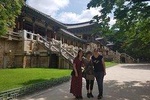
The nearby Bulguksa Temple is the most famous Buddhist temple in Korea and the home to a number of important relics from the Silla period, including most obviously the two stone pagodas Dabotap and Soekgatap. It also dates from the 8th century but has been rebuilt on a number of occasions.
Duration: 1 hour 30 minutes
Stop At: Seokguram, 999 Jinhyeon-dong, Gyeongju, Gyeongsangbuk-do 780-400 South Korea
Seokguram Grotto is a hermitage that is part of the Bulguksa temple complex. The grotto overlooks the East Sea and rests 750 meters above sea level. It holds some of the best Buddhist sculptures in the world, including the main Buddha. Construction lasted from 742 to 774. Inside the round-shaped main hall are the Bonjon Statue, Bodhi-sattva, and his disciples. The Bonjon figure wearing a generous smile is seated on the stage engraved with a lotus flower design. As the sunrise from this spot is quite beautiful, many people climb the mountain at daybreak.
Duration: 1 hour
Stop At: Cheomseongdae Observatory, Wolseong-dong, Gyeongju, Gyeongsangbuk-do South Korea
Cheomseongdae means "Star Gazing Tower." Built during the reign of Queen Seonduk (27th ruler of the Shilla dynasty) in 634, it is the oldest existing observatory in Asia.
It has 27 levels of stones in a round shape with four sets of parallel bars to make a square-shaped structure on its top. The 12 rectangular base stones are positioned in a square, three on each side, representing the four seasons and twelve months of each year. For over two thousand years, astronomers studied the movements of stars and planets and charted them. Court astrologers reported and interpreted their findings to the King who would then act according to their predictions.
Duration: 30 minutes