Give us feedback!
 4.3333335 from partner site
Private Half-Day Bucharest City Tour
Package Details
Destination:
Bucharest, Romania, Romania
Duration: 4 hours
Price:
$141.71
Details & Booking at viator.com
Like & Rate this package!
4.3333335 from partner site
Offered by: Viator
This is a private tour at Bucharest.
We will pickup you from your hotel, will make a panoramic tour by car, you will see the Palace of Parliament, Unirii Square, Universitatii Square, Victoriei Square, the Romanian Guvern, VIctoriei Street and we will stop at the Atheneum.
From here will start the walking tour in Revolution Square, Old City, Princely Court and many other.
Explore Bucharest’s bohemian charm and Communist legacy on a half-day city sightseeing tour.
Get a taste for Romanian peasant life at the down charming streets in the historic city center.
We will discuss about the Royal Family of Romania which is descends in a direct genealogical line, from the Imperial German Family of Hohenzollern-Sigmaringen and is related to all the great European royal families.
We will pickup you from your hotel, will make a panoramic tour by car, you will see the Palace of Parliament, Unirii Square, Universitatii Square, Victoriei Square, the Romanian Guvern, VIctoriei Street and we will stop at the Atheneum.
From here will start the walking tour in Revolution Square, Old City, Princely Court and many other.
Explore Bucharest’s bohemian charm and Communist legacy on a half-day city sightseeing tour.
Get a taste for Romanian peasant life at the down charming streets in the historic city center.
We will discuss about the Royal Family of Romania which is descends in a direct genealogical line, from the Imperial German Family of Hohenzollern-Sigmaringen and is related to all the great European royal families.
Itinerary
This is a typical itinerary for this product
Stop At: Palace of Parliament, Strada Izvor 2-4, Bucharest 050711 Romania
Only outside.
The Palace of the Parliament is the seat of the Parliament of Romania, located atop Dealul Spirii in Bucharest, the national capital. The Palace has a height of 84 metres (276 ft), a floor area of 365,000 square metres (3,930,000 sq ft) and a volume of 2,550,000 cubic metres (90,000,000 cu ft). The Palace of the Parliament is the heaviest building in the world, weighing about 4,098,500,000 kilograms (9.0356×10⁹ lb).
The building was designed and supervised by chief architect Anca Petrescu, with a team of approximately 700 architects, and constructed over a period of 13 years (1984–97) in Totalitarian and modernist Neoclassical architectural forms and styles, with socialist realism in mind.
Duration: 15 minutes
Stop At: Ateneul Roman, Str. Franklin 1, Bucharest Romania
The Romanian Athenaeum is a concert hall in the center of Bucharest, Romania and a landmark of the Romanian capital city. Opened in 1888, the ornate, domed, circular building is the city's main concert hall and home of the "George Enescu" Philharmonic and of the George Enescu annual international music festival.
In 1865, cultural and scientific personalities such as Constantin Esarcu, V. A. Urechia, and Nicolae Creţulescu founded the Romanian Atheneum Cultural Society. To serve its purposes, the Romanian Athenaeum, a building dedicated to art and science, would be erected in Bucharest.
The building was designed by the French architect Albert Galleron, built on a property that had belonged to the Văcărescu family and inaugurated in 1888, although work continued until 1897. A portion of the construction funds was raised by public subscription in a 28-year-long effort, of which the slogan is still remembered today: "Donate one leu for the Ateneu!"
Duration: 15 minutes
Stop At: Piaka Revolukiei, Calea Victoriei Boulevard, Bucharest Romania
Revolution Square is a square in central Bucharest, on Calea Victoriei. Known as Piața Palatului (Palace Square) until 1989, it was later renamed after the Romanian Revolution of December 1989.
The square also houses the building of the former Central Committee of the Romanian Communist Party (from where Nicolae Ceaușescu and his wife fled by helicopter on December 22, 1989). In 1990, the building became the seat of the Senate and since 2006 it houses the Ministry of Interior and Administrative Reform.
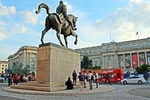
Prior to 1948, an equestrian statue of King Carol I of Romania stood there. Created in 1930 by the Croatian sculptor Ivan Meštrović, the statue was destroyed in 1948 by the Communists, who never paid damages to the sculptor. In 2005, the Romanian Minister of Culture decided to recreate the destroyed statue from a model that was kept by Meštrović's family.
Duration: 30 minutes
Stop At: Palatul Regal/Royal Palace, Calea Victoriei 49-53, Bucharest Romania
Only outside.
The Royal Palace of Bucharest, known as Palace of the Republic (Romanian: Palatul Republicii) between 1948 and 1990, is a monumental building situated in the capital of Romania, on Calea Victoriei. The Palace in its various incarnations served as official residence for the Kings of Romania until 1947, when the communist regime was installed after Michael I of Romania's forced abdication. Since 1950 the Palace hosts the National Museum of Art of Romania. The former Romanian royal family currently uses Elisabeta Palace as its official residence in Bucharest.
The Palace is the largest and most significant royal residence in the country, containing emblematic official spaces such as the Throne Hall, the Royal Dining Hall and the monumental Voivodes' Staircase. An equestrian statue of the first king of Romania, Carol I stands in the center of a large square in front of it, traditionally known as the "Palace Square", but renamed "Revolution Square.
Duration: 10 minutes
Stop At: Macca Villacrosse Passage, Pasajul Macca, Bucharest 030058 Romania
Pasajul Macca-Vilacrosse is a fork-shaped, yellow glass covered arcaded street in central Bucharest. Câmpineanu Inn once stood in the place nowadays occupied by the passage.
Duration: 10 minutes
Stop At: Muzeul National de Istorie a Romaniei, Calea Victoriei 12 Sector 3, Bucharest 030026 Romania
Only Outside.
The Post Palace is one of the most monumental buildings in Bucharest. Far from being a fancily decorated structure, the palace strikes by its size and architectural soberness. Its tourist worth derives from its historical background and from the fact the palace has been hosting the National Museum of Romanian History since 1972.
The National Museum of Romanian History is one of the most valuable museums in Bucharest, and a must visit for all tourists (foreigners and nationals alike) who want to make a direct experience of the history of the Romanian people. However, the museological patrimony aside, the Post Palace is in itself a tourist sight worth searching out.
It was built between 1894 and 1900 by the design of Alexandru Săvulescu, in order to serve as headquarters of the Romanian Post, which it deed, until 1972.
Duration: 10 minutes
Stop At: Stavropoleos Monastery, Strada Stavropoleos 4, Bucharest Romania
Stavropoleos Monastery, also known as Stavropoleos Church during the last century when the monastery was dissolved, is an Eastern Orthodox monastery for nuns in central Bucharest, Romania. Its church is built in Brâncovenesc style. The patrons of the church (the saints to whom the church is dedicated) are St. Archangels Michael and Gabriel. The name Stavropoleos is the genitive case of Stavropolis (Greek, "The city of the Cross"). One of the monastery's constant interests is Byzantine music, expressed through its choir and the largest collection of Byzantine music books in Romania.
Duration: 15 minutes
Stop At: University's Square, Bulevardul Regina Elisabeta 3, Bucharest 030167 Romania
University Square is located in downtown Bucharest, near the University of Bucharest. It is served by Universitate metro station.
Four statues can be found in the University Square, in front of the University; they depict Ion Heliade Rădulescu (1879), Michael the Brave (1874), Gheorghe Lazăr (1889) and Spiru Haret (1932).
The Ion Luca Caragiale Bucharest National Theatre and the Intercontinental Hotel (one of the tallest buildings in Bucharest) are also located near University Square.
University Square marks the northeastern boundary of the Old Center of Bucharest.
Since the end of 2014, after a project costing up to 65 million euros, the National Theatre has a new face, dominated by futuristic elements.
Duration: 15 minutes