Give us feedback!
 4.7 from partner site
Poienari Fortress - The Real Castle of Dracula - Vlad the Impaler, Private Tour
Package Details
Destination:
Bucharest, Romania, Romania
Duration: 10 hours
Price:
$111.71
Details & Booking at viator.com
Like & Rate this package!
4.7 from partner site
Offered by: Viator
This is a privete tour from Bucharest to:
- the real Castle of Vlad the Impaler (Dracula).
- the huge Vidraru Dam and Vidraru Lake.
- the most beautiful monastery în Wallachia - Cutrea de Argeș.
We pick you up in the morning and drive two and a half hours to the real castle of Dracula - Vlad the Impaler, Poienari Fortress.
Here we will climb 1480 steps (200 meters difference in level) to Poienari Citadel, which stand high on a cliff overlooking the Arges River, at the foothills of the Carpathian Mountains.
Our professional guide will tell you why prince Vlad the Impaler is associated with the fictional character Dracula.
After we descended the hill we will have lunch at a traditional romanian restaurant.
From here we go to Vidraru Dam, a spectacular construction of 166 meters high and 305 meters length.
The last stop is at Curtea de Arges Monastery which is one of the most beautiful architectural monument în Wallachia.
Here you will visit the tombs of Romanian Kings.
- the real Castle of Vlad the Impaler (Dracula).
- the huge Vidraru Dam and Vidraru Lake.
- the most beautiful monastery în Wallachia - Cutrea de Argeș.
We pick you up in the morning and drive two and a half hours to the real castle of Dracula - Vlad the Impaler, Poienari Fortress.
Here we will climb 1480 steps (200 meters difference in level) to Poienari Citadel, which stand high on a cliff overlooking the Arges River, at the foothills of the Carpathian Mountains.
Our professional guide will tell you why prince Vlad the Impaler is associated with the fictional character Dracula.
After we descended the hill we will have lunch at a traditional romanian restaurant.
From here we go to Vidraru Dam, a spectacular construction of 166 meters high and 305 meters length.
The last stop is at Curtea de Arges Monastery which is one of the most beautiful architectural monument în Wallachia.
Here you will visit the tombs of Romanian Kings.
Itinerary
This is a typical itinerary for this product
Stop At: Poienari Castle, Transfagarasan, Arefu 117040 Romania
The ruins of Poienari Fortress stand high on a cliff overlooking the Arges River, at the foothills of the Carpathian Mountains. Built at the beginning of the 13th century by the first Walachian rulers, the castle changed names and residents a few times over the decades; eventually, it was abandoned and left in ruins.
Vlad Tepes ( Vlad the Impaler) recognized the potential of the location and upon taking over the throne, he ordered that the structure be repaired and consolidated, turning it into one of his main fortresses. When the Turks attacked and captured the castle in 1462, Vlad escaped via a secret passageway leading north through the mountains. Although the castle was used for many years after Vlad's death in 1476, it was eventually abandoned again in the first half of the 16th century and left to the ravages of time and weather.
In 1888, a major landslide brought down a portion of the castle which crashed into the river far below.
Duration: 2 hours
Stop At: Vidraru Dam, DN7C, Curtea de Arges 117040 Romania
Vidraru Lake and Dam - built between 1960 to 1966, for the production of electricity, irrigation and flood prevention, being now an excellent place also for recreation, tourism and sports, eg Bungee jumping extreme sport.
The dam stood at its completion, measured at height, in 8th place in Europe and ranks 20th in the world. Thousands were drilled underground galleries of 42 km long, was excavated one million cubic meters of underground rock, was poured nearly one million cubic meters of concrete, and human sacrifices have cost over eighty lives.
Between Fruntii Mountains and Ghitu Massif, in lake waters gather rivers Capra, Buda and several direct tributaries - Raul Doamnei, Cernatul and Valsan, Topologul, Valea lui Stan and Limpedea River, which have a total flow of about 5.5 m3 / s .
The lake surface is 893 ha, length of 10.3 km, the maximum width is 2.2 km inValea Lupului - Călugărița zone and it has a circumference of 28 km and water depth is 155 m high near curved dam of 166 m
Duration: 40 minutes
Stop At: Curtea de Arges Monastery, Bulevardul Basarabilor 1, Curtea de Arges 115300 Romania
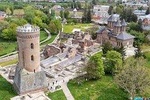
Curtea de Arges Monastery is one of the most famous monasteries in Romania and a must-see attraction if you’re looking to discover centuries-old religious sites. It’s the monumental church and its unique architectural style that make this monastery one of the most representative in Romania, a country that has hundreds of religious monuments of venerable age.
The burial place of Kings Carol the 1st and Ferdinand and Queens Elisabeta and Maria, this church – also known as the Cathedral from Curtea de Arges – had an overwhelming influence in the past on the architectural style of many religious monuments from the southern part of the country.
From medieval plans to royal renovations
Built 500 years ago by the medieval Prince Neagoe Basarab, the church was from the beginning a key religious landmark in Southern Romania given the use of expensive and rare materials and the hand-carved decorations inspired not only from the Byzantine tradition, but also from the Ottoman world.
Duration: 1 hour
Special Offer - Book by December 1 and travel between October 6 and December 14 to save 5% off our previously offered price! - Book Now!