Give us feedback!
Private Ephesus and Sirince VillageTour from Kusadasi
Package Details
Destination:
Kuşadası, Aydın, Turkey
Duration: 5 to 6 hours
Price:
$53.14
Details & Booking at viator.com
Like & Rate this package!
Offered by: Viator
All TOUR GUIDES VACCINATED !! ( Please ask your guide Vaccination Certificate)
After a short journey you will find yourself in the heart of history. And then you will walk into the ancient city of ephesus which named has been written to history in the gold letter.Our guide will enlighten you about history of region ,structures of ephesus, culture and tradations of ancient life deeply.
During the route you will find out the odeon, bouleterion, temple of domitian, Temple of Hadrian, the Fountain of Trajan, Brothel, the Great Theater and the spectacular Celsus Library, one of the best-preserved buildings among the ruins and it was the third lasrgest library in ancient time.
Walk along marble street more than two thousands years old. Then reach to greatest building of ephesus. where st john mentioned to pagans people about Christianity.
After a short journey you will find yourself in the heart of history. And then you will walk into the ancient city of ephesus which named has been written to history in the gold letter.Our guide will enlighten you about history of region ,structures of ephesus, culture and tradations of ancient life deeply.
During the route you will find out the odeon, bouleterion, temple of domitian, Temple of Hadrian, the Fountain of Trajan, Brothel, the Great Theater and the spectacular Celsus Library, one of the best-preserved buildings among the ruins and it was the third lasrgest library in ancient time.
Walk along marble street more than two thousands years old. Then reach to greatest building of ephesus. where st john mentioned to pagans people about Christianity.
Itinerary
This is a typical itinerary for this product
Stop At: Ancient City of Ephesus, Selcuk 35920 Turkey
This enclosure for archaeological remains at Ephesus elegantly reconciles historic conservation with accessibility for visitors. The site of a succession of great ancient civilizations, Ephesus, on the south-west coast of modern Turkey, During the 2nd century BC, Ephesus was the fourth largest city in the eastern Roman Empire, famous for its Artemesium, the Library of Celsus and its medical school.
Ephesus; Ancient Greek city of Asia Minor, near the mouth of the Menderes River, in what is today West Turkey, South of Smyrna (now Izmir). One of the greatest of the Ionian cities, it became the leading seaport of the region. Its wealth was proverbial. The Greek city was near an old center of worship of a native nature goddess, who was equated with the Greek Artemis, and c.550 B.C. a large temple was built.
Duration: 2 hours
Stop At: Bibliotheque de Celsus, Efes Selcuk Merkez, Selcuk, Selcuk Turkey
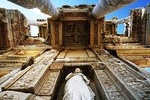
Celsus Library is one of the most beautiful structures in Ephesus. Celcius Library was built in 117 A.D. Celsus Library was a monumental tomb for Gaius Julius Celsus Polemaeanus, the governor of the province of Asia; from his son Galius Julius Aquila. The grave of Celsus was beneath the ground floor, across the entrance and there was a statue of Athena over it. Because Athena was the goddess of the wisdom
Duration: 20 minutes
Stop At: Sirince, Sirince, Izmir Province, Turkish Aegean Coast
This pretty old Orthodox village, 12 km away from Ephesus and 30 km from Kusadasi, was once Cirkince ("ugly"). Indeed its habitants gave this name on purpose as they did not want to be bothered by foreigners nor to share the beauty of their village.
Still after years, visitors understood that the village was not ugly at all and called it Sirince ("pretty"). As the village is located on the top of a mountain, anyone will enjoy the impressive wine yards' and peach trees' views on his way.
Duration: 2 hours
Stop At: The Temple of Artemis, Ataturk, Park Ici Yolu No:12, Selcuk Turkey
The Temple of Artemis is known as one of the Seven Wonders of the ancient world. It has been built in the areas of Ephesus on a flat area which has over the centuries turned into a swamp. If you visit Ephesus today, you can only see the ruins of the foundations of this marvelous construction of the Hellenistic Age, entirely made of marble and full of sculptured columns' capitals and shafts. The most beautiful remaining of this temple are today exhibited in the London British Museum.
The oldest remaining found date back till the 6th century BC. It was surrounded by 36 huge columns, later enlarged upon the orders of the Lydia King, Kreisos, during the 6th century BC. Most of the exhibits in the London British Museum belong to this period.
Duration: 30 minutes
Stop At: State Agora, Selcuk Turkey
The agora on the southern part of the Basilica is the State Agora, and was built in the Roman Period in the first century B.C. This agora was used not for commerce but for business, it played an important role as a meeting place for the governmental discussions. During the excavations in the northeast corner of the Agora were found a great number of graves from the 7th-6th centuries B.C and a stone-paved road, and a archaic sarcophagus of terra cotta.
Duration: 15 minutes
Stop At: The Odeion, Efes Selcuk Merkez, Selcuk, Selcuk Turkey
This building has the shape of a small theatre with the stage building, seating places and the orchestra.It had double function in use. First it was used as a Bouleuterion for the meetings of the Boulea or the Senate. The second fuction was the Odeum as a concert hall for the performances.It was constructed in the 2nd century A.D by the order of Publius Vedius Antonius and his wife Flavia paiana, two wealthy citizens in Ephesus.
Duration: 15 minutes
Stop At: Brothel, Selcuk Turkey
A peristyle house on the corner of Curetes Street and the Marble Road is known as the brothel, because in the excavations, a statue of Priapus with an oversize phallus was found in the house. The statue is now presented in Ephesus Museum.
The construction of the building dates to the Trajan (98-117 A.D.) It has two entrances, one from the Marble Road and one from the Curetes Street. It has a hall on the first floor , and on the second floor there are number of small rooms. On the west side of the house there is a reception area with colored mosaics on the floor, symbolizing the four season. The chamber next to it is the bath of the house with an elliptical pool. On the floor of the pool, there is a mosaic describing three women eating and drinking, a waitress standing, a mouse and a cat nibbling crumbs.
Duration: 15 minutes