Give us feedback!
Private Tour-Tiananmen Square,Forbidden City,Summer Palace&Mutianyu Great Wall
Package Details
Destination:
Beijing, China, China
Duration: 10 hours
Price:
$350.00
Details & Booking at viator.com
Like & Rate this package!
Offered by: Viator
You may have limited time to travel in Beijing, this tour will be including all the major famous historical sites to visit in one day. Tiananmen Square, Forbidden City, Summer Palace and Mutianyu Great Wall, all the entrance fee of these historical sights are included in this tour, a yummy local lunch with drinks included as well. Round trip private transportation and a professional English speaking tour guide will be accompanying you to know Beijing in one day, a great tour experience it will be.
Itinerary
This is a typical itinerary for this product
Stop At: Tiananmen Square (Tiananmen Guangchang), West Changan Street, Dongcheng District, Beijing 100006 China
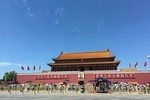
Located at the center of Beijing City and the midpoint of Chang'an Avenue is the remarkable Tiananmen Square, where you can visit the Tiananmen Tower, Monument to the People's Heroes, Great Hall of the People, Chairman Mao Zedong Memorial Hall and see the national flag raising ceremony. Thousands of people come to the Square every day. It is the must place to visit in Beijing City.
Duration: 30 minutes
Stop At: Forbidden City-The Palace Museum, No.4 Jingshanqian Street, Dongcheng District, Beijing 100009 China
Forbidden City, also known as the Palace Museum, and Gu Gong in Chinese, lies at the city center of Beijing, and once served as the imperial palace for 24 emperors during the Ming and Qing Dynasties (1368 - 1911). It was first built throughout 14 years during the reign of Emperor Chengzu in the Ming Dynasty (1368-1644). Ancient Chinese Astronomers believed that the Purple Star (Polaris) was in the center of heaven and the Heavenly Emperor lived in the Purple Palace. The Palace for the emperor on earth was so called the Purple City. It was forbidden to enter without special permission of the emperor. Hence its name 'The Purple Forbidden City', usually 'The Forbidden City'.
Now known as the Palace Museum, it is to the north of Tiananmen Square. Rectangular in shape, it is the world's largest palace complex and covers 74 hectares. Surrounded by a 52-meter-wide moat and a 10-meter-high wall are more than 8,700 rooms. The wall has a gate on each side. The distance between the south Meridian Gate (Wumen) and the north Gate of Divine Prowess (Shenwumen) is 961 meters (1,051 yards), while the distance between the east and west gates is 753 meters (823 yards). There are unique and delicately structured towers on each of the four corners of the curtain wall. These afford views over both the palace and the city outside.
The Forbidden City is divided into two parts. The southern section, or the Outer Court was where the emperor exercised his supreme power over the nation. The northern section, or the Inner Court was where he lived with his royal family.
Until 1924 when the last emperor of China was driven from the Inner Court, fourteen emperors of the Ming dynasty and ten emperors of the Qing dynasty had reigned here. Having been the imperial palace for some five centuries, Forbidden City houses numerous rare treasures and curiosities. Listed by UNESCO as a World Cultural Heritage Site in 1987, the Palace Museum is now one of the most popular tourist attractions world-wide.
Construction of the palace complex began in 1407, the 5th year of the Yongle reign of the third emperor (Emperor Chengzu, Zhu Di) of the Ming dynasty. It was completed fourteen years later in 1420, and then the capital city was moved from Nanjing to Beijing the next year. It was said that a million workers including one hundred thousand artisans were driven into the long-term hard labor. Stone needed was quarried from Fangshan District. It was said a well was dug every fifty meters along the road in order to pour water onto the road in winter to slide huge stones on ice into the city. Huge amounts of timber and other materials were freighted from faraway provinces.
Ancient Chinese people displayed their very considerable skills in building the Forbidden City. Take the grand red city wall for example. It has an 8.6 meters wide base reducing to 6.66 meters wide at the top. The angular shape of the wall totally frustrates attempts to climb it. The bricks were made from white lime and glutinous rice while the cement is made from glutinous rice and egg whites. These incredible materials make the wall extraordinarily strong.
Since yellow is the symbol of the royal family, it is the dominant color in it. Roofs are built with yellow glazed tiles; decorations in the palace are painted yellow; even the bricks on the ground are made yellow by a special process. However, there is one exception. Wenyuange, the royal library, has a black roof. The reason is that it was believed black represented water then and could extinguish fire.
Nowadays, Forbidden City is open to tourists from home and abroad. Splendid painted decoration on these royal architectural wonders, the grand and deluxe halls, with their surprisingly magnificent treasures will certainly satisfy 'modern civilians'.
Duration: 2 hours
Stop At: Summer Palace (Yiheyuan), No.19 Xinjian Gongmen Road, Haidian District, Beijing 100080 China
The Summer Palace, also called "Yi He Yuan" literally meaning "the Garden of Restful Peace" in Chinese, is one of the most visited scenic spots together with the Forbidden City, Temple of Heaven or Great Wall in Beijing city. Immense garden at a few kilometers away from the city, the Summer Palace holds its name to perfection as this was where emperors and the imperial family used to retreat at summer time, away from the heat that was burning the Forbidden City. This ancient royal garden is beautifully composed of palaces, temples, gardens, pavilions, lakes and corridors fully radiating the natural beauty and the grandeur of imperial gardens. As the largest garden in China, the Summer Palace is today the center of interests of all tourists coming to visit Beijing and its many cultural and historical relics. Looking like a part of Heaven after visiting the turmoil of Beijing city center, the Summer Palace is the place where to have a rest to discover the amazing architecture of the park invented hundred of years ago during the Qing Dynasty (1644-1911).
Duration: 2 hours
Stop At: Mutianyu Great Wall, Mutianyu Village, Bohai Town, Huairou District, Beijing China
The Mutianyu Great Wall is one of the best-preserved and best-known Great Wall sections. The Great Wall at Mutianyu has breath-taking scenery but less tourists, It was first built in Northern Qi Dynasty (550-557). In the Ming Dynasty (1368-1644), Tan Lun and Qi Jiguang, two famous patriotic generals, rebuilt it in order to strengthen its defensive potential when they guarded the strategic pass. It served as the northern protective screen, guarding the capital and imperial mausoleums for generations.
Duration: 2 hours