Give us feedback!
Private Tour: Warsaw Communism Tour by retro minibus
Package Details
Destination:
Warsaw, Central Poland, Poland
Duration: 3 hours
Price:
$61.67
Details & Booking at viator.com
Like & Rate this package!
Offered by: Viator
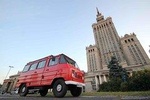
Let yourself be taken on a ride by retro minibus made in communist Poland to investigate the history, ideology and architecture of a former Polish communist state. Warsaw seems perfect for it due to World War 2 destruction of the city and reconstruction done by the communist government. There's a lot to see, be prepared then for a high pace and strict schedule. Palace of Culture and Science, Constitution sq, former Communist Party HQ are just some places one either visits or passes on this tour. Stories about the black market, an idea of a garden-city of Warsaw and new communist ideology combined with the right context and retro time machine will bring these past days back to life. Witness visit of Pope John Paul, an introduction of Martial Law and Free Elections of 1989 through tales told during this 3-hour experience.
Itinerary
This is a typical itinerary for this product
Stop At: Muranów, 00-001 Warsaw, Poland
The Muranów district was build just after the war on the rubble of a densely built-up and vibrant Jewish district of Warsaw. Muranów is today a souvenir of the architecture and ideology of socialist realism.
The Venetian origin of the Muranów name is a bitter irony of history because the word "ghetto" was used for the first time in Venice in 1516.
Duration: 30 minutes
Stop At: Banking and Financial Centre Nowy Świat, Nowy Świat 6/12, 00-400 Warszawa, Poland
Central Committee of the Polish United Workers' Party was the central ruling body of the Polish United Workers' Party, the dominant political party in the People's Republic of Poland (1948-1990).
Duration: 15 minutes
Stop At: Monument of the Free Word, Mysia 2, Warsaw Poland
Censorship in People's Republic of Poland was performed by the Main Office of Control of Press, Publications and Shows. Private letters, newspapers, TV shows and news, even songs lyrics - all were a subject of check and editing of the Office. All data that could give a negative picture of Eastern Block became illegal. News about natural catastrophes, knowledge about the toxicity of asbestos, or even of the plastic used in artificial Christmas trees was strictly forbidden.
Duration: 15 minutes
Stop At: Plac Konstytucji, plac Konstytucji, Warsaw 00-001 Poland
The Square was constructed in the initial post-war years as the main element of social realist urban project. Together with the Palace of Culture and Science, it was the main architectural social realist investment of Warsaw in 1949-1956. Its name comes from the Stalinist constitution adopted in communist Poland.
Duration: 30 minutes
Stop At: Palace of Culture and Science, Plac Defilad 1, Warsaw 00-110 Poland
The Palace of Culture and Science is the undisputed symbol of Warsaw. The Palace was built in 1952-1955 as a gift from the Soviet Union to the people of Poland.
Varsovians still commonly use nicknames to refer to the Palace, notably "Beijing", "clown", "nightmarish dream of a drunk confectioner", "Stalin's syringe", "small but stylish". Other less common names include "the Elephant in Lacy Underwear", "Russian wedding cake", or even "Stalin's dick".
The permanent residents of the Palace are cats that live in the basement. Animals have their guardian who cares about them. In the highest part of the Palace, peregrine falcons live, which just below the spire, have their nest erected. They have been there since 1998. A pair of falcons have young children there. In the Internet users' competition, the young falcons were given the names: Bazyl, Orion and Wawa. A little lower in towers at the height of the 15th floor, the kestrels found their asylum. And on the level of the 6th floor, on the roof of the Studio Theater, among the melliferous bushes, there is an apiary of urban bees.
Duration: 15 minutes
Stop At: Ministry of Agriculture and Rural Development, Wspólna 30, 00-930 Warszawa, Poland
One of the best examples of the socialist-realism style.
Duration: 5 minutes
Stop At: Plac Marszalka Jozefa Pilsudskiego, Warsaw Poland
Marshal Józef Piłsudski Square (formerly Saski Square and Adolf-Hitler-Platz and Victory Square) - monumental, extensive square with symbolic, historical and architectural value. The patron of the square is Marshal Józef Piłsudski (1867-1935), independence activist, head of state, commander-in-chief of the army and marshal of Poland.
Duration: 30 minutes