Give us feedback!

Private Tour to Pyramids and Egyptian Museum
Package Details
Destination:
Cairo, Cairo Governorate, Egypt
Duration: 6 to 8 hours
Price:
$62.86
Details & Booking at viator.com
Like & Rate this package!
Offered by: Viator
Experience Cairo’s very best with a private, full-day tour that takes in ancient sites, artifacts and a bustling bazaar. Ride a camel through the sand beside the soaring pyramids at Giza, then descend to the funerary complex at the Valley Temple. Go toe-to-toe with the enigmatic Sphinx, and pause for lunch before visiting the Egyptian Museum. Explore the stunning collection of artifacts, mummies and royal treasures with your guide, including Tutankhamun’s treasures and gold death mask; and if you wish, take an optional look at the incredible Mummy Room.
- See one of the Seven Wonders of the World (UNESCO-listed Great Pyramids and mysterious Great Sphinx)
- Explore ancient sites and the Egyptian museum with an experienced guide
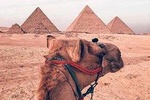
- Take a ride on a camel in the Sahara Desert
- Learn about Egypt's history and culture
- Free hotel pickup and drop-off included
- See the sights with an Egyptologist guide
- See one of the Seven Wonders of the World (UNESCO-listed Great Pyramids and mysterious Great Sphinx)
- Explore ancient sites and the Egyptian museum with an experienced guide
- Take a ride on a camel in the Sahara Desert
- Learn about Egypt's history and culture
- Free hotel pickup and drop-off included
- See the sights with an Egyptologist guide
Itinerary
This is a typical itinerary for this product
Stop At: Pyramids of Giza, Al Haram Str., Giza 12611 Egypt
The Giza pyramid complex, also called the Giza Necropolis, is the site on the Giza Plateau in Egypt that includes the Great Pyramid of Giza, the Pyramid of Khafre, and the Pyramid of Menkaure, along with their associated pyramid complexes and the Great Sphinx of Giza. All were built during the Fourth Dynasty of the Old Kingdom of Ancient Egypt. The site also includes several cemeteries and the remains of a workers' village.
The site is at the edges of the Western Desert, approximately 9 km (5 mi) west of the Nile River in the city of Giza, and about 13 km (8 mi) southwest of the city centre of Cairo.
The Great Pyramid and the Pyramid of Khafre are the largest pyramids built in ancient Egypt, and they have historically been common as emblems of ancient Egypt in the Western imagination. They were popularised in Hellenistic times, when the Great Pyramid was listed by Antipater of Sidon as one of the Seven Wonders of the World. It is by far the oldest of the ancient Wonders and the only one still in existence.
The Pyramids of Giza consist of the Great Pyramid of Giza (also known as the Pyramid of Cheops or Khufu and constructed c. 2580 – c. 2560 BC), the somewhat smaller Pyramid of Khafre (or Chephren) a few hundred meters to the south-west, and the relatively modest-sized Pyramid of Menkaure (or Mykerinos) a few hundred meters farther south-west. The Great Sphinx lies on the east side of the complex. Current consensus among Egyptologists is that the head of the Great Sphinx is that of Khafre. Along with these major monuments are a number of smaller satellite edifices, known as "queens" pyramids, causeways and valley pyramids.
Duration: 3 hours
Stop At: Great Sphinx, Al-Haram, Giza Egypt
The Great Sphinx of Giza, commonly referred to as the Sphinx of Giza or just the Sphinx, is a limestone statue of a reclining sphinx, a mythical creature with the body of a lion and the head of a human. Facing directly from West to East, it stands on the Giza Plateau on the west bank of the Nile in Giza, Egypt. The face of the Sphinx is generally believed to represent the pharaoh Khafre.
Cut from the bedrock, the original shape of the Sphinx has been restored with layers of blocks. It measures 73 m (240 ft) long from paw to tail, 20 m (66 ft) high from the base to the top of the head and 19 m (62 ft) wide at its rear haunches. It is the oldest known monumental sculpture in Egypt and is commonly believed to have been built by ancient Egyptians of the Old Kingdom during the reign of the pharaoh Khafre (c. 2558–2532 BC)
Duration: 30 minutes
Stop At: The Museum of Egyptian Antiquities, Midan El Tahrir Geographical Society Building, Cairo 11511 Egypt
The Museum of Egyptian Antiquities, known commonly as the Egyptian Museum or Museum of Cairo, in Cairo, Egypt, is home to an extensive collection of ancient Egyptian antiquities. It has 120,000 items, with a representative amount on display, the remainder in storerooms. Built in 1901 by the Italian construction company Garozzo-Zaffarani to a design by the French architect Marcel Dourgnon, the edifice is one of the largest museums in the region. As of March 2019, the museum is open to the public. In 2020 the museum is due to be superseded by the new Grand Egyptian Museum at Giza.
Duration: 2 hours