Give us feedback!
Tour to Vardzia from Tbilisi (Vanis Kvabebi, Khertvisi, Sapara, Rabati, Borjomi)
Package Details
Destination:
Tbilisi, Georgia, Georgia
Duration: 15 hours
Price:
$95.00
Details & Booking at viator.com
Like & Rate this package!
Offered by: Viator
Private full day tour to Vardzia includes visiting southern Georgia's unique cave city and monastery Vardzia built in 12th century that is the most picturesque monument of medieval Georgia, Vanis Kvabebi cave monastery from the 8th century, fortress of Khertvisi built in the 2nd century BC and destroyed by Alexander the Great, Sapara Monastery from at least the 9th century in a green forested canyon distinguished by its pink and yellow stones, cultural and historical complex Rabati that is a symbol of tolerance established in the 9th century and balneological resort Borjomi, well-known with its mineral waters that dates back to the 1850s. Private tour to Vardzia is suitable for people who enjoy visiting medieval caves, castles, churches and exploring breathtaking Georgian nature. Total drive 540 km (335 miles).
Itinerary
This is a typical itinerary for this product
Stop At: Vardzia, Erusheti Mountain, Aspindza 383770 Georgia
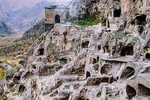
Vardzia is a cave monastery on the Erusheti Mountain on the left bank of Mtkvari River (12th century). According to the myth, the young Tamar, when out hunting with Giorgi, lost in the caves; when called for, she replied "I am here, uncle" ("aq var dzia"), giving the site its name.The caves stretch for 500 meters and in up to 19 levels. The Church of the Dormition, dating to the 1180s during the golden age of Tamar and Rustaveli. The site was abandoned after the Ottoman takeover in the 16th century. Extended area of Vardzia-Khertvisi has been submitted for future inscription on the UNESCO Heritage List.
Duration: 1 hour
Stop At: Cave Town Vanis-Kvabebi, Gogasheni Georgia
Vanis Kvabebi is a cave monastery complex that dates from 8th century and consists of a defensive wall built in 1204 and a maze of tunnels running on several levels in the side of the mountain.
There are also two churches in the complex. A newer stone church stands near the top of the wall, and a smaller, domed church that clings to the rock on the level of the highest tunnels.
Duration: 30 minutes
Stop At: Khertvisi Fortress, Vil. Khertvisi, Aspindza 0500 Georgia
Khertvisi fortress was first built in the 2nd century BC. The church was built in 985, and the present walls were built in 1354. As the legend says, Khertvisi was destroyed by Alexander the Great. It became a town (12th). Mongols destroyed (13th). Jakeli family owned (15th). Turks invaded (16th) and owned during 300 years. Returned and used as military base (19th).
Duration: 30 minutes
Stop At: Sapara Monastery, Akhaltsikhe Georgia
Sapara Monastery is a Georgian Orthodox monastery that has existed from at least the 9th century.. At the end of the 13th century Sapara became a possession of the Jakeli family, whose leader, Sargis Jakeli, was adept at staying on good terms with the Mongols, which enabled Samtskhe to enjoy a peace unusual for the time. When he grew old, Sargis took monastic orders and changed his name to Saba. His son Beka built the largest of the 12 churches here, St Saba's Church, named after the saint whose name his father had adopted, one of the most architecturally important churches of its time. The 14th-century frescoes inside are of high quality. From the end of the 16th century until the beginning of the 17th century the Sapara Monastery became empty due to the expansion of Ottoman Empire policy into Samtskhe and during this process the monastery's icons and other treasures were taken to more protected areas of Georgia.
Duration: 30 minutes
Stop At: Rabati Castle, Akhaltsikhe Georgia
Rabati Castle originally established in the 9th century as the Lomisa Castle, but was rebuilt by Ottomans. Most of the surviving buildings date from the 17th-18th centuries. The city was established in the 9th century by Guaram Mampal, son of the King of Tao. From the 13th-14th centuries it was the capital of Samtskhe-Saatabago, ruled by dynasty of Jaqeli.
Duration: 1 hour
Stop At: Borjomi Central Park, 50, 9 Aprili Street, Borjomi 1200 Georgia
Borjomi is a resort town with a population of 10,546 and is a balneological and climatic resort. Borjomi has several districts, of which Likani, Papa and Plateau are particularly favorable for treatment. The main treatment of the resort is mineral water used for drinking and balneological procedures. Other treatment factors in Borjomi are climatotherapy, mud treatment. The best time for climatotherapy is June-October. Medical indications: chronic diseases of the gastrointestinal tract, liver and biliary tract, alteration of substances, some diseases of the cardiovascular system. The season lasts all year. Borjomi has striking nature and unique mineral waters. One of the best places visit is the “Mineral Water Park”. The park itself dates back to the 1850s and is an attractive destination all throughout the year. Here you can taste the natural Borjomi mineral water and relax in a beautiful environment.
Duration: 1 hour