Give us feedback!
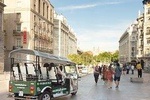
Christmas lights tour of Madrid by electric tuk-tuk
Package Details
Destination:
Madrid, Comunidad de Madrid, Spain
Duration: 59 minutes
Price:
$50.19
Details & Booking at viator.com
Like & Rate this package!
Offered by: Viator
Madrid dresses up at Christmas and at Eco Tuk Tuk we want to show you with this 60-minute tour so that you can enjoy it in a comfortable and fun way. The city is known for its illuminations at this time of year and on this tour you can enjoy its unique decoration known throughout the world. And do not hesitate to ask our guides to take photos of you.
Turn your stay in Madrid into an unforgettable experience and take home a great memory of this wonderful city!
We comply with the measures for the reduction of contagion by COVID19 of the Ministry of Health of Spain for guides and means of transport.
* Note: in winter the tuk-tuk have protective layers against rain and wind. They also have blankets so that our clients do not get cold.
Turn your stay in Madrid into an unforgettable experience and take home a great memory of this wonderful city!
We comply with the measures for the reduction of contagion by COVID19 of the Ministry of Health of Spain for guides and means of transport.
* Note: in winter the tuk-tuk have protective layers against rain and wind. They also have blankets so that our clients do not get cold.
Itinerary
This is a typical itinerary for this product
Pass By: Puerta de Alcala, Plaza Independencia 1, 28001 Madrid Spain
This monumental door, built by mandate of Carlos III to replace a previous one dating from the 16th century, was inaugurated in 1778.
Designed by Francesco Sabatini, it is a granite arc of triumph of neoclassical style, the first built in Europe after the fall of the Roman Empire, a precursor to others known as the Arc de Triomphe in Paris or the Brandenburg Gate in Berlin. Unlike the Puerta de Toledo or San Vicente, it has five openings instead of the usual three.
The two facades of which it is composed show different decorations, making the inner face easier (initially the one facing the city, which includes the four virtues: Prudence, Justice, Temperance and Fortress) than the exterior, chaired by the royal shield and with greater decorative wealth, which was what those who entered Madrid saw.
It receives its name for being located next to the road that led to Alcalá de Henares.
Pass By: Barrio de Salamanca, Barrio de Salamanca, Madrid
The tour includes a tour of the main streets of Barrio Salamanca: Velázquez, Ortega and Gasset and Serrano.
Pass By: Mercado San Miguel, Plaza San Miguel, 28005 Madrid Spain
Opened in May 1916 as a food market, this centennial establishment becomes in May 2009 the first gastronomic market in Madrid. During 2018 the market experiences a period of consolidation of much of its gastronomic content, with renowned chefs nationally and internationally.
Pass By: Plaza Colon, Madrid Spain
The Christopher Columbus monument presides over the square from the center of the fountain around which the traffic revolves. This white marble sculpture, in neo-Gothic style, next to its imposing stone-carved pedestal, measures 17 meters and was built in 1885 by Jerónimo Suñol, on the occasion of the wedding celebration between Alfonso XII and María de las Mercedes de Orleans.
The square also houses the Gardens of Discovery, a park opened in 1970, where you can admire various sculptures such as the monument dedicated to the discovery of America.
In the basement is the Cultural Center of the Villa Fernán Gómez.
Pass By: Cibeles Fountain, Plaza de Cibeles, Madrid Spain
Surrounded by the buildings of the Palacio de Buenavista (Army Headquarters), Palacio de Linares (Casa de América), Palacio de Comunicaciones (formerly the Post Office headquarters and currently the City Council of Madrid) and Banco de España.
The fountain represents the Roman goddess Cibeles, symbol of the land, agriculture and fertility, on a car pulled by two lions, the mythological characters Hipomenes and Atalanta. The goddess and the lions were carved in marble and the rest in stone. The sculpture of the goddess is the work of Francisco Gutiérrez. The two lions have been sculpted by the Frenchman Roberto Michel.
The goddess is an icon for the followers of the Real Madrid football team, since the Madrid team titles are celebrated, as well as the successes of the Spanish soccer team.
Pass By: Palacio de Cibeles, Plaza Cibeles 1 and Calle de Alcala, 28014 Madrid Spain
Designed and built by Antonio Palacios and Joaquín Otamendi as the headquarters of the Post and Telegraph Society of Spain, it was inaugurated in 1909. In 1993, it was declared a Site of Cultural Interest with a Monument category.
Following patterns of rationality and functionality, the building represents the union of tradition and modernity. Built in stone, iron and glass, the Cibeles Palace sits on a site that had housed the former recreational gardens of El Buen Retiro.
Pass By: Banco de Espana, Calle Alcala 48, 28014 Madrid Spain
All a decorative waste, awarded at the National Exhibition of Fine Arts of 1884. The building was built with the aim of providing the National Bank with a seat more in line with the importance of its functions, such as the single issuance of coins and bills for everything Spanish territory
The interior of the building can only be visited by groups of educational centers and universities. Exceptionally, also by non-profit cultural and associative entities.
Pass By: Plaza de Canalejas, Plaza de canalejas., Madrid Spain
to Plaza de Canalejas, formerly known as the Four Streets; It is located in the Centro district of Madrid, it is located between Carrera de San Jerónimo and Calle de la Cruz, Sevilla and Príncipe. It bears the name of the politician and orator José Canalejas (1854-1912), who was assassinated by an anarchist while looking at the window of the disappeared San Martín bookstore, on the neighboring Puerta del Sol corner of Carretas street, about a hundred meters from this small square.
Pass By: Plaza de Santa Ana, Madrid Spain
Plaza de Santa Ana is an open space in the Cortes neighborhood, in the Centro district of Madrid. It dates back to 1810 and throughout its history it has undergone numerous urbanization processes that have modified its appearance with varying degrees of success.
Pass By: Casa de Cervantes, Calle Cervantes 2, 28014 Madrid Spain
Former residence of the famous writer Miguel de Cervantes, author of "Don Quixote", with guided tours.
Pass By: Casa Museo Lope de Vega, Calle Cervantes 11, 28014 Madrid Spain
The Lope de Vega House-Museum is located at number 11 Cervantes street in the Spanish city of Madrid
Through the Library Museum and the Exhibition Rooms, the collections, the functioning and the history of the National Library are disseminated.
Pass By: Fuente de Neptuno, Paseo del Prado Plaza de Canovas del Castillo, 28014 Madrid Spain
Both gods occupy prominent positions within the Greek mythological hierarchy and rival in the sports field, since the fans of Atlético de Madrid celebrate their victories in the square of the god of the sea, while that of Real Madrid does so in that of Cibeles.
As part of the original Ventura Rodríguez project, both sources were initially confronted, looking at each other on the side of Paseo del Prado. Both Cibeles and Neptune experienced restructuring and transfer processes at the end of the 19th century, finally occupying the center of the Cibeles and Cánovas del Castillo squares, respectively.
Pass By: Prado National Museum, Calle Ruiz de Alarcon 23, 28014 Madrid Spain
Singularly rich in paintings by European masters from the 16th to the 19th centuries, according to art historian and hispanist Jonathan Brown "few would dare to doubt that it is the most important museum in the world in European painting."
Its main attraction lies in the wide presence of Velázquez, El Greco, Goya (the most widely represented artist in the museum), Tiziano, Rubens and El Bosco, of which he has the best and most extensive collections that exist worldwide, a what should be added outstanding sets of authors as important as Murillo, Ribera, Zurbarán, Fra Angelico, Rafael, Veronese, Tintoretto, Patinir, Antonio Moro, Van Dyck or Poussin, to name just a few of the most relevant.
Pass By: Jeronimos, Jeronimos, Madrid
Popularly known as "Los Jerónimos", its official name is that of Parish Church of San Jerónimo el Real. It is located next to the Prado Museum, at the back, and is late Gothic with Renaissance influences from the early 16th century. Although there is little left of the original building, it has been remodeled and restored many times over the centuries.
His name refers to his special relationship with the kings of Spain, to begin with it was built by order of the Catholic Monarchs and throughout history it became the place of spiritual retreat of several monarchs. In addition, for centuries it has been the scene of royal investiture in the absence of a cathedral and the wedding of Alfonso XIII was also held here, for which the great stairway leading to its door was built in 1906.