Give us feedback!
UNESCO Small Group Day Tour of Jeju Island - South Course
Package Details
Destination:
Seogwipo, Jeju Island, South Korea
Duration: 8 hours
Price:
$125.00
Details & Booking at viator.com
Like & Rate this package!
Offered by: Viator
Jeju Small-Group UNESCO Day Tour - South Course
–
South side of Jeju island is for those who looking for Jeju’s UNESCO heritages, Great scenery, and High-quality tour. The picturesque island of Jeju is a UNESCO–listed gem lying off the southern shores of South Korea. On this all-inclusive full-day UNESCO tour, experience the best of Jeju Island in one day with entrance fees, lunch, and round-trip travel from your downtown hotel included. Hike up Mt.Halla, reach sites of interest including Jusangjeolli cliff, Cheonjiyeon falls, and enjoy personal attention from your guide on this small-group tour — limited to 15 people per group. This tour is available on Tue/Thur/Sat.
–
South side of Jeju island is for those who looking for Jeju’s UNESCO heritages, Great scenery, and High-quality tour. The picturesque island of Jeju is a UNESCO–listed gem lying off the southern shores of South Korea. On this all-inclusive full-day UNESCO tour, experience the best of Jeju Island in one day with entrance fees, lunch, and round-trip travel from your downtown hotel included. Hike up Mt.Halla, reach sites of interest including Jusangjeolli cliff, Cheonjiyeon falls, and enjoy personal attention from your guide on this small-group tour — limited to 15 people per group. This tour is available on Tue/Thur/Sat.
Itinerary
This is a typical itinerary for this product
Stop At: Mysterious Road (Dokkaebi Road), 2894-63, 1100-ro, Jeju, Jeju Island 63079 South Korea
There’s a hundred-meter section on 1100 Road where things roll upward. This road became known to the world in 1981 when a couple on honeymoon got out of their car for photo taking while placing their car gears in neutral and witnessed it rolling upward. This road actually has 3-degree downward slant but the surrounding terrain makes it look like an upward slant.
Duration: 10 minutes
Stop At: Hallasan National Park, San 220-1 Sanghyo-dong, Seogwipo, Jeju Island South Korea
Eoseungsaengak Trail 60mins Trekking – Hallasan Mountain stands proudly at the center of Jeju Island and is perhaps the island’s most memorable landmarks. Also called Mt. Yeongjusan, meaning “mountain high enough to pull the galaxy,” Hallasan Mountain is widely known by scientists for its geological value. It was designated as the national park in 1970, UNESCO Biosphere Reserve in 2002, UNESCO World Heritage in 2007, UNESCO Geopark in 2010.
–
Eoseungsaengak rises 1,169m above sea level. It takes approximately 30 minutes to climb to the top along its 1.3 km long trail.
You can enjoy the amazing view of Jeju city on the front side and Submit of Mt.Halla at the behind.
–
※ When the road is closed due to heavy rain, heavy snow or icy road, it will be replaced with visiting Jeju National Museum.
Duration: 1 hour
Stop At: Jeju 1100 Altitude Wetland, Hallasan National Park, Seogwipo, Jeju Island South Korea
The 1100 Altitude Wetland is a remarkable place to view the diversity of plant and animal species which inhabit the wetlands of the Jeju, which was included on Ramsar List in 2009.
–
A mountainous wetland consisting of a number of unique freshwater marshes and pools, situated on Jeju Island. As the name suggests, the site is located at 1100m asl within the Mt Halla World Heritage site. The wetland is in an area of low gradient enabling the capture and retention of freshwater, to form small permanent lakes and peat bogs that support diverse floristic assemblages and significant endemism.
–
※ When the road is closed due to heavy rain, heavy snow or icy road, it will be replaced with visiting Jeju National Museum.
Duration: 20 minutes
Stop At: Daepo Haean Jusangjeolli Cliff, 36-30, Ieodo-ro, Seogwipo, Jeju Island 63547 South Korea
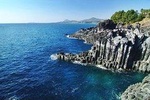
Following the farm road about 600m to the southwest from Daepo-dong, at the end of the pine tree forest is a cliff. At the base of this cliff is the Jisatgae Coast along with the imposing stone pillars. Jusangjeolli are stone pillars piled up along the coast and is a designated cultural monument of Jeju Island. Jusangjeolli Cliff was formed when the lava from Hallasan Mountain erupted into the sea of Jungmun. They are rock pillars shaped like cubes or hexagons of various sizes and almost seem as if stone masons had carved them out. The administration of the district named them ‘Jisatgae Rocks’ from their old name ‘Jisatgae’. The 20m cliff makes it a popular spot for high tide and sea angling. The waves of the high tide crashing into the side of the cliff provide a breathtaking view of the ocean surrounding the pillars.
Duration: 20 minutes
Stop At: Yakcheonsa Temple, 293-28, Ieodo-ro, Seogwipo, Jeju Island South Korea
The architectural style of Yakcheonsa Temple is reminiscent of that of Buddhist temples of the early Joseon Dynasty. Measuring an impressive 30m high and spanning a total area of 3,305 meters squared, it is the largest temple in the East.Upon entering Yakcheonsa Temple, guests will be greeted by a 5m-tall statue of Vairocana, the tallest of such statues in Korea, on a 4m high pedestal. The walls on both the right and left have been sculpted into large altar portraits of Buddha and in front of the Dharma Hall is a giant Buddhist temple bell, weighing 18 tons. Beloved for its size and grandeur, the temple consists of a main temple (2,652 meters squared) and a 3-story residential structure for the Buddhist monks.
Duration: 30 minutes
Stop At: Cheonjiyeon Falls, Cheonji-dong, Seogwipo, Jeju Island South Korea
The water at Cheonjiyeon Falls, meaning “sky connected with land,” appears to fall from the heavens, giving the falls its name. Apart from the wild Dampalsu trees, designated as Natural Monument No. 163, the wooded area also contains a great variety of rare plants such as brambles, Songyeopnan as well as Gusiljappam trees, Sanyuja trees (Chinese lemon trees), and camellias which all make up a forest specified as Natural Monument No. 379. Take a walk along the subtropical path towards the Cheonjiyeon Falls for a kilometer and you will be able to hear the magnificent sound of the water falling. The waterfall is 22m high, 12m wide and 20m in depth. The clear and deep water of Cheonjiyeon Falls is designated as Natural Monument No. 27 and is renowned as a habitat for Mutae eels (Natural Monument No. 258).
Duration: 30 minutes
Stop At: Dosun Dawon, 152-41, Jungsanganseo-ro 356beon-gil, Seogwipo, Jeju Island 63555 South Korea
Seogwi Dawon, located at the foot of Mt. Halla, is a place built by an old couple who are dedicated to protecting and preserving Jeju’s tea culture. The farm owner is producing only the quality green teas.
Duration: 35 minutes