Give us feedback!
Our philosophy is simple. We want to encourage you to dream. BIG! Then we help you plan your trip, get the most out of it while you're traveling and help you share your experience with friends.
Join Now It's FREE
Related Categories
Dreams Still To Do
Checked-Off Dreams
Dreams Still To Do
Checked-Off Dreams
Advertisement
Explore Geysers
-
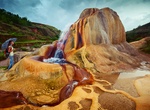
See Clepsydra Geyser, Yellowstone National Park, Wyoming
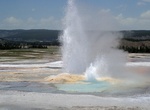
Clepsydra Geyser is a geyser in the Lower Geyser Basin of Yellowstone National Park in the United States. Clepsydra Geyser is the most active member of the Lower Geyser Basin’s Fountain Group. It’s multivent cone has attractive, yellow-stained geyserite. Clepsydra has been in near-constant eruptive activity since the 1959 Hebgen Lake Earthquake. Pauses in ... -
See Cliff Geyser, Yellowstone National Park, Wyoming
Cliff Geyser is located in Black Sand Basin in Yellowstone National Park. -
See Comet Geyser, Upper Geyser Basin, Yellowstone National Park, Wyoming
Comet Geyser is a geyser in the Upper Geyser Basin of Yellowstone National Park in the United States. Comet Geyser is part of the Daisy Group which includes Daisy Geyser, Splendid Geyser and Brilliant Pool. As opposed to the other features in this group, Comet erupts almost continuously. Every few minutes it surges to a height of 6 feet (1.8 m). This constant eruption... -
See Congress Pool, Norris Geyser Basin, Yellowstone National Park, Wyoming
A visit during the majority of the year will show a Congress Pool that appears pale blue in color. Due to the variable nature of Norris features, it is possible to see the same pool looking muddy and boiling violently. At Norris, geothermal "disturbances" take place annually. No other thermal area in Yellowstone exhibits this phenomenon. Mysteriously, features throug... -
See Crackling Lake, Norris Geyser Basin, Yellowstone National Park, Wyoming
The name of this thermal feature was proposed by Ed Leigh in 1967 because of popping sounds from nearby springs on its southern shore. It was formerly simply called Spring #39 in Dr. Peale's publication entitled Gibbon Geyser Basin. -
Off-road to Crystal Geyser, Utah
Crystal Geyser is located on the east bank of the Green River approximately 4.8 miles downstream from Green River, Utah. It is a rare example of a cold water carbon dioxide driven geyser; geothermal activity does not play a role in the activity of the geyser. The ground water near the geyser has significant quantities of dissolved carbon dioxide, along with substantia... -
See Daisy Geyser, Yellowstone National Park, Wyoming
Daisy Geyser is a geyser in the Upper Geyser Basin of Yellowstone National Park in the United States. Daisy Geyser is part of the Daisy Group. It was named prior to 1890 by the Hague Party. It erupts every 110 to 240 minutes for a period of 3 to 5 minutes and is one of the most predictable geysers in the park. Its fountain erupts at an angle to the ground and reaches ... -
See Depression Geyser, Upper Geyser Basin, Yellowstone National Park
The 1959 Hebgen Lake Earthquake seems to have caused this geyser to become more active. Depression Geyser erupts water 6–10 feet (1.8–3 m) every 8–36 hours. Depression Geyser is a deep blue pool with two main vent openings and a connected smaller pool to the north-northwest. However, it has become less active and more varied in its eruptions since an... -
See Echinus Geyser, Norris Geyser Basin, Yellowstone National Park, Wyoming
Echinus (e-KI-nus) Geyser was a perennial crowd-pleaser which typically erupted every 35 to 75 minutes. Late in 1998, this geyser altered its interval and for the next few years became less frequent and predictable. For the last several years, Echinus eruptions have been extremely rare. When active, its pool fills gradually with water;then suddenly, bursts of steam an... -
See Excelsior Geyser Crater, Yellowstone National Park, Wyoming
Excelsior Geyser Crater, formerly known as Excelsior Geyser, is a hot spring in the Midway Geyser Basin of Yellowstone National Park in the United States. Excelsior was named by the Hayden Geological Survey of 1871. Possibly the only known photograph of Excelsior in full eruption was taken by Frank Jay Haynes in 1888. The Excelsior Geyser pool discharges 4,000 to 4,50... -
See Fan and Mortar Geysers, Yellowstone National Park, Wyoming
Fan and Mortar Geysers are two geysers in the Upper Geyser Basin in Yellowstone National Park. For the past several decades, they have erupted in concert with one another and are generally talked about together. The records detailing these geysers' known eruptive history shows that they have been infrequent and irregular performers. The two geysers lie at the edge of ... -
See Fishing Cone, Yellowstone National Park
Fishing Cone is a geyser in the West Thumb Geyser Basin of Yellowstone National Park in the United States. In the earlier part of the 20th century, this cone had eruptions as high as 40 feet (12 m). As the water level in Yellowstone Lake has increased, the cone is now inundated during the spring and the temperatures in the cone have cooled enough that it no longer eru... -
Visit Geysers d'Andranomandroatra Analavory (Analavory Geysers), Madagascar
Analavory Geysers are four cold water geysers located about 12 km north-east from the town of Analavory. -
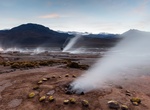
Visit Geysers del Tatio (El Tatio Geyser), Chile
El Tatio is a geyser field located within the Andes Mountains of northern Chile at 4,200 meters above mean sea level. Contrary to some reports, it is not the highest-elevation geyser field in the world. Puchuldiza Geyser Field, Chile, and possibly several other fields are higher in elevation. Tourists often visit the geysers while touring the nearby Atacama Desert and... -
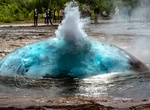
See Geysir (The Great Geysir), Iceland
Geysir, sometimes known as The Great Geysir or Strokkur Geyser, is a geyser in southwestern Iceland. It was the first geyser described in a printed source and the first known to modern Europeans. The English word geyser (a spouting hot spring) derives from Geysir. The name Geysir itself is derived from the Icelandic verbgeysa, "to gush", the verb from Old Norse. Geysi...