Give us feedback!
Our philosophy is simple. We want to encourage you to dream. BIG! Then we help you plan your trip, get the most out of it while you're traveling and help you share your experience with friends.
Join Now It's FREE
Related Categories
Dreams Still To Do
Checked-Off Dreams
Dreams Still To Do
Checked-Off Dreams
Advertisement
Explore Geysers
-
See Spa Geyser, Yellowstone National Park, Wyoming
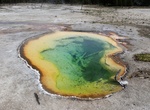
Spa Geyser is located in Upper Geyser Basin in Yellowstone National Park. It's near Morning Glory Pool. -
See Spasm Geyser, Lower Geyser Basin, Yellowstone National Park, Wyoming
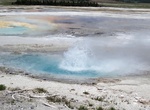
Spasm Geyser is located along the Fountain Paint Pot trail in Lower Geyser Basin, Yellowstone National Park, Wyoming. -
See Splendid Geyser, Upper Geyser Basin, Yellowstone National Park
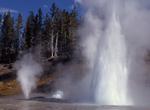
Splendid Geyser is a geyser in the Upper Geyser Basin of Yellowstone National Park in the United States. Splendid Geyser is part of the Daisy Group. Its eruptions are infrequent and unpredictable, unless it is active. When it does erupt, its fountain can reach a height of 200 feet (60 m). Eruptions are more likely if a storm front reduces barometric pressure and lower... -
See Steamboat Geyser, Norris Geyser Basin, Yellowstone National Park
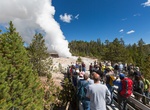
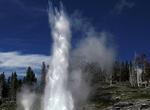
Steamboat Geyser, in Yellowstone National Park's Norris Geyser Basin, is the world's tallest currently-active geyser. During major eruptions, water may be thrown more than 300 feet (90 m) into the air. Steamboat's major eruptions last from 3 to 40 minutes, and are followed by powerful jets of steam. Steamboat does not erupt on a predictable schedule, with recorded int... -
See Strokkur, Iceland
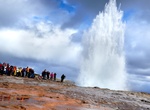
Strokkur is a fountain geyser in the geothermal area beside the Hvítá River in Iceland in the southwest part of the country, east of Reykjavík. It is one of Iceland's most famous geysers, erupting about every 4–8 minutes 15 – 20 m high, sometimes up to 40 m high. Strokkur and its surrounding areas regularly attracts tourists to view th... -
See Tardy Geyser, Upper Geyser Basin, Yellowstone National Park, Wyoming
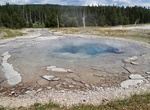
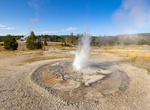
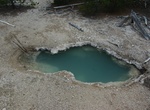
Tardy Geyser is a shallow, blue pool with rims of geyserite around the small vent at the middle of the pool. Outside of the geyserite rim, shallow water collects and orange thermophiles grow along the runoff channels. Tardy Geyser is part of the Sawmill Complex and likely gained its name from its record of activity right after a Sawmill Geyser eruption. Tardy Geyser ... -
See Turban Geyser, Upper Geyser Basin, Yellowstone National Park
Turban Geyser is a geyser in the Upper Geyser Basin of Yellowstone National Park in the United States. Turban Geyser belongs to the Grand Group (or Grand Geyser Complex), and its eruption is tied to Grand Geyser. In the hours prior to Grand's eruption, Turban will have five minute eruptions every 15–25 minutes. These eruptions measure 5–10 feet (2–3 ... -
See Twig Geyser, Lower Geyser Basin, Yellowstone National Park, Wyoming
Twig Geyser is a moderately small, fountain-type geyser in the Fountain Group of Yellowstone's Lower Geyser Basin. It has a basin about 4.5 to 5 meters in diameter with a centrally-located vent. Eruptions vary in duration and consist of splashes that reach 1 to 2 or even ~3 meters high. Fairly brief pauses with a more-or-less sustained water level in the basin are fre... -
Explore Upper Geyser Basin, Yellowstone National Park, Wyoming
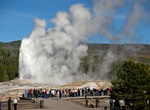
South of Norris Geyser Basin in Yellowstone National Park along the rim of the caldera is the Upper Geyser Basin, which has the highest concentration of geothermal features in the park. This complement of features includes the most famous geyser in the park, Old Faithful Geyser, as well as four other predictable large geysers. One of these large geysers in the ar... -
Explore Valley of Geysers, Kamchatka, Russia (UNESCO site)
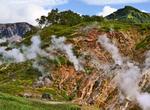
The Valley of Geysers is a geyser field on Kamchatka Peninsula, Russia, and has the second largest concentration of geysers in the world. This 6 km long basin with approximately ninety geysers and many hot springs is situated on the Kamchatka Peninsula in the Russian Far East, predominantly on the left bank of the ever-deepening Geysernaya River, into which geothermal... -
See Vent Geyser, Upper Geyser Basin, Yellowstone National Park
Vent Geyser is a geyser in the Upper Geyser Basin of Yellowstone National Park in the United States. Vent Geyser belongs to the Grand Group (or Grand Geyser Complex), and its eruption is tied to Grand Geyser. Normally, it erupts immediately after Grand and continues to erupt intermittently for about an hour afterward along with Turban Geyser. On rare occasions, it has... -
See West Geyser, Yellowstone National Park, Wyoming
West Geyser is located in the Biscuit Basin area in Yellowstone National Park. West Geyser is a colorful, fountain-type geyser in the western Sapphire Group of Yellowstone's Upper Geyser Basin. The pool has an irregularly pear-shaped outline that is about 7 meters long and about 4.5 meters wide. Eruptions at West Geyser are very rare, but did occur in 1959, 1986, and ... -
Hike West Thumb Geyser Basin Trail, Yellowstone National Park, Wyoming
The West Thumb Geyser Basin, including Potts Basin to the north, is the largest geyser basin on the shores of Yellowstone Lake. The heat source of the thermal features in this location is thought to be relatively close to the surface, only 10,000 feet (3,000 m) down. West Thumb is about the same size as another famous volcanic caldera, Crater Lake in Oregon, but much ... -
See Whale's Mouth, Norris Geyser Basin, Yellowstone National Park, Wyoming
This hot spring was named by a park naturalist in 1967 because its shape "resembles the mouth and gullet of a giant fish". This is regarded by many as an especially peculiar thing for a naturalist to say, due to the fact that whales are not fish. -
See Whirligig Geyser, Yellowstone National Park, Wyoming
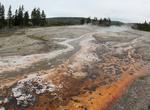
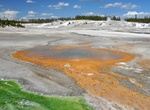
Little Whirligig got its name because of its close proximity to Whirligig Geyser. Whirligig was so named because its water swirls in its crater during eruptions. The orange-yellow iron oxide deposits around Little Whirligig make it one of the most colorful features in Porcelain Basin. It has been dormant for several years.