Give us feedback!
Our philosophy is simple. We want to encourage you to dream. BIG! Then we help you plan your trip, get the most out of it while you're traveling and help you share your experience with friends.
Join Now It's FREE
Dreams Still To Do
Checked-Off Dreams
Dreams Still To Do
Checked-Off Dreams
Advertisement
Explore New 2020-21 UNESCO Sites
-
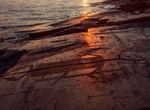
Visit Petroglyphs of Lake Onega and the White Sea, Russia (UNESCO Site)
The site contains 4,500 petroglyphs carved in the rocks during the Neolithic period dated 6 to 7 thousand years ago and located in the Republic of Karelia in the Russian Federation. It is one of the largest such sites in Europe with petroglyphs that document Neolithic culture in Fennoscandia. The serial property encompasses 33 sites in two component parts 300km apart:... -
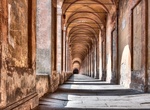
Visit Porticoes of Bologna, Italy (UNESCO Site)
The Porticoes of Bologna are an important cultural and architectural heritage of Bologna, Italy and represent a symbol of the city together with the numerous towers. No other city in the world has as many porticoes as Bologna: all together, they cover more than 38 kilometres (24 mi) only in the historic center, but can reach up to 53 kilometres (33 mi) if those outsid... -
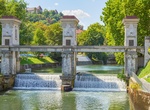
Stroll Promenade along the Embankments and Bridges of the Ljubljanica River, Slovenia (UNESCO Site)
The Ljubljanica has become a popular site for archaeologists and treasure hunters to dive for lost relics and artifacts. Locations in the river between Ljubljana and Vrhnika have offered up pieces of history from the Stone Age to the Renaissance, belonging to a variety of groups, from local ancient cultures to more well-known groups like the Romans and the Celts.[4]On... -
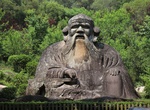
Visit Quanzhou: Emporium of the World in Song-Yuan China (UNESCO Site)
The serial site of Quanzhou illustrates the city’s vibrancy as a maritime emporium during the Song and Yuan periods (10th - 14th centuries AD) and its interconnection with the Chinese hinterland. Quanzhou thrived during a highly significant period for maritime trade in Asia. The site encompasses religious buildings, including the 11th century AD Qingjing Mosque,... -
Visit Ramappa Temple, Telangana (UNESCO Site)
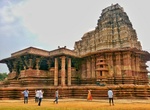
Ramappa Temple, also known as the Rudreshwara (Lord Siva) temple, is a UNESCO World Heritage Site located in the state of Telangana in southern India. It is 66 km (41 mi) away from Warangal, 15 km (9.3 mi) from Mulugu, 209 km (130 mi) from Hyderabad. It lies in a valley in Palampet village of Venkatapur mandal of Mulugu district, a tiny village long past its days of g... -
See Roman Walls in Mirje, Ljubljana, Slovenia (UNESCO Site)
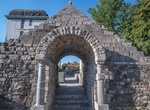
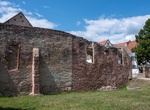
Remains of an ancient Roman stone wall & pyramid structure beside a small, quiet park. -
Visit Roșia Montană Mining Landscape, Romania (UNESCO Site)
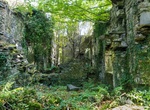
Located in the Metalliferous range of the Apuseni Mountains in the west of Romania, Roșia Montană features the most significant, extensive and technically diverse underground Roman gold mining complex known at the time of inscription. As Alburnus Maior, it was the site of extensive gold-mining during the Roman Empire. Over 166 years starting in 106 CE, the Romans extr... -
Visit San Michele Oratory, Padua, Italy (UNESCO Site)
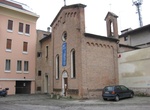
The San Michele Oratory or Oratory of San Michele (Italian -Oratorio di San Michele) is an oratory chapel in Padova, Italy. The interior is painted with a cycle of frescoes on the life of the Virgin Mary by Jacopo da Verona. It first arose near the Torlonga del Castello Carrarese, outside the ancient Roman walls of the city. It was built in 1397 over the ruins of the ... -
Visit Sannai-Maruyama Site, Aomori Prefecture, Japan (UNESCO Site)
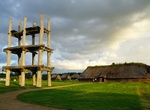
The Sannai-Maruyama Site (三内丸山遺跡,Sannai-Maruyama iseki) is an archaeological site and museum located in the Maruyama and Yasuta neighborhoods to the southwest of central Aomori in Aomori Prefecture in northern Japan, containing the ruins of a very large Jōmon period settlement. The ruins of a 40-hectare (400,000 m2; 99-acre) settlement were discovered in 1992, when Ao... -
Visit Scrovegni Chapel, Veneto, Italy (UNESCO Site)
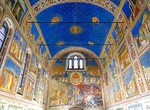
The Scrovegni Chapel (Italian:Cappella degli Scrovegni[kapˈpɛlla deʎʎi skroˈveɲɲi]), also known as the Arena Chapel, is a small church, adjacent to the Augustinian monastery, theMonastero degli Eremitaniin Padua, region of Veneto, Italy. The chapel and monastery are now part of the complex of the Museo Civico of Padua. The chapel contains a fresco cycle by Giotto, com... -
Visit Settlement and Artificial Mummification of the Chinchorro Culture in the Arica and Parinacota Region (UNESCO Site)
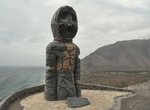
The property consists of three component parts: Faldeo Norte del Morro de Arica, Colón 10, both in the city of Arica, and Desembocadura de Camarones, in a rural environment some 100km further south. Together they bear testimony to a culture of marine hunter-gatherers who resided in the arid and hostile northern coast of the Atacama Desert in northernmost Chile ... -
Visit ShUM Sites of Speyer, Worms and Mainz, Germany (UNESCO Site)
Located in the former Imperial cathedral cities of Speyer, Worms and Mainz, in the Upper Rhine Valley, the serial site of Speyer, Worms and Mainz comprise the Speyer Jewry-Court, with the structures of the synagogue and women’s shul (Yiddish for synagogue), the archaeological vestiges of the yeshiva (religious school), the courtyard and the still intact undergro... -
Visit Sítio Roberto Burle Marx, Barra de Guaratiba, Rio de Janeiro (UNESCO Site)
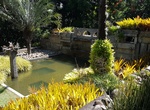
Situated west of Rio de Janeiro, the site embodies a successful project developed over more than 40 years by landscape architect and artist Roberto Burle Marx (1909-1994) to create a “living work of art” and a “landscape laboratory” using native plants and drawing on Modernist ideas. Began in 1949, the garden features the key characteristics th... -
Explore Slate industry in the Nantlle Valley, Wales (UNESCO Site)
The Slate Industry in the Nantlle Valley was the major industry of the area. The Nantlle Valley is the site of oldest slate quarry in Wales at Cilgwyn, and during the nineteenth and twentieth centuries it was a major centre of the Slate industry in Wales. The quarries of the area are being considered as a World Heritage site. The slate veins that cross the Nantlle Val... -
Visit Spa, Belgium (UNESCO Site)
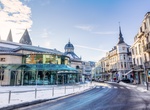
Spa (Walloon:Spå) is a Belgian town located in Liège Province, and the town where the term spa originates. The town of Spa is situated in a valley in the Ardennes mountains 35 kilometres (22 miles) southeast of the city of Liège and 45 kilometres (28 miles) southwest of Aachen. In 2006, Spa had a population of 10,543 and an area of 39.85 square kil...