Give us feedback!


 See all
Our philosophy is simple. We want to encourage you to dream. BIG! Then we help you plan your trip, get the most out of it while you're traveling and help you share your experience with friends.
Join Now It's FREE
Dream Packages
Duration: 12 hours
Price: $267.70
Price: $267.70
Duration: 4 days
Price: $1026.70
Price: $1026.70
Duration: 6 hours
Price: $182.94
Price: $182.94
Duration: 8 days
Price: $1251.74
Price: $1251.74
Dreams Still To Do
Checked-Off Dreams
Dreams Still To Do
Checked-Off Dreams
Advertisement
Explore Ancient Places & Ruins
-
Visit Hartashen Megalithic Avenue, Armenia
Hartashen Megalithic Avenue is a column of prehistoric megalithic rocks in Armenia. There are two columns of megalithic rocks which do not intersect and there is no road connection to this site. Armenian academics have proposed that the megalith formation was built around 7000-5000 BC. There are two rows of basalt stones which are placed at an angle, and in each row ... -
Visit Hatra, Iraq (UNESCO site)
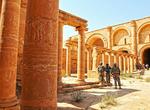
Hatra is an ancient city in the Ninawa Governorate and al-Jazira region of Iraq. It is currently known as al-Hadr, a name which appears once in ancient inscriptions, and it in the ancient Iranian province of Khvarvaran. The city lies 290 km (180 miles) northwest of Baghdad and 110 km (68 miles) southwest of Mosul. Hatra is the best preserved and most informative examp... -
Visit Hawara, Faiyum, Egypt
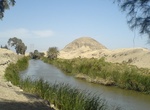
Hawara is an archaeological site of Ancient Egypt, south of the site of Crocodilopolis ('Arsinoë', also known as 'Medinet al-Faiyum') at the entrance to the depression of the Fayyum oasis. It is the site of a pyramid built by the Pharaoh Amenemhat III in the 19th century BC. Amenemhat III was the last powerful ruler of the 12th Dynasty, and the pyramid he built a... -
See Haytor Granite Tramway, Dartmoor, Devon
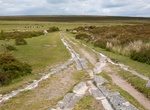
The Haytor Granite Tramway (also called Heytor) was a tramway built to convey granite from Haytor Down, Dartmoor, Devon to the Stover Canal. It was very unusual in that the track was formed of granite sections, shaped to guide the wheels of horse-drawn wagons. It was built in 1820; the granite was in demand in the developing cities of England as masonry to construct p... -
Visit Hazara Rama Temple, India (UNESCO site)
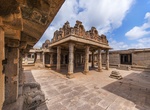
Hazara Rama Temple Complex is well known for elaborate frescoes from the Hindu religion and a sprawling courtyard well-laid with gardens. It is well known for more than many thousand carvings & inscriptions on & in the temple depicting the mighty story of Ramayana. It has about 1000 carvings & inscriptions depicting the story of Ramayana. Hampi is a villag... -
See Heart of Neolithic Orkney, Scotland (UNESCO site)
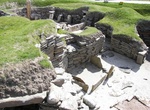
Heart of Neolithic Orkney refers to a group of Neolithic monuments found on the Mainland, one of the islands of Orkney, Scotland. The name was adopted by UNESCO when it proclaimed these sites as a World Heritage Site in 1999. The site of patrimony currently consists of four sites: Maeshowe - a unique chambered cairn and passage grave, aligned so that its central... -
Explore Hedeby, Germany (UNESCO Site)
Hedeby was an important Viking Age (8th to the 11th centuries) trading settlement near the southern end of the Jutland Peninsula, now in the Schleswig-Flensburg district of Schleswig-Holstein, Germany. It is the most important archaeological site in Schleswig-Holstein. The settlement developed as a trading centre at the head of a narrow, navigable inlet known as the S... -
Visit Heidelberg Castle, Germany
Heidelberg Castle (Schloß Heidelberg) is a famous ruin in Germany and landmark of Heidelberg. The castle ruins are among the most important Renaissance structures north of the Alps. The castle has only been partially rebuilt since its demolition in the 17th and 18th centuries. It is located 80 metres (260 ft) up the northern part of the Königstuhl hillside,... -
Visit Hemenway House Overlook, Mesa Verde National Park, Colorado
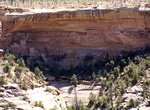
Hemenway House Overlook and Cliff Palace Loop Road are open 8 am to sunset from late spring to December 1, or until the first significant snowfall.Perched on a remote cliff in Soda Canyon, Hemenway House looks to fall off the small ledge on which it rests. Built in the 1200s, the cliff dwelling has 26 rooms and one kiva and was part of the larger Balcony House communi... -
Visit Hephaestia, Lemnos Island, Greece
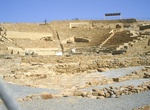
Hephaestia and Hephaistia (Ancient Greek: Ἡφαιστία), or Hephaestias or Hephaistias (Ἡφαιστίας), was a town of Ancient Greece, now an archeological site on the northern shore of Lemnos, Greek island in the northern Aegean Sea. It was named in the honor of Hephaistos, Greek god of metallurgy, whose cul... -
Visit Heraion of Argos, Argolid, Greece
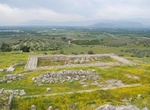
The Heraion of Argos is an ancient sanctuary in the Argolid, Greece, dedicated to Hera, whose epithet "Argive Hera" (Ἥρη Ἀργείη Here Argeie) appears in Homer's works. Hera herself claims to be the protector of Argos in Iliad IV, 50–52): "The three towns I love best are Argos, Sparta and Mycenae of the broad streets". The memory was ... -
Visit Heraion of Perachora, Greece
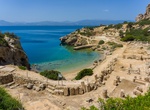
The Heraion of Perachora is a sanctuary of the goddess Hera situated in a small cove of the Corinthian gulf at the end of the Perachora peninsula. In addition to a temple of Hera of unusual construction and antiquity, the remains of a number of other structures have also been found, including an L-shaped stoa, a large cistern, dining rooms, and a second potential temp... -
Visit Heraion of Samos, Greece (UNESCO site)
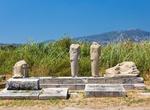
The Heraion of Samos was a large sanctuary to the goddess Hera, in the southern region of Samos, Greece, 6 km southwest of the ancient city, in a low, marshy river basin near the sea. The Late Archaic Heraion of Samos was the first of the gigantic free-standing Ionic temples, but its predecessors at this site reached back to the Geometric Period of the 8th century BC,... -
Visit Herod's Palace (Herodium), Israel
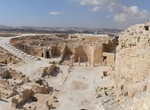
Herod the Great built a palace within the fortress of Herodium, about 12 kilometers south of Jerusalem. Herod himself commissioned a lavish palace to be built between 23 and 15 BCE atop Herodium for all to see. The palace itself consisted of four towers of seven stories, a bathhouse, courtyards, a Roman theatre, banquet rooms, a large walkway (“the course”... -
Visit Hierapolis, Turkey (UNESCO site)
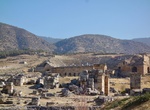
Hierapolis was the ancient Greco-Roman city on top of hot springs located in south western Turkey near Denizli. Hierapolis is a UNESCO World Heritage Site. The hot springs there have been used as a spa since the 2nd century BCE, and people came to soothe their ailments, with many of them retiring or dying here. The large necropolis is filled with sarcophagi, incl...


Price: $33.00