Give us feedback!


 See all

Our philosophy is simple. We want to encourage you to dream. BIG! Then we help you plan your trip, get the most out of it while you're traveling and help you share your experience with friends.
Join Now It's FREE
Dream Packages
Duration: 10 hours
Price: $128.95
Price: $128.95
Duration: 11 hours
Price: $208.42
Price: $208.42
Duration: 3 hours
Price: $157.00
Price: $157.00
Duration: 14 hours
Price: $341.00
Price: $341.00
Dreams Still To Do
Checked-Off Dreams
Dreams Still To Do
Checked-Off Dreams
Advertisement
Explore Ancient Places & Ruins
-
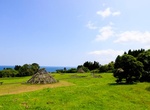
Visit Goshono Site, Ichinohe, Japan (UNESCO Site)
Goshono ruins (御所野遺跡,Goshono iseki) is a middle Jōmon period archaeological site in the town of Ichinohe, Iwate Prefecture, in the Tōhoku region of northern Japan. Discovered during the construction of an industrial park in 1989, the area was designated a National Historic Site in 1993 by the Japanese government. The Goshono ruins consist of a large scale residential ... -
Hike Government Trail, Cedar Mesa, Utah
The Quail rock art panel is a panel of Native American rock art located at the intersect of Grand Gulch and Step Canyon in Cedar Mesa, San Juan County, Utah. Grand Gulch contains a large number of relatively well-preserved rock art and ledge dwellings. The Quail Panel is a grouping of pictographs that were probably created by people of the Basketmaker II or Fremont cu... -
Visit Gradara Castle, Italy
The Gradara Castle is a medieval fortress that is located in the town of Gradara, Marche, in Italy. It is protected by two walls, the outermost of which extends for almost 800 meters, making it the imposing structure. Particularly striking is the view of the fortress and the underlying historical village at night. The castle is one of the most visited monuments in the... -
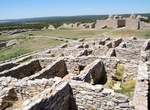
See Gran Quivira Ruins, New Mexico
The Gran Quivira Ruins are located about 25 miles south of Mountainair, at about 6500 feet (1981 m) above sea level. There is a small visitor center near the parking lot. A 0.5 mile (0.8 km) trail leads through partially excavated pueblo ruins and the ruins of the uncompleted mission church. "The Gran Quivira, as it has been called for over a hundred years, is by far... -
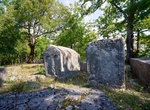
Visit Grčka Glavica Necropolis, Glavatičevo, Bosnia and Herzegovina
Grčka Glavica necropolis, in Biskupi hamlet of the Glavatičevo village, Municipality of Konjic, Bosnia and Herzegovina, is inscribed on the list of 28 medieval stećak necropolises that were declared a UNESCO World Heritage Site in 2016. The list includes 20 necropolises in Bosnia and Herzegovina, 3 in Serbia, 3 in Montenegro, and 2 in Croatia. The necropolis is also i... -
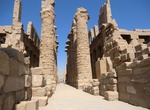
Visit Great Hypostyle Hall, Karnak Temple, Luxor, Egypt
The Great Hypostyle Hall is located within the Karnak temple complex, in the Precinct of Amon-Re. It is one of the most visited monuments of Ancient Egypt. The structure was built around the 19th Egyptian Dynasty (c. 1290–1224 BC). Its design was initially instituted by Hatshepsut, at the North-west chapel to Amun in the upper terrace of Deir el-Bahri. The name ... -
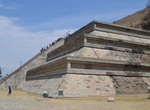
See Great Pyramid of Cholula, Mexico
The Great Pyramid of Cholula, also known as Tlachihualtepetl, is a huge complex located in Cholula, Puebla, Mexico. It is the largest archaeological site of a pyramid (temple) in the New World. The pyramid stands 55 metres (180 ft) above the surrounding plain, and in its final form it measured 400 by 400 metres (1,300 by 1,300 ft). The pyramid is a temple that has tra... -
See Great Pyramid of Giza, Egypt (UNESCO site)
The Great Pyramid of Giza[a] is the largest Egyptian pyramid. It served as the tomb of pharaoh Khufu, who ruled during the Fourth Dynasty of the Old Kingdom. Built c. 2600 BC, over a period of about 26 years, the pyramid is the oldest of the Seven Wonders of the Ancient World, and the only wonder that has remained largely intact. It is the most famous monument ... -
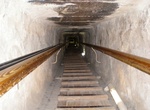
Go Inside Great Pyramid of Khufu, Egypt
The original entrance to the Great Pyramid is 17 metres (56 ft) vertically above ground level and 7.29 metres (23.9 ft) east of the centre line of the pyramid. From this original entrance, there is a Descending Passage 0.96 metres (3.1 ft) high and 1.04 metres (3.4 ft) wide, which goes down at an angle of 26° 31'23" through the masonry of the pyramid and then into... -
See Great Sphinx of Giza, Egypt
The Great Sphinx of Giza (English: The Terrifying One), commonly referred to as the Sphinx, is a limestone statue of a reclining or couchant sphinx (a mythical creature with a lion's body and a human head) that stands on the Giza Plateau on the west bank of the Nile in Giza, Egypt. It is the largest monolith statue in the world, standing 73.5 metres (241 ft) long, 19.... -
Walk on the Great Wall, China (UNESCO site)
The Great Wall, known to the Chinese as the “Long Wall of Ten Thousand Li”, is a magnificent defensive structure built to ward off invasions of the Celestial Empire by barbarians. The roots of the fortification’s construction stretch back nearly 3,000 years. Approximately 2,300 years ago the Emperor, Qin Shi Huang, instigated the linking and restorat... -
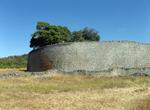
Visit Great Zimbabwe National Monument, Zimbabwe (UNESCO site)
Great Zimbabwe is a ruined city that was once the capital of the Kingdom of Zimbabwe, which existed from 1100 to 1450 AD during the country’s Late Iron Age. The monument, which first began to be constructed in the 11th century and which continued to be built until the 14th century, spanned an area of 722 hectares (1,784 acres) and at its peak could have housed u... -
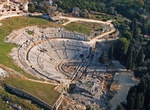
Visit Greek Theatre of Syracuse (Teatro Greco), Sicily (UNESCO site)
The Greek theatre of Syracuse lies on the south slopes of the Temenite hill, overlooking the modern city of Syracuse in southeastern Sicily. It was first built in the 5th century BC, rebuilt in the 3rd century BC and renovated again in the Roman period. Today, it is a part of the Unesco World Heritage Site of "Syracuse and the Rocky Necropolis of Pantalica". Despite i... -
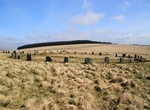
Hike to Grey Wethers Stone Circle, Dartmoor, England
Grey Wethers consists of a pair of prehistoric stone circles, situated on grassy plateau to the north of Postbridge, Dartmoor, in the United Kingdom. The circles are each approximately 33 m (108 ft) in diameter, and less than five metres apart. Their centre points are aligned almost exactly north to south. The northern circle has 20 stones remaining, while the souther... -
Visit Grimspound, Devon, England
Grimspound is a late Bronze Age settlement, situated on Dartmoor in Devon, England. It consists of a set of 24 hut circles surrounded by a low stone wall. The name was first recorded by the Reverend Richard Polwhele in 1797; it was probably derived from the Anglo-Saxon god of war, Grim (more commonly known as Woden, or Odin). In 1893 an archaeological dig was carried ...




Price: $869.00