Give us feedback!
Our philosophy is simple. We want to encourage you to dream. BIG! Then we help you plan your trip, get the most out of it while you're traveling and help you share your experience with friends.
Join Now It's FREE
Dreams Still To Do
Checked-Off Dreams
Dreams Still To Do
Checked-Off Dreams
Advertisement
Explore Landmarks (Natural)
-
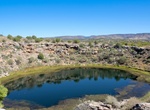
Visit Montezuma Well, Montezuma Castle National Monument, Arizona
Montezuma Well, a detached unit of Montezuma Castle National Monument, is a natural limestone sinkhole near Rimrock, Arizona through which some 1,400,000 US gallons (5,300,000 L) of water flow each day through two underground springs. It is located 11 miles (18 km) northeast of Montezuma Castle. The well measures in at 368 feet (112 m) across and 55 feet (17 m) deep. ... -
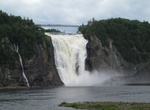
See Montmorency Falls (Chute Montmorency), Quebec, Canada
The Montmorency Falls (Chute Montmorency) are a large waterfall on the Montmorency River in Quebec, Canada. The falls are located on the boundary between the borough of Beauport, Quebec City, and Boischatel, about 12 km from the heart of old Quebec City. The area surrounding the falls is protected within the Montmorency Falls Park (French:Parc de la Chute-Montmorency)... -
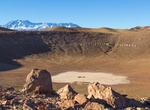
Explore Monturaqui Crater, Chile
Monturaqui is an impact crater in Chile. It lies south of the Salar de Atacama and was formed 663,000 ± 90,000 years ago by the impact of an IAB meteorite. It is 350 m × 370 m (1,150 ft × 1,210 ft) wide and 34 m (112 ft) deep and contains a salt pan. Only a few remnants of the meteorite that formed the crater have been collected, with most of the ro... -
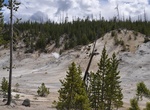
Hike to Monument Geyser Basin, Yellowstone National Park, Wyoming
The Monument Geyser Basin has no active geysers, but its 'monuments' are siliceous sinter deposits similar to the siliceous spires discovered on the floor of Yellowstone Lake. Scientists hypothesize that this basin's structures formed from a hot water system in a glacially dammed lake during the waning stages of the Pinedale Glaciation. The basin is on a ridge reached... -
See Monument Rocks (Chalk Pyramids), Kansas
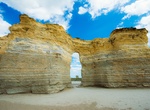
Monument Rocks (also Chalk Pyramids) are a series of large chalk formations in Gove County, Kansas, rich in fossils. The formations were the first landmark in Kansas chosen by the US Department of the Interior as a National Natural Landmark. The chalk formations reach a height of up to 70 ft (21 m) and include formations such as buttes and arches. The carbon... -
See Mooney Falls, Arizona
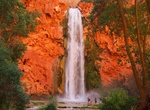
Mooney Falls is the fourth main waterfall in the canyon. It is named after D. W. "James" Mooney, a miner, who in 1882 – according to his companions – decided to mine the area near Havasu Falls for minerals. The group then decided to try Mooney Falls. One of his companions was injured, so James Mooney decided to try to climb up the falls with his companion ... -
See Moon Hill, China
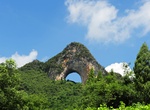
Moon Hill is a hill with a natural arch through it a few kilometers outside Yangshuo in southern China's Guangxi autonomous region. It is so named for a wide, semicircular hole through the hill, all that remains of what was once a limestone cave formed in the phreatic zone. Like most formations in the region, it is karst. It is also a popular tourist attraction. It ta... -
Rock Climb Moon Hill, China
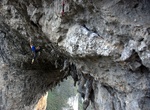
Rock Climb the Moon Hill arch in Yangshuo, China. The Moon Hill is located to the south of Yangshuo across the Jingbao river along China National Highway 321. It has an elevation of 380 m (1,250 ft), while the hill is 230 m (750 ft) in relative height and 410 m (1,350 ft) in length. The arch is about 50 meters in height. -
Visit Moon Landscape (Moon Valley), Namibia
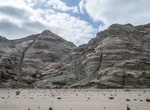
The Moon Landscape is a set of eroded hills and valleys carved by the Swakop River. -
Explore Moon Valley, Saudi Arabia
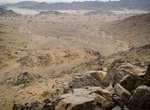
Hike around Moon Valley, Saudi Arabia. -
See Moqui Marbles in Utah
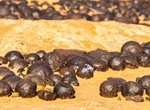
The Navajo Sandstone is a geological formation in the Glen Canyon Group that is spread across the U.S. states of southern Nevada, northern Arizona, northwest Colorado, and Utah as part of the Colorado Plateau province of the United States. The Navajo Sandstone is particularly prominent in southern Utah, where it forms the main attractions of a number of national parks... -
Explore Morasko Meteorite Nature Reserve, Poznań, Poland
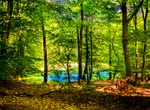
The Morasko meteorite nature reserve (Polish:Rezerwat przyrody meteoryt Morasko) is located in Morasko, on the northern edge of the city of Poznań, Poland. It contains seven meteor craters. The reserve has an area of 55 hectares (136 acres) and was established in 1976. The land of the reserve is covered by a forest of oak and hornbeam trees, among which grow a number ... -
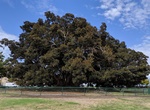
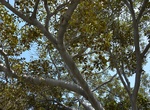
See Moreton Bay Fig Tree (Balboa Park), San Diego, California
The remarkable large tree to the north of the museum is a Moreton Bay Fig tree, which—like most of the other large trees in the Prado area of Balboa Park—was planted in preparation for the 1915 exposition. The 1914 planting list for the exposition shows a five-gallon fig tree planted at this location. Since it was a few years old at the time it was planted... -
See Moreton Bay Fig Tree (Heritage Tree #5), Coronado, California
Moreton Bay Fig (Serial 005) located adjacent to Star Park at 1121 Flora Avenue was designated a Heritage Tree on December 7, 2011. Ficus Macrophylla, native to northeastern Australia, has heavy buttressing trunks that spread to support a massive crown that can grow to more than 100 feet in diameter. -
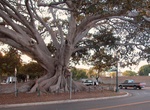
See Moreton Bay Fig Tree (Santa Barbara), California
An iconic photo op, this 1876 fig tree is one of the country's largest, spanning more than 170 feet.