Give us feedback!


 See all
Our philosophy is simple. We want to encourage you to dream. BIG! Then we help you plan your trip, get the most out of it while you're traveling and help you share your experience with friends.
Join Now It's FREE
Dream Packages
Duration: 5 days
Price: $726.42
Price: $726.42
Duration: 3 hours
Price: $118.81
Price: $118.81
Duration: 10 hours 30 minutes
Price: $207.02
Price: $207.02
Duration: 9 hours
Price: $135.68
Price: $135.68
Dreams Still To Do
Checked-Off Dreams
Dreams Still To Do
Checked-Off Dreams
Advertisement
Explore Man-Made Sites
-
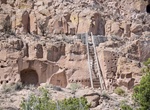
Tour Puye Cliff Dwellings, New Mexico
The Puye Cliff Dwellings are the ruins of an abandoned pueblo, located in Santa Clara Canyon on Santa Clara Pueblo Reservation land near Española, New Mexico. Established in the late 1200s or early 1300s and abandoned by about 1600, this is among the largest of the prehistoric Indian settlements on the Pajarito Plateau, showing a variety of architectural forms ... -
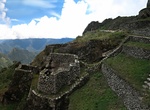
See Puyupatamarca, Peru
Puyupatamarca or Phuyupatamarca is an archaeological site along the Inca Trail in the Urubamba Valley of Peru. Due to its altitude of roughly 3200 metres, it is known as "La Ciudad entre la Niebla" ("The City Above the Clouds"). It contains Inca ruins, with five small stone baths which during the wet season contain constant fresh running water. -
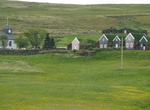
See Pverá Turf House, Laxárdalur, Iceland
Þverá in Laxárdalur is a turf farm, consisting of a dwelling house and outbuildings. The farm is situated in the Laxárdalur valley in Northern Iceland, by the Laxá salmon fishing river and on the edge of the lava fields of Aðaldalshraun. The farmstead is still inhabited and was modernized in the 1960´s with new dwelling hous... -
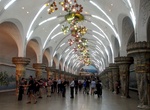
Ride Pyongyang Metro, Pyongyang, North Korea
The Pyongyang Metro (Korean: 평양 지하철도) is the rapid transit system in Pyongyang, the capital and largest city of North Korea. It consists of two lines: the Chollima Line, which runs north from Puhŭng Station on the banks of the Taedong River to Pulgŭnbyŏl Station, and the Hyŏksin Line, which runs from Kwangbok Station in the southwest to Ragwŏn Station in the northeast... -
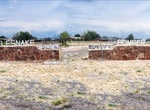
Visit Pyote Air Force Base (Rattlesnake Bomber Base), Pyote, Texas
Pyote Air Force Base was a World War II United States Army Air Forces training airbase. It was on 2,745 acres (1,111 ha) a mile from the town of Pyote, Texas, on U.S. Highway 80, 20 miles west of Monahans, 230 miles (370 km) east of El Paso. Tribute to the first squadrons who trained at Rattlesnake Bomber Base Texas Historical Marker It was nicknamed "Rattle... -
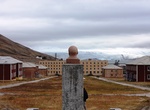
Visit Pyramiden, Russia
Pyramiden is an abandoned Russian settlement and coal-mining community on the archipelago of Svalbard, Norway. Founded by Sweden in 1910 and sold to the Soviet Union in 1927, Pyramiden was closed in 1998 and has since remained largely abandoned with most of its infrastructure and buildings still in place. Since 2007 there have been efforts to make it a tourist attract... -
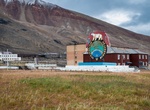
Visit Pyramiden, Svalbard, Norway
Pyramiden is a Russian settlement and coal-mining community on the archipelago of Svalbard, Norway. Founded by Sweden in 1910 and sold to the Soviet Union in 1927, Pyramiden was closed in 1998 and has since remained largely abandoned with most of its infrastructure and buildings still in place. Since 2007 there have been efforts to make it a tourist attraction. Pyrami... -
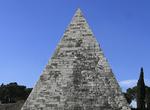
See Pyramid of Cestius, Rome, Italy
The Pyramid of Cestius (Piramide di Caio Cestio or Piramide Cestia) is an ancient pyramid in Rome, Italy, near the Porta San Paolo and the Protestant Cemetery. It stands in a fork between two ancient roads, the Via Ostiensis and another road that ran west to the Tiber along the approximate line of the modern Via della Marmorata. Due to its incorporation into the city'... -
Visit Pyramid of Djedefre, Kerdasa, Egypt
The pyramid of Djedefre consists today mostly of ruins located at Abu Rawash in Egypt. It is Egypt's northernmost pyramid and is believed to have been built by Djedefre, son and successor to king Khufu. Excavation report on the pyramid complex was published in 2011. Though some Egyptologists in the last few decades have suggested otherwise, recent excavations at Abu R... -
See Pyramid of Djedkare Isesi, Pyramids of Saqqara
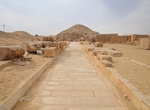
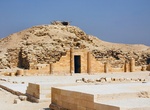
The pyramid of Djedkare Isesi (in ancient EgyptianNfr Ḏd-kꜣ-rꜥ("Beautiful is Djedkare")) is a late 25th to mid 24th century BC pyramid complex built for the Fifth Dynasty pharaoh Djedkare Isesi.[a] The pyramid is referred to asHaram el-Shawaf(Arabic: هَرَم ٱلشَّوَّاف, romanized: Haram ash-Shawwāf, lit. 'The Sentinel Pyramid') by locals. It was the first pyramid... -
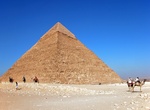
See Pyramid of Khafre, Egypt
The Pyramid of Khafre or of Chephren is the second-tallest and second-largest of the Ancient Egyptian Pyramids of Giza and the tomb of the Fourth-Dynasty pharaoh Khafre (Chefren), who ruled from c. 2558 to 2532 BC. The pyramid has a base length of 215.5 m (706 ft) and rises up to a height of 136.4 metres (448 ft) The pyramid is made of limestone blocks weighing... -
See Pyramid of Khentkaus I, Giza, Egypt
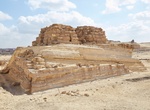
The pyramid of Khentkaus I or step tomb of Khentkaus I is a Fourth Dynasty two-stepped tomb built for the Queen Mother Khentkaus I in Giza. The tomb, built in two phases coinciding with its two steps, was originally known as the fourth pyramid of Giza. In the first phase, a nearly square block of bedrock, around which the stone had been quarried for the Giza pyramids,... -
See Pyramid of Menkaure, Egypt
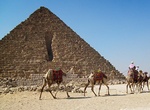
The Pyramid of Menkaure, located on the Giza Plateau in the southwestern outskirts of Cairo, Egypt, is the smallest of the three main Pyramids of Giza. It is thought to have been built to serve as the tomb of the fourth dynasty Egyptian Pharaoh Menkaure. Menkaure's pyramid had an original height of 65.5 metres (215 feet) and was the smallest of the three major pyramid... -
See Pyramid of Merenre, Saqqara (Sakkara)
The pyramid of Pharaoh Merenre was constructed for Merenre Nemtyemsaf I during the Sixth Dynasty of Egypt at Saqqara 450 metres (1,480 ft) to the south-west of the pyramid of Pepi I and a similar distance to the pyramid of Djedkare. Its ancient name was "Merenre's beauty shines" or perhaps "The Perfection of Merenre Appears". Today it consists mostly of ruins; it is h... -
Visit Pyramid of Pepi I, Saqqara, Egypt
The pyramid of Pepi I (in ancient Egyptian Men-nefer-Pepi meaning Pepi's splendour is enduring) is the pyramid complex built for the Egyptian pharaoh Pepi I of the Sixth Dynasty in the 24th or 23rd century BC.[a] The complex gave its name to the capital city of Egypt, Memphis. As in the pyramids of his predecessors, Pepi I's substructure was filled with vertical colum...
Price: $208.42