Give us feedback!


 See all
Our philosophy is simple. We want to encourage you to dream. BIG! Then we help you plan your trip, get the most out of it while you're traveling and help you share your experience with friends.
Join Now It's FREE
Dream Packages
Duration: 2 days
Price: $398.24
Price: $398.24
Duration: 11 hours
Price: $110.50
Price: $110.50
Duration: 10 hours 30 minutes
Price: $207.02
Price: $207.02
Duration: 11 hours
Price: $208.42
Price: $208.42
Dreams Still To Do
Checked-Off Dreams
Dreams Still To Do
Checked-Off Dreams
Advertisement
Explore Man-Made Sites
-
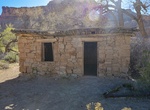
Visit Stone Cabin, Spring Valley State Park, Nevada
Stone Cabin was originally built in the 1870s by George Moody using blocks of the surrounding volcanic tuff rocks. It is now fully restored. If you see the "closed" sign out front? The Cabin may be closed, but the hiking trail behind it is always open. Want to visit the cabin when it's not open? Talk to any Park staff member and they will be happy to open it up for y... -
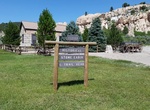
Visit Stone Cabin Day Use, Utah
Stone Cabin is a historical cabin located along the Green River Daily. This site offers a metal fire ring and picnic table under cottonwood trees -
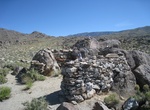
Off-road to Stone Cabin Ruins, Ownes Valley, California
Remains of a stone cabin. The roof is long gone but the stonework endures. -
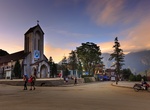
Visit Stone Church, Sapa, Viet Nam
The Stone Church has been built by French in early 20th century. The terrain was carefully selected and the church is based on a cross shape. There are many local activities on Saturdays. -
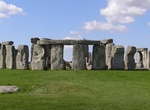
Visit Stonehenge, England (UNESCO site)
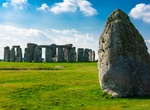
Stonehenge is a prehistoric monument located in England and is one of the most famous sites in the world. Stonehenge is composed of earthworks surrounding a circular setting of large standing stones. It is at the centre of the most dense complex of Neolithic and Bronze Age monuments in England, including several hundred burial mounds. It's located in the county of Wil... -
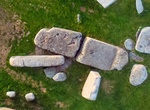
See Stonehenge Altar Stone, England
The Altar Stone is a recumbent central megalith at Stonehenge in England, dating to Stonehenge phase 3i, around 2600 BCE. It is identified as Stone 80 in scholarly articles. Its name probably comes from a comment by Inigo Jones who wrote: ‘... whether it might be an Altar or no I leave to the judgment of others’. The Altar Stone is made of a purplish-green... -
Visit Stonehenge Aotearoa, Wairarapa, New Zealand
Stonehenge Aotearoa, is a practical, open-sky observatory inspired by and built on a similar scale to the famous Stonehenge in England. The henge is a modern adaptation, inspired by the many stone circles and henges scattered around the world. Stonehenge Aotearoa is designed specifically for its location in Wairarapa region of New Zealand's North Island. Astronomer Ri... -
See Stonehenge Cursus, Stonehenge, England
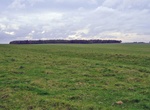
The Stonehenge Cursus (sometimes known as the Greater Cursus) is a large Neolithic cursus monument on Salisbury plain, near to Stonehenge in Wiltshire, England. It is roughly 3 kilometres (1.9 mi) long and between 100 metres (330 ft) and 150 metres (490 ft) wide. Excavations in 2007 dated the construction of the earthwork to between 3630 and 3375 BCE, ... -
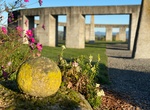
Visit Stonehenge Replica, Makomanai Takino Cemetery, Sapporo, Hokkaido, Japan
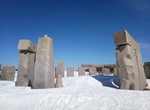
Makomanai Takino Cemetery, located on the outskirts of Sapporo City, is a large park with a Stonehenge replica along with other large statues. -
See Stonehenge Station Stones, England
The Station Stones are elements of the prehistoric monument of Stonehenge. Originally there were four stones, resembling the four corners of a rectangle that straddles the inner sarsen circle, set just inside Stonehenge's surrounding bank. Two stood on earth mounds at opposing corners, one corner broadly in the north of the site and one in the south. The mounds are ca... -
Visit Stone House (Erfurt), Erfurt, Germany
The Stone House, which was built around 1200 and redesigned around 1250, is a unique example of a medieval secular building under Jewish ownership with its Gothic structural forms and its painted wooden ceiling on the first floor. It inscribed on the UNESCO World Heritage List on 17 September, 2023 during the 45th session of the World Heritage Committee in Riyadh, Ki... -
See Stone Labyrinths of Bolshoi Zayatsky Island, Russia
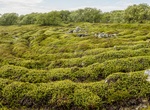
The stone labyrinths of Bolshoi Zayatsky Island are a group of 13 or 14 labyrinths on Bolshoi Zayatsky Island, one of the Solovetsky Islands in Arkhangelsk Oblast, Russia. As well as 13 or 14 labyrinths, there are more than 850 heaps of boulders on Bolshoi Zayatsky Island, plus numerous other stone settings such as a stone symbol with radial spokes, possibly represent... -
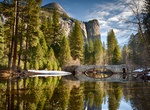
Walk across Stoneman Bridge, Yosemite Valley
The Stoneman Bridge (1933) resembles the Clark and Happy Isles bridges, with a 72-foot (22 m) main span carrying a 27-foot (8.2 m) road and two 6-foot (1.8 m) sidewalks. The equestrian subways in the abutments were slightly enlarged in width to 8.5 feet (2.6 m) and were extended out from the surface of the wing walls for greater emphasis. It is located at the Camp Cur... -
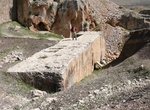
See Stone of the South (Second Monolith), Baalbek (Heliopolis), Lebanon
The Stone of the South, also called the Second Monolith, was rediscovered in the same quarry in the 1990s. With its weight estimated at 1,242 t, it surpasses even the dimension of the Stone of the Pregnant Woman. (There is some confusion over the naming, due to its location having been forgotten, and accordingly some sources identify "Stone of the South" as an alterna... -
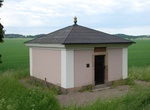
See Stones of Mora, Knivsta, Sweden
The Stones of Mora (Swedish: Mora stenar) is a historic location in Knivsta, Sweden. Several Medieval kings of Sweden were proclaimed at the assembly of Mora near modern Uppsala. It was moved in the 15th century and was considered to have been lost. However, there are a number of stones of record in a small building in the vicinity of the former assembly site. The Sto...

Price: $918.22