Give us feedback!


 See all
Our philosophy is simple. We want to encourage you to dream. BIG! Then we help you plan your trip, get the most out of it while you're traveling and help you share your experience with friends.
Join Now It's FREE
Dream Packages
Duration: 4 days
Price: $663.61
Price: $663.61
Duration: 4 days
Price: $785.33
Price: $785.33
Duration: 11 hours
Price: $208.42
Price: $208.42
Duration: 2 days
Price: $398.24
Price: $398.24
Dreams Still To Do
Checked-Off Dreams
Dreams Still To Do
Checked-Off Dreams
Advertisement
Explore Man-Made Sites
-
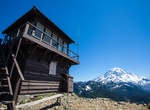
Hike to Tolmie Peak Fire Lookout, Mount Rainier National Park
The Tolmie Peak Fire Lookout is one of four fire lookout stations built in Mount Rainier National Park by the National Park Service (NPS) between 1932 and 1934. The two-story structure houses a lookout station on the upper level and storage at ground level. The design was prepared under the supervision of Edwin A. Nickel of the NPS Branch of Plans and Designs. The new... -
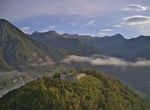
Visit Tolmin Castle, Tolmin, Slovenia
Tolmin Castle, also known as the Castle on Kozlov Rob above Tolmin (Grad na Kozlovem Robu nad Tolminom), is a fortress ruin on the ridge of Kozlov Rob ('Billy-goat's Edge') above the town of Tolmin in southwestern Slovenia. The castle was first mentioned in 1188, and its chapel of Saint Martin in 1194. The east and north towers appear to have formed the original core ... -
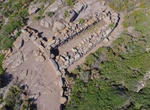
Visit Tomba Dei Giganti su Niu 'e su Crobu, Sant'Antioco Island, Sardinia, Italy
The giants' tomb of Su Niu 'e Su Crobu (the crow's nest) is an archaeological site located in the municipality of Sant'Antioco. The monument is located on an elevated rocky plain in the southern part of the Sulcis island, not far from the sea and the important Nuragic complex of Grutti 'e Acqua. The tomb of the giants , dating back ... -
Visit Tomba Punica Punta delle Oche, San Pietro Island, Sardinia, Italy
Tomba Punica Punta delle Oche is an old archaeological site on San Pietro Island, Sardinia, Italy. -
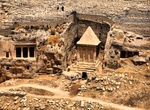
See Tomb of Absalom, Jerusalem
Tomb of Absalom, also called Absalom's Pillar, is an ancient monumental rock-cut tomb with a conical roof located in the Kidron Valley in Jerusalem. Although traditionally ascribed to Absalom, the rebellious son of King David of Israel (circa 1000 BC), recent scholarship has attributed it to the 1st century AD. Absalom's Pillar is approximately 47 feet in height. The ... -
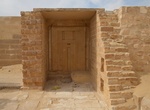
See Tomb of Akhethetep, Saqqara (Sakkara)
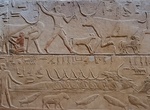
The Tomb of Akhethetep, also known as Mastaba of Akhethetep (French:Mastaba d'Akhethétep), is a tomb complex in Saqqarah, Egypt. It was built for Akhethetep, a royal official, near the western part of the Pyramid of Djoser. Akhethetep was an official with several, mainly religious titles. includingpriest of Heka,priest of Khnumandpriest of Horus. The tomb's dec... -
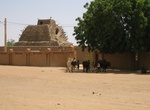
See Tomb of Askia, Mali (UNESCO site)
The Tomb of Askia, in Gao, Mali, is believed to be the burial place of Askia Mohammad I, one of the Songhai Empire's most prolific emperors. It was built at the end of the fifteenth century and is designated as a UNESCO World Heritage Site. UNESCO describes the tomb as a fine example of the monumental mud-building traditions of the West African Sahel. The complex incl... -
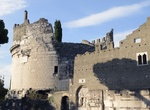
Visit Tomb of Caecilia Metella, Via Appia, Rome, Italy
The Tomb of Caecilia Metella (Italian: Mausoleo di Cecilia Metella) is a mausoleum located just outside Rome at the three mile marker of the Via Appia. It was built during the 1st century BC to honor Caecilia Metella, who was the daughter of Quintus Caecilius Metellus Creticus, a consul in 69 BC, and the wife of Marcus Licinius Crassus who served under Julius Caesar a... -
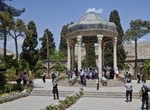
Visit Tomb of Hafez, Shiraz, Iran
The Tomb of Hafez and its associated memorial hall, the Hāfezieh, are two memorial structures erected in the northern edge of Shiraz, Iran, in memory of the celebrated Persian poet Hafez. The open pavilion structures are situated in the Musalla Gardens on the north bank of a seasonal river and house the marble tomb of Hafez. The present buildings, built in 1935 and de... -
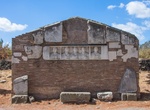
See Tomb of Hilarus Fuscus, Rome, Italy
The Tomb of Hilarus Fuscus(Latin: Hilarus Fuscus or Hilarius Fuscus) is a funerary monument located near the fourth mile of the Appian Way or Via Appia Antica, to the southeast of Rome. The tomb was restored by Luigi Canina in the mid-1800s. An inscription bearing the names of those represented on the masonry disappeared in the period between 1978 and 1998. The sculpt... -
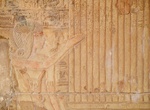
See Tomb of Horemheb in Saqqara, Egypt
The Memphite Tomb of Horemheb is located in the Saqqara necropolis, near Memphis, Egypt. It was constructed before Horemheb ascended to the throne and was never used for his burial, since he later built the Theban tomb KV57 for this purpose. His two wives Mutnedjmet and Amenia were buried within the structure. The tomb was discovered by art robbers at the beginning of... -
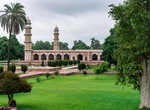
See Tomb of Jahangir, Lahore, Punjab, Pakistan
The Tomb of Jahangir (Urdu: مقبرہُ جہانگیر) is a 17th-century mausoleum built for the Mughal Emperor Jahangir. The mausoleum dates from 1637, and is located in Shahdara Bagh in Lahore, Punjab, Pakistan, along the banks of the Ravi River. The site is famous for its interiors that are extensively embellished with frescoes and marble, and its exterior that is richly... -
Visit Tomb of Kagemni, Saqqara, Egypt
The tomb of Kagemni is the largest mastaba in the cemetery associated with the reign of the Sixth Dynasty king Teti (ca. 2323-2150 BCE). Kagemni was a Vizier, the highest position in the royal administration. -
See Tomb of Khải Định, Hue, Viet Nam
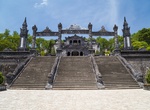
The Tomb of Khải Định is located in Chau Chu mountain near Huế in Vietnam. It was built for Khải Định, the twelfth Emperor of the Nguyễn dynasty. It was built from 1920 to 1931 taking 11 years to complete. The tomb is a blend of Western and Eastern architecture. It is located on a steep hill outside of the capital city of Huế. -
Visit Tomb of King Kongmin, Kaesong, North Korea (UNESCO Site)
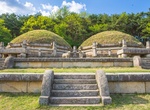
The Tomb of King Kongmin, more correctly known as the Hyonjongrung Royal Tomb, is a 14th-century mausoleum located in Haeson-ri, Kaepung County just outside of the city of Kaesong, North Korea. It is one of the Royal Tombs of the Koryo Dynasty. The site consists of two separate burial mounds, Hyonrung, which contain the remains of Kongmin, 31st king of the Koryo ...

Price: $88.47