Give us feedback!
Our philosophy is simple. We want to encourage you to dream. BIG! Then we help you plan your trip, get the most out of it while you're traveling and help you share your experience with friends.
Join Now It's FREE
Related Categories
Dreams Still To Do
Checked-Off Dreams
Dreams Still To Do
Checked-Off Dreams
Advertisement
Explore UNESCO Sites
-
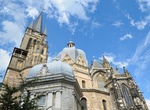
See Aachen Cathedral, Germany (UNESCO site)
Aachen Cathedral, frequently referred to as the "Imperial Cathedral" is a Roman Catholic church in Aachen, Germany. The church is the oldest cathedral in northern Europe and was known as the "Royal Church of St. Mary at Aachen" during the Middle Ages. For 600 years, from 936 to 1531, the Aachen chapel was the church of coronation for 30 German kings and 12 queens... -
See Aapravasi Ghat, Mauritius (UNESCO site)
The Immigration Depot (Aapravasi Ghat) is a building complex located in Port Louis, on the Indian Ocean island of Mauritius, which was the first British colony to receive indentured, or contracted, labor workforce from India. From 1849 to 1923, half a million Indian indentured labourers passed through the Immigration Depot, to be eventually transported to plantations ... -
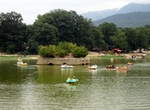
Visit Abbasabad Garden, Iran (UNESCO Site)
Abbasabad (Abbas Abad) Garden is located outside of Behshahr, Mazandaran, Iran. It is an UNESCO site as part of the Persian Gardens site. -
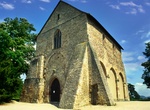
See Abbey and Altenmünster of Lorsch, Germany (UNESCO site)
The Abbey of Lorsch is a former Imperial Abbey in Lorsch, Germany, about 10 km east of Worms, one of the most renowned monasteries of the Carolingian Empire. Even in its ruined state, its remains are among the most important pre-Romanesque–Carolingian style buildings in Germany. Its chronicle, entered in the Lorscher Codex compiled in the 1170s (now in the ... -
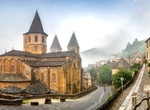
Visit Abbey Church of Saint Foy, Conques, France (UNESCO site)
The Abbey Church of Saint Foy St. in Conques, France, was a popular stop for pilgrims traveling the Way of St. James to Santiago de Compostela, in what is now Spain. The main draw for medieval pilgrims at Conques were the remains of St. Foy, a young woman martyred during the fourth century. The relics of St. Foy arrived in Conques through theft in 866. After unsuccess... -
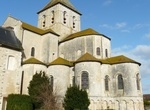
See Abbey Church of Saint-Savin sur Gartempe, France (UNESCO site)
The Abbey Church of Saint-Savin-sur-Gartempe is located in Saint-Savin-sur-Gartempe, in Poitou, France. The Romanesque church was begun in the mid 11th century and contains many beautiful 11th- and 12th-century murals which are still in a remarkable state of preservation. It has been a UNESCO World Heritage Site since 1983. The cruciform church carries a square t... -
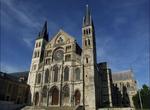
See Abbey of Saint-Remi, Reims, France (UNESCO site)
The Abbey of Saint-Remi is an abbey in Reims, France, founded in the sixth century. Since 1099 it has conserved the relics of Saint Remi (died 553), the Bishop of Reims who converted Clovis, King of the Franks, to Christianity at Christmas in AD 496, after he defeated the Alamanni in the Battle of Tolbiac. The present basilica was the abbey church; it was consecrated ... -
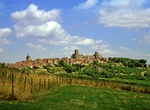
See Abbey of Vézelay, France (UNESCO site)
Vézelay Abbey (now known as Basilique Sainte-Marie-Madeleine) was a Benedictine and Cluniac monastery in Vézelay in the Yonne département in Burgundy, France. The Benedictine abbey church of Ste-Marie-Madeleine (or Basilica of St. Mary Magdalene), with its complicated program of imagery in sculpted capitals and portals, is one of the outstanding m... -
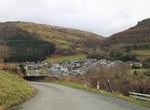
Visit Abergynolwyn, Gwynedd, Wales (UNESCO Site)
Abergynolwyn (English: Mouth of the River with a Whirlpool) is a village in southern Gwynedd, Wales, located at the confluence of the Nant Gwernol and the Afon Dysynni. The population of the community which is named after the village of Llanfihangel-y-Pennant was 339 at the 2011 census. Historically, the village was part of Merionethshire and its main industry was sla... -
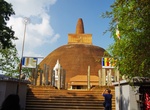
Visit Abhayagiri Vihāra, Anuradhapura, Sri Lanka
Abhayagiri Vihāra was a major monastery site of Mahayana, Theravada and Vajrayana Buddhism that was situated in Anuradhapura, Sri Lanka. It is one of the most extensive ruins in the world and one of the most sacred Buddhist pilgrimage cities in the nation. Historically it was a great monastic centre as well as a royal capital, with magnificent monasteries rising to ma... -
See Abri de Cro-Magnon Cave, Vézère Valley, France (UNESCO site)
The Cro-Magnon were the first early modern humans (early Homo sapiens sapiens) of the European Upper Paleolithic. The earliest known remains of Cro-Magnon-like humans are radiometrically dated to 35,000 years before present. The name derives from the Abri de Cro-Magnon (French: rock shelter of Cro-Magnon, the big cave in Occitan) near the commune of Les Eyzies-de-Taya... -
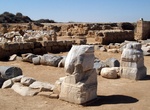
See Abu Mena, Egypt (UNESCO site)
Abu Mena was a town, monastery complex and Christian pilgrimage center in Late Antique Egypt, about 45 km southwest of Alexandria. Its remains were designated a World Heritage Site in 1979. There are very few standing remains, but the foundations of most major buildings, such as the great basilica, are easily discernible. Recent agricultural efforts in the area have l... -
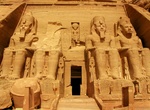
See Abu Simbel Temple, Egypt (UNESCO site)
Abu Simbel temples refers to two massive rock temples in Abu Simbel in Nubia, southern Egypt on the western bank of Lake Nasser about 230 km southwest of Aswan (about 300 km by road). The complex is part of the UNESCO World Heritage Site known as the "Nubian Monuments," which run from Abu Simbel downriver to Philae (near Aswan). The twin temples were originally c... -
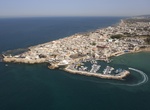
Visit Acre (Akko), Israel (UNESCO site)
Acre (Akko) is a city in the Western Galilee region of northern Israel at the northern extremity of Haifa Bay. Acre is one of the oldest continuously inhabited sites in the country. Historically, it was a strategic coastal link to the Levant. Acre is the holiest city of the Bahá'í Faith. Acre is a mixed city, 72 percent Jewish and 28 percent Arab. Acre's... -
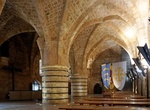
Visit Acre Hospitaller Refectory, Acre (Akko), Israel
Under the citadel and prison of Acre, archaeological excavations revealed a complex of halls, which was built and used by the Knights Hospitaller. This complex was a part of the Hospitallers' citadel, which was included in the northern defences of Acre. The complex includes six semi-joined halls, one recently excavated large hall, a dungeon, a refectory (dining room) ...