Give us feedback!
Our philosophy is simple. We want to encourage you to dream. BIG! Then we help you plan your trip, get the most out of it while you're traveling and help you share your experience with friends.
Join Now It's FREE
Related Categories
Dreams Still To Do
Checked-Off Dreams
Dreams Still To Do
Checked-Off Dreams
Advertisement
Explore UNESCO Sites
-
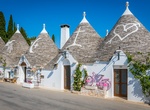
Visit Alberobello, Italy (UNESCO site)
Alberobello is a small town in Puglia, Italy and is famous for its fairy tale like 14th century Trulli huts, a remarkable examples of drywall (mortarless) construction. The trullo is a fascinating architectural feature of this area of Puglia, a building with conical roof made without mortar. It is one of the best preserved and most homogeneous urban areas of this type... -
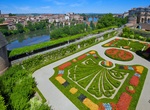
Visit Albi, France (UNESCO site)
Albi is a commune in southern France. It is the prefecture of the Tarn department. It is located on the River Tarn, c. 85 km northeast of Toulouse. Its inhabitants are called Albigensians (French: Albigeois, Albigeoise(s), Occitan: albigés -esa(s)). It was the seat of the Archbishop of Albi and is the seat of the Diocese of Albi. The episcopal city, situat... -
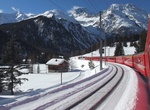
Ride Albula Railway, Switzerland
The Albula Railway is a single track metre gauge railway line forming part of the so-called core network of the Rhaetian Railway (RhB), in the Canton of Graubünden, Switzerland. It links Thusis on the Hinterrhein (697 m (2,287 ft) above sea level) with the spa resort of St. Moritz in Engadine (1,774 m (5,820 ft) above sea level). Construction of the Albula Railwa... -
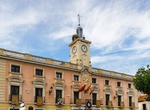
Visit Alcalá de Henares, Spain (UNESCO site)
Alcalá de Henares, meaning Citadel on the river Henares, is a Spanish city, whose historical centre is one of UNESCO's World Heritage Sites, and one of the first bishoprics founded in Spain. Located in the Autonomous Community of Madrid, 35 km northeast of the city of Madrid, at an altitude of 588 metres (1929 ft) above sea level, it has a population of around ... -
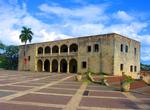
Visit Alcázar de Colón, Santo Domingo, Dominican Republic (UNESCO site)
The Alcázar de Colón, or Columbus Alcazar, located in Santo Domingo, Dominican Republic, is the oldest Viceregal residence in America, and forms part of the Colonial Zone of Santo Domingo World Heritage Site. The building houses the Museo Alcázar de Diego Colón, whose collection exhibits the Caribbean's most important ensemble of European l... -
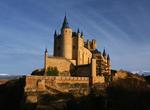
Visit Alcázar of Segovia, Spain (UNESCO site)
The Alcázar of Segovia (Segovia Castle) is a stone fortification, located in the old city of Segovia, Spain. Rising out on a rocky crag above the confluence of the rivers Eresma and Clamores near the Guadarrama mountains, it is one of the most distinctive castle-palaces in Spain by virtue of its shape – like the bow of a ship. The Alcázar was origi... -
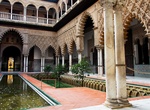
See Alcázar of Seville, Spain (UNESCO site)
The Alcázar of Seville (Spanish "Reales Alcázares de Sevilla" or "Royal Alcazars of Seville") is a royal palace in Seville, Spain, originally a Moorish fort. The Almohades were the first to build a palace, which was called Al-Muwarak, on the site of the modern day Alcázar. The palace is one of the best remaining examples of mudéjar architec... -
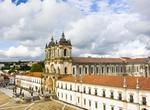
See Alcobaça Monastery, Portugal (UNESCO site)
The Alcobaça Monastery is a Mediaeval Roman Catholic Monastery located in the town of Alcobaça, in central Portugal. It was founded by the first Portuguese King, Afonso Henriques, in 1153, and maintained a close association with the Kings of Portugal throughout its history. The church and monastery were the first Gothic buildings in Portugal, and, togeth... -
Visit Aldabra Atoll, Seychelles (UNESCO site)
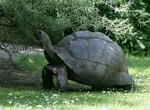
Aldabra, the world's second largest coral atoll, is in the Aldabra Group of islands in the Indian Ocean that form part of the Seychelles. Uninhabited and extremely isolated, Aldabra is virtually untouched by humans, has distinctive island fauna including the Aldabra Giant Tortoise, and is designated a World Heritage Site. The atoll is the second largest in the world b... -
Visit Al Diwan (The Siq), Madain Salih, Saudi Arabia
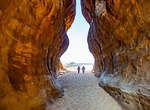
In the middle of the Jebel Ithlib is a natural slit that measures 40 m (131 feet), called the Siq, after a similar corridor at Petra. At its entrance, to the right, is a square chamber containing three stone benches that served as a triclinium for sacred feasts. Today, the chamber is known as al-Diwan (court). -
Explore Alejandro de Humboldt National Park, Cuba (UNESCO site)
Parque Nacional Alejandro de Humboldt is a national park in the Cuban provinces of Holguín and Guantánamo. It is named after the German scientist Alexander von Humboldt who visited the island in 1800 and 1801. The park was inscribed as a UNESCO World Heritage Site in 2001 for of its size, altitude range, complex lithology, landform diversity, and wealth ... -
See Alekšupīte Canals, Kuldīga, Latvia
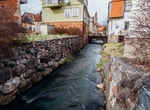
The Alekšupīte River flows directly along the walls of many buildings which is why Kuldīga has been called the Venice of Latvia. Initially the buildings of the town centre were constructed as the suburb of Kuldīga. In 1701, during the Great Northern War, the Swedish army invaded Kuldīga Castle and in 1709 it became uninhabitable, but in the 19th century th... -
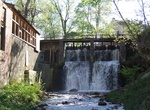
See Alekšupīte Waterfall, Kuldīga, Latvia
Alekšupīte Waterfall was fixed and built up in the 17th century to use the stream to operate the first paper mill in Kurzeme. As the waterfall is created artificially and is located next to the unattended mill building. An annual race is held on the Alekšupīte, when the contestants run directly along the river bottom. -
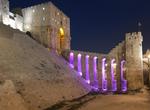
Visit Aleppo, Syria (UNESCO site)
Aleppo is the largest city in Syria. For centuries, Aleppo was Greater Syria's largest city and the Ottoman Empire's third, after Constantinople and Cairo. Although relatively close to Damascus in distance, Aleppo is distinct in identity, architecture and culture, all shaped by a markedly different history and geography. Aleppo is one of the oldest continuously inhabi... -
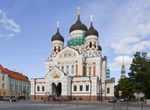
See Alexander Nevsky Cathedral, Tallinn, Estonia (UNESCO site)
The Alexander Nevsky Cathedral is an orthodox cathedral in the Tallinn Old Town, Estonia. It was built to a design by Mikhail Preobrazhensky in a typical Russian Revival style between 1894 and 1900, during the period when the country was part of the Russian Empire. The Alexander Nevsky Cathedral is Tallinn's largest and grandest orthodox cupola cathedral. It is dedica...