Give us feedback!


 See all
Our philosophy is simple. We want to encourage you to dream. BIG! Then we help you plan your trip, get the most out of it while you're traveling and help you share your experience with friends.
Join Now It's FREE
Dream Packages
Duration: 3 days
Price: $396.78
Price: $396.78
Duration: 12 hours 30 minutes
Price: $104.91
Price: $104.91
Duration: 5 days
Price: $726.42
Price: $726.42
Duration: 8 days
Price: $1186.79
Price: $1186.79
Dreams Still To Do
Checked-Off Dreams
Dreams Still To Do
Checked-Off Dreams
Advertisement
Explore Ancient Places & Ruins
-
Visit Paeke, Fatu Hiva, French Polynesia
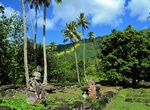
Paeke archaeological site is located on a hillside at the exit of the village on the way to Hatiheu. It features two well-preserved me’ae (traditional sacred sites) flanked by a set of brick-coloured tiki. The me’ae further up the hill has a pit into which human remains were thrown. Note: the path that leads to the site is not signed, so ask around. -
Visit Paestum & Velia, Italy (UNESCO site)
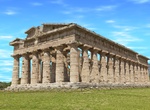
Paestum is the classical Roman name of a major Graeco-Roman city in the Campania region of Italy. It is located in the north of Cilento, near the coast about 85 km SE of Naples in the province of Salerno, and belongs to the commune of Capaccio, officially also named Capaccio-Paestum. The main features of the site today are the standing remains of three major temples i... -
Off-road to Painted Hand Pueblo, Canyons of the Ancients National Monument, Colorado
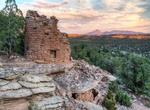
The Painted Hand Pueblo is a backcountry site that consists of non-excavated ruins built upon boulders along a cliff-face and a standing tower. The pueblo received its name from a boulder with pictographs of hands. Great Pueblo period: AD 1100 to 1300. -
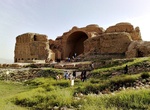
Visit Palace of Ardashir, Iran (UNESCO Site)
The Palace of Ardashir Pāpakan also known as the Atash-kadeh آتشکده, is a castle located on the slopes of the mountain on which Dezh Dokhtar is situated. Built in AD 224 by King Ardashir I of the Sassanian Empire, it is located two kilometers (1.2 miles) north of the ancient city ofGor, i.e. the old city of Piruz-Apad in Pars, in ancient Persia (Iran). The structure c... -
Visit Palace of Nestor, Peloponnese, Greece
The Palace of Nestor was an important centre in Mycenaean times, and described in Homer's Odyssey and Iliad as Nestor's kingdom of "sandy Pylos". The palace featured in the story of the Trojan War, as Homer tells us that Telemachus: went to Pylos and to Nestor, the shepherd of the people, and he received me in his lofty house and gave me kindly welcome, as a father mi... -
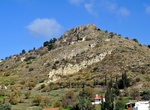
Visit Palaiochora of Aegina, Aegina Island, Saronic Islands, Greece
The ruins of Palaiochora. Walls, houses, and castle have been destroyed, only the chapels were restored. Paleochora (also Paliachora) is a medieval village of Aegina built in the 9th century; it was the capital of the island until 1826. It is located behind and above the hill of Agios Nektarios, at 7 km from the port of Aegina towards the center of the island. -
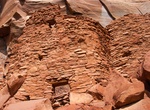
Visit Palatki Heritage Site, Sedona, Arizona
Palatki Heritage Site is located in the Coconino National Forest in Sedona, Arizona. Built in the formidable red rock cliffs of the area are a set of ruins belonging to the Sinagua. The Sinagua are thought to be connected to the Hopi Indian Tribe. The word Palatki means 'red house' in the Hopi language. The Sinagua people planted crops, made pottery, and lived in pueb... -
Visit Palenque, Mexico (UNESCO site)
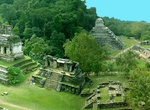
Palenque was a Maya city state in southern Mexico that flourished in the 7th century. The Palenque ruins date back to 100 BC to its fall around 800 AD. After its decline it was absorbed into the jungle, which is made up of cedar, mahogany, and sapodilla trees, but has been excavated and restored and is now a famous archaeological site attracting thousands of visitors.... -
Visit Palmyra, Syria (UNESCO site)
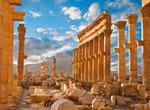
Palmyra was an ancient city in central Syria. In antiquity, it was an important city located in an oasis 215 km northeast of Damascus and 180 km southwest of the Euphrates at Deir ez-Zor. It had long been a vital caravan stop for travellers crossing the Syrian desert and was known as the Bride of the Desert. The earliest documented reference to the city by its Semitic... -
Visit Panchapandava Cave Temple, India (UNESCO Site)
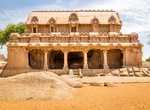
Panchapandava Cave Temple (also known as Pancha Pandava Temples and Mandapa of the Five Pandavas) is a monument at Mahabalipuram, on the Coromandel Coast of the Bay of Bengal, in the Kancheepuram district of the state of Tamil Nadu, India. The mandapa (rock sanctuary) is part of the Group of Monuments at Mahabalipuram. It is the largest cave temple in Mahabalipuram. I... -
Visit Pancha Rathas, India (UNESCO Site)
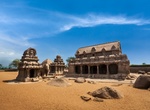
Pancha Rathas (also known as Pandava Rathas) is a monument complex at Mahabalipuram, on the Coromandel Coast of the Bay of Bengal, in the Kancheepuram district of the state of Tamil Nadu, India. Pancha Rathas is an example of monolithic Indian rock-cut architecture. Dating from the late 7th century, it is attributed to the reign of King Mahendravarman I and his son Na... -
Visit Paphos, Cyprus (UNESCO site)
Paphos, sometimes referred to as Pafos, is a coastal city in the southwest of Cyprus and the capital of Paphos District. In antiquity, two locations were called Paphos: Old Paphos and New Paphos. The currently inhabited city is New Paphos. It lies on the Mediterranean coast, about 50 km (31.07 mi) west of the Limassol (the biggest port in island), which has an A6... -
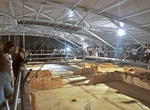
Visit Paphos Archaeological Park, Paphos, Cyprus
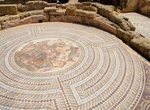
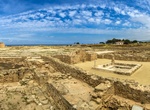
Paphos Archaeological Park (also Kato Pafos Archaeological Park) contains the major part of the important ancient Greek and Roman city and is located in Paphos, southwest Cyprus. The park, still under excavation, is within the Nea Pafos ("New Paphos") section of the coastal city. Its sites and monuments date from prehistoric times through the Middle Ages. Among the mo... -
Visit Paracas Candelabra, Peru
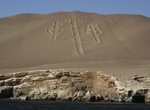
The Paracas Candelabra, also called the Candelabra of the Andes, is a well-known prehistoric geoglyph found on the northern face of the Paracas Peninsula at Pisco Bay in Peru. Pottery found nearby has been radio carbon dated to 200 BCE, the time of the Paracas culture. The design is cut two feet into the soil, with stones possibly from a later date placed around it. T... -
See Parthian Fortresses of Nisa, Turkmenistan (UNESCO site)
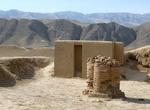
Nisa (also Parthaunisa) was an ancient city, located near modern-day Bagir village, 18 km northwest of Ashgabat, Turkmenistan. Nisa is described by some as one of the first capitals of the Parthians. It was traditionally founded by Arsaces I (reigned c. 250 BC–211 BC), and was reputedly the royal necropolis of the Parthian kings, although it has not been establi...
Price: $147.61