Give us feedback!


 See all
Our philosophy is simple. We want to encourage you to dream. BIG! Then we help you plan your trip, get the most out of it while you're traveling and help you share your experience with friends.
Join Now It's FREE
Dream Packages
Duration: 4 hours 30 minutes
Price: $33.00
Price: $33.00
Duration: 2 days
Price: $147.61
Price: $147.61
Duration: 5 hours
Price: $635.26
Price: $635.26
Duration: 12 hours
Price: $120.00
Price: $120.00
Dreams Still To Do
Checked-Off Dreams
Dreams Still To Do
Checked-Off Dreams
Advertisement
Explore Ancient Places & Ruins
-
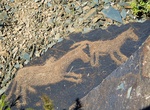
See Petroglyphs of Tamgaly, Kazakhstan (UNESCO site)
Tamgaly is a UNESCO petroglyph site in the Semirechye, Kazakhstan located 120 km to northwest of Almaty. The majority of the 5000 petroglyphs are in the lower part of the main canyon, but there are a number in the many side canyons. Most carvings depict deer and hunting scenes, but there is also a famous Buddha (or Shiva) drawing dated about 8th c. AD. The petro... -
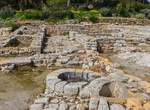
Visit Phaistos, Crete, Greece
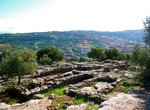
Phaistos is a Bronze Age archaeological site at Faistos, a municipality in south central Crete. Ancient Phaistos was located about 5.6 km (3.5 mi) east of the Mediterranean Sea. The name, Phaistos, survives from ancient Greek references to a city in Crete of that name, shown to be, in fact, at or near the current ruins. In 2025, the site was designated as a World Heri... -
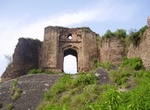
Visit Pharwala, Rawalpindi District, Pakistan
Pharwala Fort (Urdu: قلعہ پھروالہ) is a 15th century fort located about 40 km from Rawalpindi in Punjab, Pakistan. The fort is naturally defended by one side by a small Himalayan range and the other by the Swaan River. The fort was built by the Gakhars in the 15th century. The Mughal Emperor Babur conquered the fort in 1519, however after the Mughals reconciled w... -
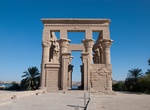
Visit Philae Temple, Egypt (UNESCO site)
Philae is an island in the Nile River and the previous site of an Ancient Egyptian temple complex in southern Egypt. The complex was dismantled and relocated to a nearby island in connection to the UNESCO project started because of the construction of the High Dam, after being partly flooded by the first Aswan Dam for half a century. Philae was remarkable for the... -
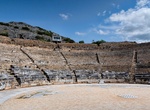
Visit Philippi, Greece (UNESCO Site)
Philippi was a major mainland Greek city northwest of the nearby island, Thasos. Its original name was Crenides. The city was renamed by Philip II of Macedon in 356 BC and abandoned in the 14th century after the Ottoman conquest. The present village of Filippoi is located near the ruins of the ancient city and is part of the region of East Macedonia and Thrace in Kava... -
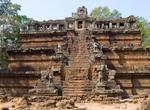
See Phimeanakas, Angkor Thom, Cambodia
Phimeanakas (celestial temple) or Vimeanakas at Angkor, Cambodia, is a Hindu temple in the Khleang style, built at the end of the 10th century, during the reign of Rajendravarman (from 941-968), then rebuilt by Suryavarman II in the shape of a three tier pyramid as a Hindu temple. On top of the pyramid there was a tower. According to legend, the king spent the first w... -
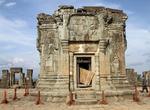
See Phnom Bakheng, Angkor, Cambodia
Phnom Bakheng at Angkor, Cambodia, is a Hindu temple in the form of a temple mountain. Dedicated to Shiva, it was built at the end of the 9th century, during the reign of King Yasovarman (889-910). Located atop a hill, it is nowadays a popular tourist spot for sunset views of the much bigger temple Angkor Wat, which lies amid the jungle about 1.5 km to the southeast. ... -
Visit Phourni (Fourni), Crete, Greece
Phourni (Greek: Φουρνί, also Fourni) is the archaeological site of an ancient Minoan cemetery in Crete, established in 2400 BC and lasted until 1200 BC. Phourni is Greek for "furnace, oven" and the name of the hill on which the cemetery is located. Phourni is located at 70100 Epano Archanes, Heraklion, Greece—located on a hill in north... -
Visit Phra Nakhon Si Ayutthaya District, Thailand
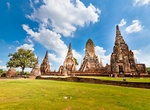
Phra Nakhon Si Ayutthaya is the capital district (amphoe Mueang) of Phra Nakhon Si Ayutthaya Province, central Thailand. Its former name as the capital city of Ayutthaya Kingdom was "Krungthep Thawarawadi Si Ayutthaya". According to George Coedes, tradition states Ramathibodi I founded Dvaravati Sri Ayudhya in 1350.:222 Created in 1897, the district was originally cal... -
Visit Phylakopi, Milos, Greece
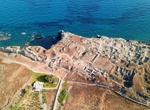
Phylakopi (Greek: Φυλακωπή), located at the northern coast of the island of Milos, is one of the most important Bronze Age settlements in the Aegean and especially in the Cyclades. The importance of Phylakopi is in its continuity throughout the Bronze Age (i.e. from mid-3rd millennium BC until the 12th century BC) and because of... -
Visit Piatra Roşie Fortress, Romania (UNESCO site)
Piatra Roşie, which means Red Rock, was a Dacian hill fort two days march to the west from Costeşti-Cetăţuie, at Luncani in Boşorod municipality. It was built in two phases. In the first phase a long (102 m) rectangular main citadel was built at the height of land with watch towers on each end and two outlying watch towers. Later the larger area inside the watch towe... -
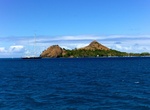
Explore Pigeon Island National Landmark, Saint Lucia
Pigeon Island is a 40-acre (160,000 m2) islet located in Gros Islet in the northern region of Saint Lucia. Once isolated from the country in the Caribbean Sea, the island was artificially joined to the western coast of mainland in 1972 by a man-made causeway built from dirt excavated to form the Rodney Bay Marina. Composed of two peaks the island is a historic site wi... -
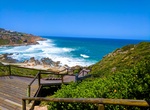
Visit Pinnacle Point, South Africa
Pinnacle Point a small promontory immediately south of Mossel Bay, a town on the southern coast of South Africa. Excavations since the year 2000 of a series of caves at Pinnacle Point, first recognized and documented in 1997 by South African professional archaeologists, Jonathan Kaplan and Peter Nilssen, have revealed occupation by Middle Stone Age people between 170,... -
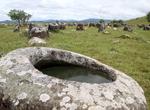
Visit Plain of Jars, Laos (UNESCO site)
The Plain of Jars (Lao: ທົ່ງໄຫຫິນ [tʰōŋ hǎj hǐn]) is a megalithic archaeological landscape in Laos. It consists of thousands of stone jars scattered around the upland valleys and the lower foothills of the central plain of the Xiangkhoang Plateau. The jars are mostly arranged in clusters ranging in number from one to several hundred. The Xieng Khouang Plateau is locat... -
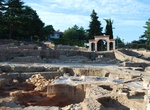
Visit Plaošnik, Ohrid, North Macedonia
Plaošnik or simply Plaoš (Macedonian: Плаошник, Плаош) is an archaeological site and holy place in Ohrid, North Macedonia, located 250 meters below Samuil's Fortress. The site is in the process of being restored to its original condition. The church was built by St. Clement in the year 893, on the foundation of an earlier Christian basilica, and dedicate...
Price: $180.27