Give us feedback!
Our philosophy is simple. We want to encourage you to dream. BIG! Then we help you plan your trip, get the most out of it while you're traveling and help you share your experience with friends.
Join Now It's FREE
Related Categories
Dreams Still To Do
Checked-Off Dreams
Dreams Still To Do
Checked-Off Dreams
Advertisement
Explore Main UNESCO Sites
-
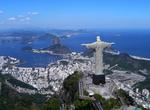
See Christ the Redeemer & Corcovado, Rio de Janeiro, Brazil (UNESCO site)
Christ the Redeemer (Cristo Redentor) is a statue of Jesus Christ in Rio de Janeiro, Brazil; considered the largest Art Deco statue in the world and the world's 5th largest statue. It is 39.6 metres (130 ft) tall, including its 9.5 metres (31 ft) pedestal, and 30 metres (98 ft) wide. It weighs 635 tonnes (625 long, 700 short tons), and is located at the peak of the 70... -
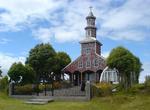
See Churches of Chiloé, Chile (UNESCO site)
The Churches of Chiloé in Chile's Chiloé Archipelago are a unique architectural phenomenon in the Americas and one of the most prominent buildings of Chilota architecture. Unlike classical Spanish colonial architecture the churches of Chiloé are made entirely in native timber with extensive use of wooden roof shingles. The churches were made to re... -
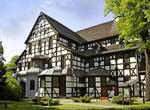
See Churches of Peace in Jawor & Świdnica, Poland (UNESCO site)
The Churches of Peace in Jawor and Świdnica in Silesia were named after the Peace of Westphalia of 1648 which permitted the Lutherans in the Roman Catholic parts of Silesia to build three Evangelical churches from wood, loam and straw outside the city walls, without steeples and church bells. The construction time was limited to one year. Since 2001, the two remaining... -
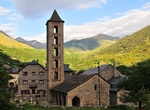
See Churches of the Vall de Boí, Spain (UNESCO site)
The Churches of the Vall de Boí are a set of nine Early Romanesque churches declared World Heritage Site by UNESCO and located in the Vall de Boí, in the Catalan comarque of Alta Ribagorça (Province of Lleida). In the early 20th century showed great eagerness to study and catalog the Romanesque wall paintings of the churches of the Vall de Bo&iacu... -
See Church of Colònia Güell, Barcelona, Spain (UNESCO site)
The Church of Colònia Güell is an unfinished work by Antoni Gaudí. It was built as a place of worship for the people in a manufacturing suburb in Santa Coloma de Cervelló, near Barcelona (Spain). Colònia Güell was the brainchild of Count Eusebi de Güell. However with Güell losing profits from his business, the money ran ... -
See Church of Hosios David (Latomos Monastery), Thessaloniki, Greece (UNESCO site)
The Church of Hosios David is a late 5th-century church in Thessaloniki, Greece. In Byzantine times, it functioned as the katholikon of the Latomos Monastery, and received a rich mosaic and fresco decoration, which was renewed in the 12th–14th centuries. The surviving examples are of high artistic quality. Under Ottoman rule, the building was converted into a mo... -
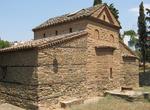
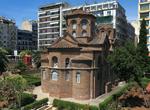
See Church of Panagia Chalkeon, Thessaloniki, Greece (UNESCO site)
The Church of Panagia Chalkeon is an 11th-century Byzantine church in the northern Greek city of Thessaloniki. According to the founder's inscription above the west entrance, the church was built in 1028 by the protospatharios Christopher, katepano of Longobardia, and his wife Maria, son Nikephoros and two daughters, Anna and Katakale. Christopher's tomb was probably ... -
See Church of Prophet Elijah, Thessaloniki, Greece (UNESCO site)
The Church of Prophet Elijah is a 14th-century church in Thessaloniki, Greece, and a UNESCO World Heritage Site. The church is located in the upper quarter of the old city, and dates to the Palaiologan period, but its original dedication is unknown. In Ottoman times, it was known as the Saraylı Mosque, and through a misinterpretation of this name came about its modern... -
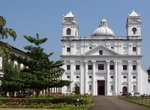
See Church of Saint Cajetao, Old Goa, India (UNESCO Site)
The Church of Saint Cajetao is one of the UNESCO sites in Old Goa, India -
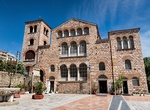
See Church of Saint Demetrius (Hagios Demetrios), Thessaloniki, Greece (UNESCO site)
The Church of Saint Demetrius, or Hagios Demetrios, is the main sanctuary dedicated to Saint Demetrius, the patron saint of Thessaloniki (in Central Macedonia, Greece), dating from a time when it was the second largest city of the Byzantine Empire. The first church on the spot was constructed in the early 4th century AD, replacing a Roman bath. A century later, a pref... -
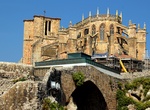
Visit Church of Saint Mary of the Assumption, Spain (UNESCO site)
Church of Saint Mary of the Assumption (Eglise Santa Maria de la Asuncion) is located in Castro Urdiales, Spain. The Church of Santa María de la Asunción is in Gothic style. Built under the protection of King Alfonso VIII of Castile in the 13th century (though it was finished in the 15th century), it is a basilica church with three naves. In the interior... -
See Church of Saint Nicholas Orphanos, Thessaloniki, Greece (UNESCO site)
The Church of Saint Nicholas Orphanos is an early 14th-century Byzantine church in the northern Greek city of Thessaloniki. The church's name, "Saint Nicholas the Orphan", is first attested in the 17th and 18th centuries, and presumably refers to its otherwise unknown ktetor (founder). From its interior decoration, the building is dated to the period 1310–1320. ... -
See Church of Saint Panteleimon, Thessaloniki, Greece (UNESCO site)
The Church of Saint Panteleimon is a late Byzantine church in Thessaloniki, Greece, and a UNESCO World Heritage Site. The church lies in the eastern part of the old city, near the Tomb of Galerius (the "Rotunda"), at the junction of Iasonidou and Arrianou streets. Its current dedication to Saint Panteleimon was given to the church after the end of Ottoman rule in 1912... -
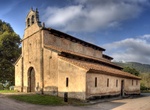
Visit Church of San Salvador de Priesca, Spain (UNESCO site)
Holy Saviour of Priesca (Iglesia de San Salvador de Priesca) is a Roman Catholic pre-romanesque church, located in Priesca, next to Villaviciosa, Asturias, northern Spain. Only a few kilometres from the Church of San Salvador de Valdediós, it is amongst the latest examples of Asturian architecture. It was inscribed to the UNESCO List of World Heritage Sites on ... -
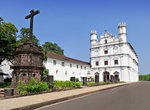
See Church of St. Francis of Assisi, Old Goa, India (UNESCO Site)
The Church of St. Francis of Assisi was built in 1661 by the Portuguese in the Portuguese Viceroyalty of India. The following is the information as seen on the plaque beside the Church of St. Francis of Assisi. "The three tier facade have octagonal towers on each side and in the central niche there is a statue of St. Michael. The main entrance is decorated with circul...