Give us feedback!


 See all
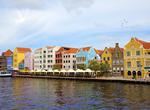
Our philosophy is simple. We want to encourage you to dream. BIG! Then we help you plan your trip, get the most out of it while you're traveling and help you share your experience with friends.
Join Now It's FREE
Dream Packages
Duration: 11 hours
Price: $110.50
Price: $110.50
Duration: 5 days
Price: $918.22
Price: $918.22
Duration: 12 hours
Price: $124.49
Price: $124.49
Duration: 14 hours
Price: $450.00
Price: $450.00
Dreams Still To Do
Checked-Off Dreams
Dreams Still To Do
Checked-Off Dreams
Advertisement
Explore Man-Made Sites
-
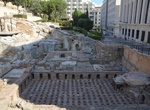
Visit Roman Baths, Beirut
Roman Berytus (Roman Baths) are located in the middle of downtown Beirut, Lebanon between Banks Street and Capuchin Street. The remains of a Roman bath of Berytus now surrounded by government buildings were found and conserved for posterity. Roman Berytus Baths is an ancient Roman thermae or bath site inside the Roman city of Berytus. It was discovered in 1968-1969 an... -
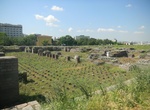
Visit Roman Baths of Ankara, Turkey
The Roman Baths of Ankara are the ruined remains of an ancient Roman bath complex in Ankara, Turkey, which were uncovered by excavations carried out in 1937-1944, and have subsequently been opened to the public as an open-air museum. The baths are located on a plateau, traditionally known as Çankırı Kapı, which rises 2.5 meters above the west side of Çan... -
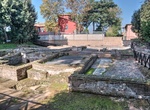
Visit Roman baths of Capo di Bove, Rome, Italy
Capo di Bove is an archaeological site on the Appian Way on the outskirts of Rome, Italy. It contains the thermal baths of a vast property owned in the 2nd century AD by Herodes Atticus and his wife Annia Regilla. Formerly privately owned, the property at No. 222 on the Appian Way was acquired by the Italian Government in 2002. The area of the baths was at that time b... -
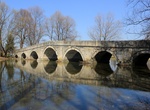
Visit Roman bridge in Ilidža, Sarajevo, Bosnia and Herzegovina
The Roman bridge in Ilidža is a bridge located in Ilidža, a chief suburb of Sarajevo, the capital of Bosnia and Herzegovina. It was built in the 16th century using actual Roman stones and crosses the Bosna river. The Roman Bridge is located not far from Vrelo Bosne on the Bosna river in the Ilidža municipality. It was constructed sometime between 1530 and 1550 fr... -
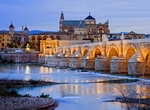
Walk Across Roman Bridge of Córdoba, Spain
The Roman bridge of Córdoba is a bridge in Córdoba, Andalusia, southern Spain, built in the early 1st century BC across the Guadalquivir river. It is included in the small preserved area known as Sotos de la Albolafia. The bridge was built by the Romans in the early 1st century BC, perhaps replacing a previous one in wood. It currently, after the Islamic... -
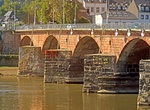
Cross Roman Bridge (Trier), Germany (UNESCO Site)
The Roman Bridge (Römerbrücke) is an ancient structure in Trier, Germany, over the Moselle. It is the oldest standing bridge in the country. The nine bridge pillars date from the 2nd century AD. The upper part was renewed twice, in the early 12th and in the early 18th century, after suffering destruction in war. It is designated as part of the Roman Monument... -
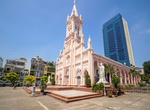
Visit Roman Catholic Diocese of Đà Nẵng (Chicken Church), Viet Nam
The diocese of Đà Nẵng is a Roman Catholic diocese in central Vietnam. The bishop is Joseph Chau Ngoc Tri since 2006. The creation of the diocese in present form was declared January 18, 1963. The diocese covers an area of 11,690 km², and is a suffragan diocese of the Archdiocese of Huế. By 2004, the diocese of Đà Nang had about 57,870 believers (2.... -
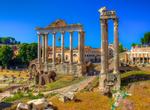
See Roman Forum, Rome, Italy
The Roman Forum is a rectangular forum (plaza) surrounded by the ruins of several important ancient government buildings at the center of the city of Rome. Citizens of the ancient city referred to this space, originally a marketplace, as theForum Magnum, or simply theForum. It was for centuries the center of Roman public life: the site of triumphal processions an... -
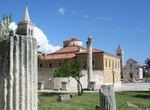
Visit Roman Forum (Zadar), Croatia
Roman Forum – the largest on the eastern side of the Adriatic, founded by the first Roman Emperor Augustus, as shown by two stone inscriptions about its completion dating from the 3rd century. -
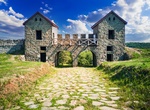
Visit Roman Frontiers of Dacia, Romania (UNESCO sites)
From 500 BCE on, the Roman Empire extended its territory across parts of Europe and North Africa until its frontier totaled some 7,500 kilometres by the 2nd century. The Romanian segment, the Dacian Limes, was operational from 106 to 271 CE. The property comprises 277 component parts and represents the longest, most complex land border of a former Roman province in Eu... -
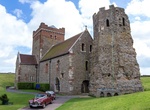
See Roman Lighthouse at Dover Castle, Dover, England
Two lighthouses, each called the Pharos, were built at Dover soon after the Roman conquest. Proposals of their date range from 50 (seven years after the invasion of 43), 80 or (since the building includes tiles identical to the mansio in the town built at that date) c. 138, though the general consensus is for a 1st-century AD date. They were sited on the two heights (... -
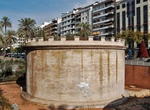
See Roman Mausoleum of Córdoba, Spain
The Roman mausoleum of Córdoba is an ancient structure in the Jardines de la Victoria, Córdoba, Andalusia, southern Spain. It is a funerary monument of cylinder-shaped that corresponded to a group of funerary monuments of the Republican era, built in the 1st century AD. It was discovered in 1993 during archaeological excavations. It includes the chamber ... -
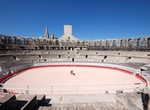
See Roman Monuments of Arles, France (UNESCO site)
Arles, Roman and Romanesque Monuments is a collection of monuments in Arles, France, including the Arles Amphitheatre and the Arles Obelisk. The collection has been listed as a UNESCO World Heritage Site since 1981. It is spread over an area of 65 ha. It is located in Arles and contains the following buildings: Arles Amphitheatre; The Roman theatre; Cryptoporticu... -
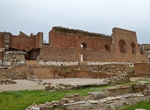
Visit Roman Odeon (Patras), Greece
The Roman Odeon, the most significant ancient monument, is in the upper town and was built around 160 AD, in the reign of either Antoninus Pius or Marcus Aurelius. It has been restored and partially reconstructed, and is used as an open-air theatre for performances and concerts in the summer. -
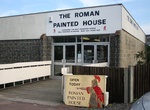
Visit Roman Painted House, Dover, England
During the construction of the new A256/York Street bypass in the 1970s, Roman remains were discovered and an eight-week excavation followed. The archaeologists discovered a Roman mansio now known as the "Roman Painted House". The mansio, a hostel for government officials, was built in c. 200. It was discovered in 1970 by the Kent Archaeological Rescue Unit and, as it...
Price: $118.81