Give us feedback!


 See all
Our philosophy is simple. We want to encourage you to dream. BIG! Then we help you plan your trip, get the most out of it while you're traveling and help you share your experience with friends.
Join Now It's FREE
Dream Packages
Duration: 2 days
Price: $779.00
Price: $779.00
Duration: 2 days
Price: $480.00
Price: $480.00
Duration: 7 hours
Price: $214.20
Price: $214.20
Duration: 2 days
Price: $147.61
Price: $147.61
Dreams Still To Do
Checked-Off Dreams
Dreams Still To Do
Checked-Off Dreams
Advertisement
Explore Ancient Places & Ruins
-
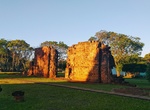
Visit Sítio Arqueológico de São Nicolau, Rio Grande do Sul, Brazil
Sítio Arqueológico de São Nicolau s a set of ruins remaining from the homonymous Jesuit reduction , which was part of the Seven Peoples of the Missions . It is located in the municipality of Rio Grande do Sul of the same name . Its population used to inhabit this same place, in the reduction founded by Father Roque Gonzales in 1626 , but had been ... -
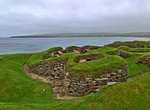
See Skara Brae, Scotland (UNESCO site)
Skara Brae is a large stone-built Neolithic settlement, located on the Bay of Skaill on the west coast of Mainland, Orkney, Scotland. It consists of ten clustered houses, and was occupied from roughly 3180 BC–2500 BC. Europe's most complete Neolithic village, Skara Brae gained UNESCO World Heritage Site status as one of four sites comprising "The Heart of Neolit... -
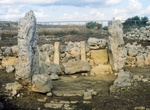
Visit Skorba Temples, Malta (UNESCO site)
The Skorba temples are megalithic remains on the northern edge of Żebbiegħ, in Malta, which have provided detailed and informative insight into the earliest periods of Malta's neolithic culture. The site was only excavated in the early 1960s, rather late in comparison to other megalithic sites, some of which had been studied since the early 19th century. The site's im... -
See Soie Castle, Switzerland
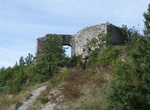
Soie Castle (German: Seta Castle) is a ruined castle in the municipality of Savièse of the Canton of Valais in Switzerland. Soie Castle was built around 1200 by Landri de Mont, the Bishop of Sion, possibly to restrict the power of the Counts of Savoy in Valais. During the conflicts between the bishop and the counts during the 13th century the castle was not dam... -
Visit Soknopaiou Nesos, Faiyum, Egypt
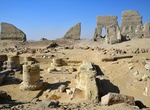
Soknopaiou Nesos was an ancient settlement in the Faiyum Oasis (Egypt), located a few kilometers north of Lake Qarun (known in antiquity as Lake Moeris). The settlement - known nowadays as Dimeh es-Seba, possibly meaning «Dimeh of the lions» - was an important religious center with an imposing temple dedicated to the god Soknopaios, an oracular god in shap... -
See South Gate Angkor Thom, Angkor, Cambodia
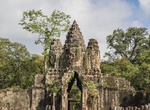
The south gate of Angkor Thom is 7.2 km north of Siem Reap, and 1.7 km north of the entrance to Angkor Wat. The walls, 8 m high and flanked by a moat, are each 3 km long, enclosing an area of 9 km². The walls are of laterite buttressed by earth, with a parapet on the top. There are gates at each of the cardinal points, from which roads lead to the Bayon at the ce... -
Visit Spitz, Greng, Switzerland (UNESCO site)
Greng is a municipality in the district of See in the canton of Fribourg in Switzerland. It is home to the Spitz prehistoric pile-dwelling (or stilt house) settlements that are part of the Prehistoric Pile dwellings around the Alps UNESCO World Heritage Site. The Greng-Spitz site has been studied since the 19th century. It was occupied at least three separate times. T... -
Hike to Split Level & Road House Ruins, Comb Ridge, Utah
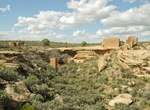
The Split Level Ruin and Road House Ruin are located in the Butler Wash area of Comb Ridge near Bluff, Utah. -
See Spruce Tree House, Mesa Verde National Park
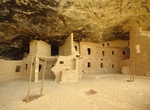
NOTE: Due to continued safety concerns relating to rock falls, Spruce Tree House remains closed for the foreseeable future until a full geotechnical assessment can be performed. Overlooks near the museum offer superb views of the cliff dwelling. Rangers are available to answer questions. Spruce Tree House is Mesa Verde National Park's best-preserved and third largest... -
See Square Tower Group, Hovenweep National Monument, Utah
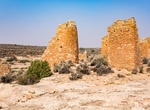
Square Tower Group is part of Hovenweep National Monument and is located in Utah next to the Hovenweep visitor center. It is the most easily accessible unit in the Monument. The group is the largest collection of pueblo buildings at Hovenweep and was populated with up to 500 people. It is in Little Ruin Canyon which is made up of Square Tower, Tower Point, and Twin T... -
Hike Square Tower Loop Trail (Little Ruin Canyon), Hovenweep National Monument, Utah
This trail begins at the Canyon Overlook and loops around Little Ruin Canyon. The loop trail is primitive, passing over slickrock and packed dirt, and is lined with rock. As you wind around the canyon, you pass within 5-10 feet of most of the Square Tower Group structures, allowing an uninterrupted and natural view of these architectural wonders. Part of the trail ent... -
See Srah Srang Temple, Angkor, Cambodia
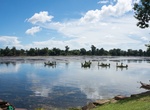
Srah Srang is a baray or reservoir at Angkor, Cambodia, located south of the East Baray and east of Banteay Kdei. Sras Srang was dug in the mid-10th century, by initiative of Kavindrarimathana, Buddhist minister of Rajendravarman II. It was modified around the year 1200 by Jayavarman VII, who added the laterite landing-stage at its western side, probably because the E... -
Visit Stabiae, Italy
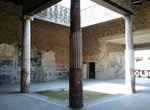
Stabiae (Latin: [ˈstabɪ.ae̯]) was an ancient city situated near the modern town of Castellammare di Stabia and approximately 4.5 km southwest of Pompeii. Like Pompeii, and being only 16 km (9.9 mi) from Mount Vesuvius, this seaside resort was largely buried by tephra ash in 79 AD eruption of Mount Vesuvius, in this case at a shallower depth of up to 5 m. Stabiae is mo... -
Visit Stadium of Delphi, Delphi, Greece
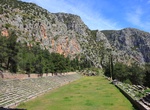
The Stadium of Delphi lies on the highest spot of the Archaeological Site of Delphi. It overlooks the sanctuary of Apollo and has a view to the Delphic landscape. It was built either within the second half of the 4th century B.C. or even after the Galatian attacks. Its measured 178 meters in length and knew several refurbishment phases. The Stadium of Delphi is the be... -
See Staigue Stone Fort, Ireland
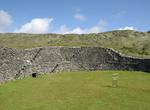
Staigue or Staig is a partly ruined stone ringfort three miles west of Sneem, on the Iveragh peninsula in County Kerry, Ireland. The fort is thought to have been built during the late Iron Age, probably somewhere between 300 and 400 AD, as a defensive stronghold for a local lord or king. It is at the head of a valley opening south to the sea, surrounded by a ditch ove...
Price: $153.52