Give us feedback!
Our philosophy is simple. We want to encourage you to dream. BIG! Then we help you plan your trip, get the most out of it while you're traveling and help you share your experience with friends.
Join Now It's FREE
Related Categories
Dreams Still To Do
Checked-Off Dreams
Dreams Still To Do
Checked-Off Dreams
Advertisement
Explore UNESCO Sites
-
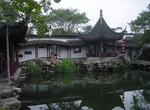
Visit Master of the Nets Garden, Suzhou, China (UNESCO site)
The Master of the Nets Garden in Suzhou is among the finest gardens in China. It is located at Canglang District, Dai Cheng Qiao Road, No. 11 Kuo Jia Tou Xiang. It is recognized with other classical Suzhou gardens as a UNESCO World Heritage Site. The garden demonstrates Chinese garden designers' adept skills for synthesizing art, nature, and architecture to create uni... -
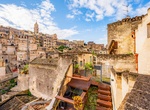
Visit Matera, Italy (UNESCO site)
Matera is a town in southern Italy that lies athwart a small canyon, which has been eroded in the course of years by a small stream, the Gravina. The Sassi (Ancient town): Matera has gained international fame for its ancient town, the "Sassi di Matera" (meaning "stones of Matera"). The Sassi originate from a prehistoric (troglodyte) settlement, and are suspected to be... -
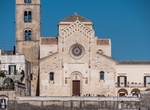
See Matera Cathedral (Piazza Duomo), Matera, Basilicata, Italy
Matera Cathedral is a Roman Catholic cathedral in Matera, Basilicata, Italy. It is dedicated to the Virgin Mary under the designation of the Madonna della Bruna and to Saint Eustace. Formerly the seat of the Bishops, later Archbishops, of Matera, it is now the cathedral of the Archdiocese of Matera-Irsina. The cathedral was built in Apulian Romanesque style in the 13t... -
Ride Matheran Hill Railway, Maharashtra, India
Matheran Hill Railway is a heritage railway in Maharashtra, India. It was built between 1901 and 1907 by Abdul Hussein Adamjee Peerbhoy, financed by his father, Sir Adamjee Peerbhoy of the Adamjee Group at the cost of Rs.16,00,000. Sir Adamjee Peerbhoy visited Matheran often and wanted to build a railway to make it easier to get there. The 2 ft (610 mm) NG line runs p... -
Explore Matobo National Park, Zimbabwe (UNESCO site)
The Matobo National Park forms the core of the Matobo or Matopos Hills, an area of granite kopjes and wooded valleys commencing some 35 kilometres south of Bulawayo, southern Zimbabwe. The Hills were formed over 2000 million years ago with granite being forced to the surface, this has eroded to produce smooth "whaleback dwalas" and broken kopjes, strewn with boulders ... -
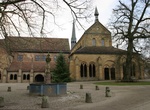
See Maulbronn Monastery, Germany (UNESCO site)
Maulbronn Monastery is the best-preserved medieval Cistercian monastery complex in Europe. It is situated on the outskirts of Maulbronn, Baden-Württemberg, Germany and is separated from the town by fortifications. Since 1993 the monastery is part of the Unesco World Heritage. The monastery was inscribed on the World Heritage List in 1993. The justification f... -
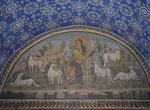
See Mausoleum of Galla Placidia, Ravenna, Italy (UNESCO site)
The Mausoleum of Galla Placidia is a Roman building in Ravenna, Italy. It was listed with seven other structures in Ravenna in the World Heritage List in 1996. The UNESCO experts describe it as "the earliest and best preserved of all mosaic monuments, and at the same time one of the most artistically perfect". The mausoleum is laid out in a Greek cross plan with a ce... -
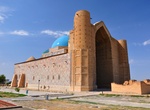
See Mausoleum of Khoja Ahmed Yasawi, Kazakhstan (UNESCO site)
The Mausoleum of Khoja Ahmed Yasawi is an unfinished mausoleum in the city of Turkestan, in southern Kazakhstan. The structure was commissioned in 1389 by Timur, who ruled the area as part of the expansive Mongol Empire, to replace a smaller 12th-century mausoleum of the famous Turkic poet and Sufi mystic,Khoja Ahmed Yasawi (1093–1166). However, constructio... -
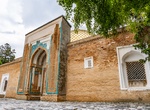
Visit Mausoleum of Mukhammad Bashoro, Panjakent, Tajikistan
The Mausoleum of Mukhammad Bashoro is situated on the bank of mountain river near the settlement of Masori Sharif in Panjakent, Tajikistan. On September 17, 2023, UNESCO designated a 886 km stretch of the Silk Road network in Central Asia as a World Heritage site. This site was included in the Silk Roads: Zarafshan-Karakum Corridor. The mausoleum was built (without po... -
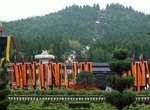
Visit Mausoleum of the First Qin Emperor (Qin Shi Huang), Shaanxi, China (UNESCO Site)
The Mausoleum of the First Qin Emperor is located in Lintong District, Xi'an, Shaanxi province of China. This mausoleum was constructed over 38 years, from 246 to 208 BC, and is situated underneath a 76-meter tall tomb mound. The layout of the mausoleum is modeled on the Qin capital Xianyang, divided into inner and outer cities. The circumference of the inner city is ... -
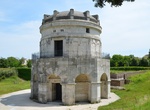
See Mausoleum of Theodoric, Ravenna, Italy (UNESCO site)
The Mausoleum of Theodoric (Mausoleo di Teodorico) is an ancient monument just outside Ravenna, Italy. It was built in 520 AD by Theodoric the Great as his future tomb. The current structure of the mausoleum is divided into two decagonal orders, one above the other; both are made of Istria stone. Its roof is a single 300–ton Istrian stone, 10 meters in diameter... -
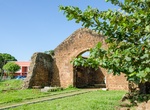
Visit M'banza Congo, Angola (UNESCO Site)
M'banza-Kongo, known as São Salvador in Portuguese from 1570 to 1975), is the capital of Angola's northwestern Zaire Province. M'banza Kongo was founded some time before the arrival of the Portuguese in 1483 and was the capital of the Kilukeni dynasty ruling at that time. The site was temporarily abandoned during civil wars in the 17th century. It lies close to... -
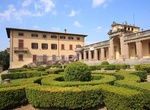
Tour Medici Villas and Gardens, Florence, Italy (UNESCO Site)
The Medici villas are a series of rural building complexes in Tuscany which were owned by members of the Medici family between the 15th century and the 17th century. The villas served several functions: they were the country palaces of the Medici, scattered over the territory that they ruled, demonstrating their power and wealth. They were also recreational resorts fo... -
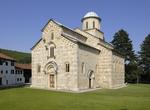
See Medieval Monuments in Kosovo, Serbia (UNESCO sites)
Medieval Monuments in Kosovo is a World Heritage Site consisting of four Serbian Orthodox Christian churches and monasteries which represent the fusion of the eastern Orthodox Byzantine and the western Romanesque ecclesiastical architecture to form the Palaiologian Renaissance style. The sites are located in the conflictive region of Kosovo, which Serbia considers to ... -
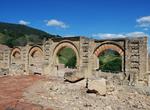
Visit Medina Azahara, Spain (UNESCO Site)
Medina Azahara is the ruins of a vast, fortified Arab Muslim medieval palace-city built by Abd-ar-Rahman III al-Nasir, (912–961) Ummayad Caliph of Córdoba, and located on the western outskirts of Córdoba, Spain. It was an Arab Muslim medieval town and the de facto capital of al-Andalus, or Muslim Spain, as the heart of the administration and govern...