Give us feedback!
Our philosophy is simple. We want to encourage you to dream. BIG! Then we help you plan your trip, get the most out of it while you're traveling and help you share your experience with friends.
Join Now It's FREE
Related Categories
Dreams Still To Do
Checked-Off Dreams
Dreams Still To Do
Checked-Off Dreams
Advertisement
Explore UNESCO Sites
-
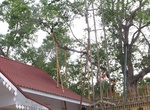
Visit Jaya Sri Maha Bodhi, Anuradhapura, Sri Lanka
Jaya Sri Maha Bodhi is a sacred fig tree in the Mahamewna Gardens, Anuradhapura, Sri Lanka. It is said to be the right-wing branch (southern branch) from the historical Sri Maha Bodhi at Buddha Gaya in India under which Lord Buddha attained Enlightenment. It was planted in 288 BC, and is the oldest living human-planted tree in the world with a known planting date. Tod... -
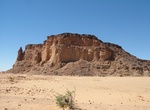
See Jebel Barkal (Gebel Barkal), Sudan (UNESCO site)
Jebel Barkal or Gebel Barkal is a very small mountain located some 400 km north of Khartoum, in Karima town in Northern State in Sudan, on a large bend of the Nile River, in the region called Nubia. In 2003, the mountain, together with the historical city of Napata (which sits at its feet), were named World Heritage Sites by UNESCO. Around 1450 BCE, the Egyptian Phara... -
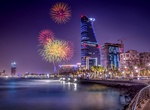
Visit Jeddah, Saudi Arabia (UNESCO Site)
Jeddah is a city located on the coast of the Red Sea and is the major urban center of western Saudi Arabia. Jeddah is the principal gateway to Mecca, Islam's holiest city, which able-bodied Muslims are required to visit at least once in their lifetime. It is also a gateway to Medina, the second holiest place in Islam. Jeddah is one of Saudi Arabia's primary resort cit... -
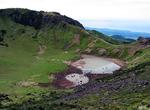
Visit Jeju Volcanic Island, South Korea (UNESCO site)
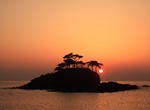
The Jeju Volcanic Island and Lava Tubes is a World Heritage Site in South Korea. Jejudo is a volcanic island, 130 kilometers from the southern coast of Korea. The largest island and smallest province in Korea, the island has a surface area of 1,846 square kilometers. A central feature of Jeju is Hallasan, the tallest mountain in South Korea and a dormant volcano, whic... -
See Jelling Mounds, Runic Stones and Church, Denmark (UNESCO site)
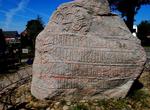
Jelling is the site of a large stone ship and two large burial mounds, the Jelling stones and Jelling Church which are an UNESCO World Heritage Site since 1994. In the North Mound, built between 958 and 959 CE (possibly for King Gorm of Denmark), an empty burial chamber was found. The South Mound was built around 970 and contains no burial. Beneath the two mounds is a... -
Explore Jeonbuk West Coast Geopark, South Korea
TheJeonbuk West CoastGeoparkis located in the midwestern part of South Korea. It includes vast tidal flats dotted with volcanoes and islands. It's one of 19 coastal wetland areas in the world with a tidal range greater than 5 m (macrotidal). Some of the sites include: Simwon Mud flat Soyosan Mountain Lava dome Seonunsan Mountain Byeong Rock Jigso Fall ... -
See Jerónimos (Hieronymites) Monastery, Belém, Lisbon, Portugal (UNESCO site)
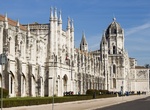
The Hieronymites Monastery is located near the shore of the parish of Belém, in the municipality of Lisbon, Portugal. The monastery is one of the most prominent monuments of the Manueline-style architecture (Portuguese late-Gothic) in Lisbon, classified in 1983 as a UNESCO World Heritage Site, along with the nearby Tower of Belém. Originally, the home fo... -
See Jesuit Block and Estancias of Córdoba, Argentina (UNESCO site)
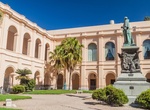
The Jesuit Block and Estancias of Córdoba (Spanish: Manzana Jesuítica y Estancias de Córdoba) are a former Jesuit reduction built by missionaries in Córdoba, Argentina, named a World Heritage Site in 2000. The Manzana Jesuítica contains the University of Córdoba, one of the oldest in South America, the Monserrat Secondary... -
See Jesuit Church, Lviv, Ukraine (UNESCO site)
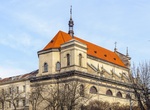
The Jesuit Church in Lviv is dedicated to Sts. Peter and Paul. When constructed in the 1610 and 1620s, it was one of the largest churches in the Polish-Lithuanian Commonwealth. Sebastian Lachmius, a monk, based his design for the church on that of Il Gesu in Rome. His designs were modified by a professional Italian architect, Jacopo Briano, in 1618–1621. A curio... -
See Jesuit Mission of La Santísima Trinidad de Paraná, Paraguay (UNESCO site)
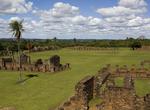
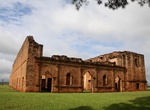
The Santísima Trinidad del Paraná Mission is considered the biggest of all the missions. Natives that came from the missions of San Carlos (nowadays in territory of Argentina) were its founders in 1712. This mission has the biggest built temple among all the Jesuit Missions, with an altar carved in a once piece stone. In it, is represented the persecutio... -
See Jesuit Missions of La Santísima Trinidad & Jesús de Tavarangue, Paraguay (UNESCO site)
La Santisima Trinidad de Paraná, or the Holy Trinity of Paraná is the name of a former Jesuit mission in Paraguay. It is an example of one of the many Jesuit Reductions, small colonies established by the missionaries in various locations in South America throughout the 17th and 18th century. Reducciones were built as miniature city-states that integrated... -
See Jesuit Missions of São Miguel das Missões, Brazil (UNESCO Site)
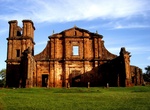
São Miguel das Missões is a Unesco World Heritage site located in the small town of São Miguel das Missões in the northwestern region of Rio Grande do Sul, a state in southern Brazil. It is also known as São Miguel Arcanjo and by its Spanish language name San Miguel. It was one of the many Jesuit Reductions in Argentina, Brazil,... -
See Jesuit Missions of the Chiquitos, Bolivia (UNESCO site)
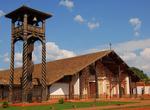
The Jesuit Missions of the Chiquitos are in the Santa Cruz department of eastern Bolivia. Six of the missions have been designated a UNESCO World Heritage Site. The missions are distinguished by the fusion of European and American Indian cultural influences. The missions were founded as reductions or reducciones de indios by Jesuits in the 17th and 18th centuries to c... -
See Jesús de Tavarangue, Paraguay (UNESCO site)
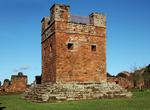
The church of Reducción de Jesús (Jesus’ Mission) was in the process of building in the moment that the Jesuits were expelled of Río de la Plata Province. It would have been one of the biggest churches of that time, with a central structure of 70 meter long and 24 meters wide. It would have been a replica of the Church of Loyola, in Italy. ... -
Visit Jetavanaramaya, Anuradhapura, Sri Lanka
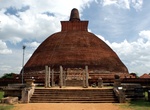
The Jetavanaramaya (world's tallest stupa) is a stupa located in the ruins of Jetavana in the sacred world heritage city of Anuradhapura, Sri Lanka. At 122 metres (400 ft) it was the world's tallest stupa and the third tallest structure in the world when it was built by King Mahasena of Anuradhapura (273–301). He initiated the construction of the stupa following...