Give us feedback!


 See all
Our philosophy is simple. We want to encourage you to dream. BIG! Then we help you plan your trip, get the most out of it while you're traveling and help you share your experience with friends.
Join Now It's FREE
Dream Packages
Duration: 3 days
Price: $396.78
Price: $396.78
Duration: 5 days
Price: $918.22
Price: $918.22
Duration: 11 hours
Price: $208.42
Price: $208.42
Duration: 4 days
Price: $663.61
Price: $663.61
Dreams Still To Do
Checked-Off Dreams
Dreams Still To Do
Checked-Off Dreams
Advertisement
Explore Ancient Places & Ruins
-
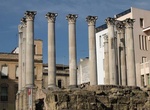
See Roman Temple of Córdoba, Spain
The Spanish city of Córdoba has the remains of a Roman temple, which was discovered in the 1950s during the expansion of City Hall. It is located in the angle formed by the streets Claudio Marcelo and Capitulares. It was not the only temple that the city had, but it was possibly the most important of all, and the only known by archaeological excavation. It is a... -
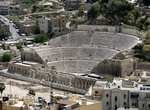
Visit Roman Theatre (Amman), Jordan
Amman's Roman Theatre is a 6,000-seat, 2nd-century Roman theatre. A famous landmark in the Jordanian capital, it dates back to the Roman period when the city was known as Philadelphia. The theatre and the nearby Odeon are flanking the new Hashemite Plaza from the south and the east respectively, while the Roman Nymphaeum is just a short stroll away in north-westerly d... -
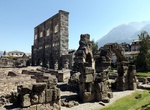
Visit Roman Theatre (Aosta), Italy
Roman Theatre is an ancient building in Aosta, north-western Italy. It was built in the late reign of Augustus, some decades after the foundation of the city (25 BC), as testified by the presence of pre-existing structures in the area. There was also an amphitheatre, built during the reign of Claudius, located nearby. It was restored in 2009. Since 2011, the theatre i... -
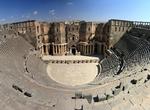
See Roman Theatre of Bosra, Syria
The Roman theatre of Bosra is an ancient Roman theatre in Bosra, Syria. It was built in the second quarter of the 2nd century CE. It is the largest, most complete and best preserved theatre of all the Roman theatres in the Middle East, and was one of the largest theatres ever constructed in the Roman world. The theatre is unusual in that it was not constructed using a... -
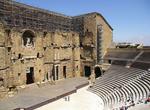
See Roman Theatre & The Triumphal Arch of Orange, France (UNESCO site)
The Théâtre antique d'Orange ("Ancient Theatre of Orange") is an ancient Roman theatre, in Orange, southern France, built early in the 1st century AD. It is owned by the municipality of Orange and is the home of the summer opera festival, the Chorégies d'Orange. It is one of the best preserved of all the Roman theatres in the Roman colony ofArausio... -
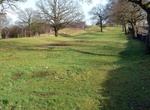
Visit Rough Castle Fort, Scotland
Rough Castle Fort is a Roman fort on the Antonine Wall roughly 2 kilometres south east of Bonnybridge near Tamfourhill in the Falkirk council area, Scotland. The Antonine Wall was built around 143 AD and stretched from Bo'ness on the River Forth to Old Kilpatrick on the River Clyde. The fort is the best preserved of the 19 forts constructed along the length of the Wal... -
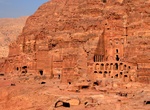
See Royal Tombs of Petra, Jordon
The impressive Royal Tombs are carved into the slopes of Mount Khubtha. From right to left: the Urn Tomb, used as a church in Byzantine times; the smaller Silk Tomb, whose name comes from the delicate shades of the sandstone; the Corinthian Tomb, allegedly a replica of Nero’s Golden Palace in Rome; and the Palace Tomb, the largest of all, inspired by a palatial ... -
Visit Royal Tombs of Selca e Poshtme, Albania
The Illyrian Tombs of Selca e Poshtme (Varret e Selcës së Poshtme) are located near the town of Pogradec in Albania near the village ofSelcë e Poshtme. On the right bank of the river Shkumbin at an elevation of 1040 m above sea level, lie the remains of the ancient city of Pelion and the accompanying necropolis. The Roman Via Egnatia led past it towards... -
See Ruinenberg, Potsdam
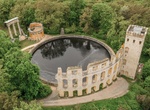
The Ruinenberg is a hill in the Bornstedt borough of Potsdam, located north of Sanssouci Park. In 1748, the Prussian king Frederick the Great had a water tank with a capacity of around 7,600 cubic metres (270,000 cu ft) built on top to supply the Sanssouci water features, and had it decorated with artificial ruins. From 1841 a surrounding landscape garden was laid out... -
See Ruins of Akrotiri, Santorini, Greece
Akrotiri is the name of an excavation site of a Minoan Bronze Age settlement on the Greek island of Santorini, associated with the Minoan civilization due to inscriptions in Linear A, and close similarities in artifact and fresco styles. The excavation is named for a modern Greek village situated on a hill nearby. The name of the site in antiquity is unknown. It was b... -
Visit Ruins of Ancient Thera, Santorini, Greece
Accessible by hiking, this ancient mountaintop city features ruins & dramatic ocean views. -
Visit Ruins of Heracleion, Alexandria, Egypt
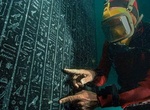
Heracleion (Ancient Greek: ἩράκλειονHērákleion), also known as Thonis (Ancient Greek: ΘῶνιςThônis; from the Ancient Egyptian:Tȝ-ḥn.t; Coptic: ⲦϩⲱⲛⲓThōni, Late Coptic [dəˈhoːni]) and sometimes called Thonis-Heracleion, was an ancient Egyptian port city located near the Canopic Mouth of the Nile,... -
Visit Ruins of Karakorum, Mongolia (UNESCO site)
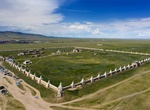
Karakorum was the capital of the Mongol Empire in the 13th century, and of the Northern Yuan in the 14-15th century. Its ruins lie in the northwestern corner of the Övörkhangai Province of Mongolia, near today's town of Kharkhorin, and adjacent to the Erdene Zuu monastery. They are part of the upper part of the World Heritage Site Orkhon Valley Cultural Land... -
See Ruins of Loropéni, Burkina Faso (UNESCO site)
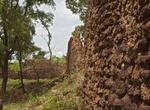
Loropéni is a market town in southern Burkina Faso, lying west of Gaoua. Local features include pre-European stone ruins, about which little is known. One theory is that they formed the enclosure of the courtyard of a Kaan Iya (king or paramount ruler of the Kaan people) from antiquity. There is a similar, though much-degraded ruin around the current royal cour... -
Visit Ruins of São Miguel das Missões, Rio Grande do Sul, Brazil (UNESCO Site)
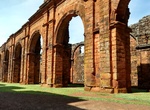
Ruins of São Miguel das Missões is a Unesco World Heritage site located in the municipality of São Miguel das Missões, in the northwestern region of Rio Grande do Sul state, in southern Brazil. The São Miguel das Missões mission was built between 1735 and around 1745 as Mission San Miguel Arcángel. São Miguel das...
Price: $635.26