Give us feedback!
Our philosophy is simple. We want to encourage you to dream. BIG! Then we help you plan your trip, get the most out of it while you're traveling and help you share your experience with friends.
Join Now It's FREE
Related Categories
Dreams Still To Do
Checked-Off Dreams
Dreams Still To Do
Checked-Off Dreams
Advertisement
Explore UNESCO Sites
-
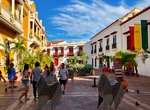
Visit Plaza San Pedro Claver, Cartagena, Colombia
San Pedro Claver Square and the church is named for Saint Peter Claver, where the body of the Jesuit saint ('Saint of the African slaves') is kept in a casket, as well as the Museum of Modern Art. -
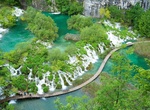
Explore Plitvice Lakes National Park, Croatia (UNESCO site)
Plitvice Lakes National Park is the oldest national park in Southeast Europe and the largest national park in Croatia. The national park was founded in 1949 and is situated in the mountainous karst area of central Croatia, at the border to Bosnia and Herzegovina. The important north-south road connection, which passes through the national park area, connects the Croat... -
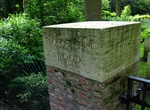
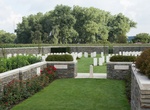
Visit Ploegsteert Wood Military Cemetery, Ypres Salient, Belgium
Ploegsteert Wood Military Cemetery is a Commonwealth War Graves Commission (CWGC) burial ground for the dead of the First World War located in the Ypres Salient within Ploegsteert Wood on the Western Front in Belgium. The cemetery grounds were assigned to the United Kingdom in perpetuity by King Albert I of Belgium in recognition of the sacrifices made by the British ... -
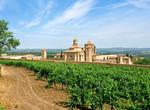
See Poblet Monastery, Spain (UNESCO site)
The Royal Abbey of Santa Maria de Poblet is a Cistercian monastery, founded in 1151, located at the feet of the Prades Mountains, in the comarca of Conca de Barberà, in Catalonia (Spain). It was founded by Cistercian monks from France on lands conquered to the Saracens. The main architect was Arnau Bargués. This monastery was the first of three sister mo... -
Explore Po Delta Park, Italy (UNESCO site)
Po Delta Park is a protected wetlands region in the Po Delta consisting of four parcels of land on the right bank of the Po and to the south. In 1999 the park was designated a World Heritage Site by UNESCO and was added to "Ferrara, City of the Renaissance, and its Po Delta." The 53,653 ha (132,580 acres) of the park contain wetlands, forest, dunes and salt pans.... -
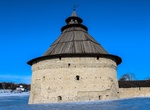
See Pokrovskaya (Intercession) Tower, Pskov Oblast, Russia (UNESCO site)
Pokrovskaya (Intercession) Tower is 15th century and part of the complex of fortress buildings of the Outer Town. On 7 July 2019, Pokrovskaya (Intercession) Tower was added as a UNESCO World Heritage Site under Churches of the Pskov School of Architecture. -
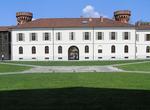
See Pollenzo Estate, Italy (UNESCO site)
The royal estate of Pollenzo is located in the Piazza della Chiesa, Pollenzo - the home of Polenta. The castle dates from the 12th century, but has been remodelled in several styles, most notably Neo-Gothic. It is connected to the St Victor's church, which houses the 16th century wooden choir stalls from Staffarda Abbey. The estate is counted as one of the Residen... -
Explore Poloniny National Park, Slovakia (UNESCO site)
Poloniny National Park is a national park in north eastern Slovakia at the Polish and Ukrainian borders, in the Bukovské vrchy mountain range, which belongs to the Eastern Carpathians. It was created on 1 October 1997 with a protected area of 298.05 km² and a buffer zone of 109.73 km². Selected areas of the park are included into Primeval Beech Forest... -
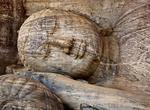
Visit Polonnaruwa, Sri Lanka (UNESCO site)
Polonnaruwa is the second most ancient of Sri Lanka's kingdoms was first declared the capital city by King Vijayabahu I, who defeated the Chola invaders in 1070 AD to reunite the country once more under a local leader. Today the ancient city of Polonnaruwa remains one of the best planned archeological relic sites in the country, standing testimony to the discipline a... -
Visit Polygon Wood Cemetery, Ypres Salient, Belgium
Polygon Wood Cemetery is a Commonwealth War Graves Commission burial ground for the dead of the First World War. It is located in Belgium, in what was the Ypres Salient on the Western Front. Polygon Wood, near the village of Zonnebeke, was the location of a number of battles during the First World War, beginning in late 1914. It had been held by the Germans since Apri... -
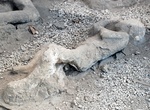
Visit Pompeii, Italy (UNESCO site)
Pompeii was an ancient city located in what is now the comune of Pompei near Naples in the Campania region of Italy. Pompeii, along with Herculaneum and many villas in the surrounding area (e.g. at Boscoreale, Stabiae), was buried under 4 to 6 m (13 to 20 ft) of volcanic ash and pumice in the Eruption of Mount Vesuvius in 79 AD. Largely preserved under the ash, the ex... -
Visit Pompeii, Herculaneum and Torre Annunziata, Italy (UNESCO sites)
The city of Pompeii is a partially buried Roman town-city near modern Naples in the Italian region of Campania, in the territory of the comune of Pompei. Along with Herculaneum, its sister city, Pompeii was destroyed and completely buried during a long catastrophic eruption of the volcano Mount Vesuvius spanning two days in 79 AD. The eruption buried Pompeii under 4 t... -
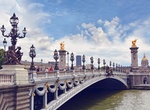
Cross Pont Alexandre III, Paris, France (UNESCO site)
The Pont Alexandre III is a deck arch bridge that spans the Seine in Paris. It connects the Champs-Élysées quarter with those of the Invalides and Eiffel Tower. The bridge is widely regarded as the most ornate, extravagant bridge in the city. It is classified as a French Monument historique since 1975. The Beaux-Arts style bridge, with its exuberant Art ... -
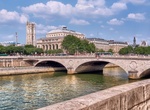
Cross Pont au Change, Paris, France (UNESCO site)
The Pont au Change is a bridge over the Seine River in Paris, France. The bridge is located at the border between the first and fourth arrondissements. It connects the Île de la Cité from the Palais de Justice and the Conciergerie, to the Right Bank, at the Place du Châtelet. Several bridges bearing the name Pont au Change have stood on this site. I... -
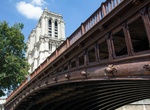
Cross Pont au Double, Paris, France (UNESCO site)
The Pont au Double is a bridge over the Seine in Paris, France. The bridge links the 4th and 5th arrondissements of Paris, from the Île de la Cité to the quai de Montebello. In 1515, Francis I was asked to build a bridge over the small branch of the Seine in order to carry patients to the Hôtel-Dieu hospital on the Île de la Cité. Const...