Give us feedback!
Our philosophy is simple. We want to encourage you to dream. BIG! Then we help you plan your trip, get the most out of it while you're traveling and help you share your experience with friends.
Join Now It's FREE
Related Categories
Dreams Still To Do
Checked-Off Dreams
Dreams Still To Do
Checked-Off Dreams
Advertisement
Explore UNESCO Sites
-
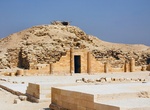
Visit Pyramid of Pepi I, Saqqara, Egypt
The pyramid of Pepi I (in ancient Egyptian Men-nefer-Pepi meaning Pepi's splendour is enduring) is the pyramid complex built for the Egyptian pharaoh Pepi I of the Sixth Dynasty in the 24th or 23rd century BC.[a] The complex gave its name to the capital city of Egypt, Memphis. As in the pyramids of his predecessors, Pepi I's substructure was filled with vertical colum... -
Visit Pyramid of Pepi II, Saqqara, Egypt
The pyramid of Pepi II was the tomb of Pharaoh Pepi II, located in southern Saqqara, to the northwest of the Mastabat al-Fir’aun. It was the final full pyramid complex to be built in Ancient Egypt. Long used as a quarry, the pyramid was excavated for the first time by Gaston Maspero in 1881. Its ruins were studied in exhaustive detail by Gustave Jéquier, ... -
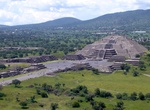
Visit Pyramid of the Moon, Teotihuacán, Mexico
The Pyramid of the Moon is the second-largest pyramid in Mesoamerica, after the Pyramid of the Sun, and located in modern-day San Martín de las Pirámides, Mexico. It is found in the western part of the ancient city of Teotihuacan and mimics the contours of the mountain Cerro Gordo, just north of the site. Cerro Gordo may have been calledTenan, which in N... -
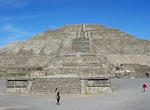
Visit Pyramid of the Sun, Teotihuacán, Mexico
The Pyramid of the Sun is the largest building in Teotihuacan, and one of the largest in Mesoamerica. It is believed to have been constructed about 200 AD. Found along the Avenue of the Dead, in between the Pyramid of the Moon and the Ciudadela, and in the shadow of the mountain Cerro Gordo, the pyramid is part of a large complex in the heart of the city. The namePyra... -
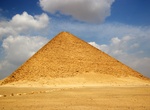
See Pyramids of Dahshur (Dashur), Egypt (UNESCO site)
Dahshur (Dashur), is a royal necropolis located in the desert on the west bank of the Nile approximately 40 kilometres south of Cairo. It is known chiefly for several pyramids, two of which are among the oldest, largest and best preserved in Egypt. The Bent Pyramid and the Red Pyramid were constructed during the reign of Pharaoh Snofru (2613-2589 BCE), father of Khufu... -
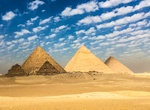
See Pyramids of Giza, Egypt (UNESCO site)
In the city of Giza, near the outskirts of Cairo in Egypt lies an ancient complex of unbelievable architectural achievement known the world over as “The Great Pyramids”. The collection of these ancient marvels includes three giant pyramids: the largest known as the Pyramid of Khufu in recognition of the Egyptian ruler to be entombed therein; nearby lies th... -
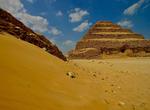
Explore Pyramids of Saqqara (Sakkara), Egypt
Saqqara (Sakkara, Saqqarah) is a vast, ancient burial ground in Egypt, serving as the necropolis for the Ancient Egyptian capital, Memphis. Saqqara features numerous pyramids, including the world famous Step pyramid of Djoser, sometimes referred to as the Step Tomb due to its rectangular base, as well as a number of mastabas. Located some 30 km (19 mi) south of m... -
Explore Pyrénées National Park, France (UNESCO Site)
The Pyrénées National Park is a national park located within the French départements of Hautes-Pyrénées and Pyrénées-Atlantiques. Located along the border of France and Spain is a scenic and mountainous landscape offering a variety of outdoor activities including hiking, skiing, mountain climbing and observing wildlife.... -
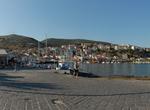
See Pythagoreion, Greece (UNESCO site)
The Pythagoreion is an ancient fortified port in Samos, Greece. A nice and tranquil city with charter- and yacht tourism as its main industry today. It has three ports with a new marina and a dock for ferrys and passangerboats to other islands like Pathmos and to mainland Greece and Turkey. I contains ancient Greek and Roman monuments and a famous ancient tunnel, the ... -
Visit Pyu Ancient Cities, Myanmar (UNESCO Site)
The Pyu city states were a group of city-states that existed from c. 2nd century BCE to c. mid-11th century in present-day Upper Burma (Myanmar). The city-states were founded as part of the southward migration by the Tibeto-Burman-speaking Pyu people, the earliest inhabitants of Burma of whom records are extant. The thousand-year period, often referred to as thePyu mi... -
Explore Qadisha Valley, Lebanon (UNESCO site)
The Kadisha Valley (Qadisha Valley) lies within the Becharre and Zgharta Districts of the North Governorate of Lebanon. The valley is a deep gorge carved by the Kadisha River, also known as the Nahr Abu Ali when it reaches Tripoli. Kadisha means "Holy" in Aramaic, and the valley, sometimes called the Holy Valley, has sheltered Christian monastic communities for m... -
See Qal’at al-Bahrain (Bahrain Fort), Bahrain (UNESCO site)
The Qal'at al-Bahrain (also known as the Bahrain Fort or Fort of Bahrain and previously as the Portugal Fort as well as the fort of Nader Shah, the Persian king) is an archaeological site located in Bahrain. Archaeological excavations carried out since 1954 have unearthed antiquaries from an artificial mound of 12 m height containing seven stratified layers, created b... -
Visit Qal’at Salah El-Din (Saone), Syria (UNESCO site)
The Citadel of Salah Ed-Din (Qalaat Salah Ed-Din; once known as Saone, also known as Saladin Castle) is a castle in Syria. It is located c. 30 km east of Latakia, in high mountainous terrain, on a ridge between two deep ravines and surrounded by forest. One of the most magnificent features of the fortress is the 28 m deep ditch, which was cut into living rock probably... -
Visit Qal'eh Dokhtar, Fars, Iran (UNESCO Site)
Qal'eh Dokhtar, Ghale Dokhtar , Dezh Dokhtar, is a castle made by Ardashir I, in present-day Fars, Iran, in 209 AD. It is located on a mountain slope near the Firouzabad-Kavar road. The name of the castle implies it was dedicated to the Goddess Anahita, to whom the term "Maiden" refers. After capturing Isfahan and Kerman from the Parthians, Ardashir (re)built the city... -
Visit Qalhat, Oman (UNESCO Site)
The ancient city of Qalhat, or Galhat (in the map of Abraham Ortelius, it named as Calha), is located just over 20 km north of Sur, in the Ash Sharqiyah Region of northeastern Oman. During his visit, Ibn Battuta noted, that it had "fine bazaars and one of the most beautiful mosques." He further noted the mosque was built by Bibi Maryam and included walls of qashani. B...