Give us feedback!
Our philosophy is simple. We want to encourage you to dream. BIG! Then we help you plan your trip, get the most out of it while you're traveling and help you share your experience with friends.
Join Now It's FREE
Related Categories
Dreams Still To Do
Checked-Off Dreams
Dreams Still To Do
Checked-Off Dreams
Advertisement
Explore UNESCO Sites
-
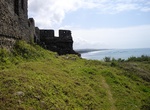
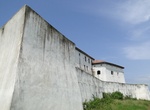
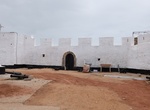
See Fort Amsterdam, Kormantin, Ghana (UNESCO site)
Fort Amsterdam is a fort in Kormantin, Ghana. It was built by the English between 1638 and 1645 as Fort Cormantine and was captured by admiral Engel de Ruyter of the Dutch West India Company in 1665. It was subsequently made part of the Dutch Gold Coast, and remained part of it until the fort was traded with the British in 1868. -
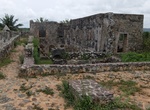
See Fort Batenstein, Ghana (UNESCO site)
Fort Batenstein was the second trading post established by the Dutch on their Gold Coast between 1595 and 1600, after Fort Nassau was founded in Mouri around the same time. It was situated near Butre (old spelling: Boutry). In 1649, the trading post was upgraded into a fort. The fort was ceded with the entire Dutch Gold Coast to Britain in 1872. At this fort, the Trea... -
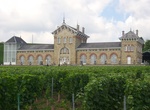
Visit Fort Chabrol, Épernay, France (UNESCO site)
Fort Chabrol is a research laboratory of a Champagne house, based in Epernay, France. Fort Chabrol. It is a place where scientific research is developing: the grafting to combat phylloxera damage and transmit this new technique to Champagne winegrowers. Fort Chabrol was inscribed to the UNESCO List of World Heritage Sites on July 4, 2015 under the Champagne Hillsides... -
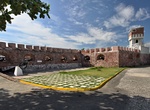
Visit Fort Charles, Port Royal, Jamaica
Fort Charles was built between 1650 and 1660, the first fort constructed in Port Royal, Jamaica. Fort Charles is located in the small town of Port Royal in Jamaica. The town was founded on a natural harbour and Fort Charles was constructed to guard its entrance. According to Donny L. Hamilton, the fort was situated at the tip of the sand spit separating Kingston Harb... -
See Fort Coenraadsburg (Fort Sao Jago da Mina), Ghana (UNESCO site)
Fort Coenraadsburg or Conraadsburg, also Fort Sao Jago da Mina, is a fort on the Dutch Gold Coast, built in 1652 to protect Fort Elmina from attacks. Before the fort was established, a reinforced chapel was built on the hill by the Portuguese, which was burned to the ground by the Dutch in the Battle of Elmina (1637). The fort was ceded with the entire Dutch Gold Coas... -
Visit Fort de Loncin, Liège, Belgium
The Fort de Loncin is one of twelve forts built around Liège, Belgium, in the late 19th century. The overall Fortified Position of Liège was a constituent part of the country's National Redoubt. Fort de Loncin was constructed between 1881 and 1884 according to the plans of General Henri Alexis Brialmont. Contrasting with the French forts built in the sam... -
See Fort des Têtes, France (UNESCO site)
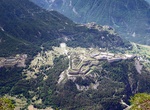
The Fort des Têtes, also known as the Fort des Trois-Têtes, is a fortification in the vicinity of Briançon in the Dauphiné region of southeastern France. It was first surveyed by Vauban in 1700. In 1709 the Marshal Berwick established a fortified camp on the plateau, overlooking the valley of the Durance from a height of 1,440 metres (4,720 f... -
Visit Fort Douaumont, Verdun, France
Fort Douaumont (FrenchFort de Douaumont) was the largest and highest fort on the ring of 19 large defensive forts protecting the city of Verdun, France since the 1890s. However, by 1915 the French General Staff had concluded that even the best-protected forts of Verdun could not resist bombardments from the German 420 mm (16.5 in) Gamma guns. These newly deployed gian... -
See Fort Good Hope (Fort Goedehoop), Ghana (UNESCO site)
Fort Goede Hoop or Fort Good Hope is was a fort on the Dutch Gold Coast, established in 1667 near Senya Beraku. The fort was occupied between 1781 and 1785 by the British, as well as by the local Akim population between 1811 and 1816. In 1868, the fort was ceded to the United Kingdom in a large trade of forts between the Netherlands and Britain. -
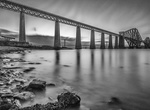
See Forth Bridge, Scotland (UNESCO site)
The Forth Bridge is a cantilever railway bridge across the Firth of Forth in the east of Scotland, 9 miles (14 kilometres) west of central Edinburgh. It is considered as a symbol of Scotland (having been voted Scotland's greatest man-made wonder in 2016), and is a UNESCO World Heritage Site. It was designed by the English engineers Sir John Fowler and Sir Benjamin Bak... -
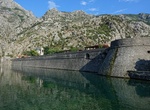
See Fortifications of Kotor, Kotor, Montenegro
The fortifications of Kotor are an integrated historical fortification system that protected the medieval town of Kotor containing ramparts, towers, citadels, gates, bastions, forts, cisterns, a castle, and ancillary buildings and structures. They incorporate military architecture of Illyria, the Byzantine Empire, Venice, and Austria. Together with the old town and it... -
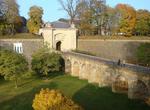
See Fortifications of Longwy, France (UNESCO site)
Longwy is a commune in the Meurthe-et-Moselle department in north-eastern France. Longwy has historically been an industrial center of the Lorraine iron mining district. The town is known for its artistic glazed pottery. Longwy initially belonged to Lotharingia. After the division of that kingdom, the town became part of Upper Lorraine and ultimately the Duchy of Bar.... -
Visit Fortifications of Mycenae, Mycenae, Peloponnese, Greece
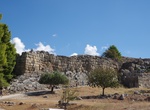
Mycenae is a city in the Argolid, in the Peloponnese peninsula of Greece. It was first excavated by Heinrich and Sophia Schliemann in the 1870s and is believed to have flourished in the Mid- to Late Bronze Age. The fortifications of Mycenae were built with the use of Cyclopean masonry. With the citadel built on a cliff, the architects created protection not only for ... -
Visit Fortified Cities of M'Zab Valley, Algeria (UNESCO site)
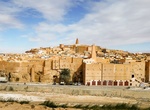
The M'zab valley in the Ghardaïa Province (Wilaya) was inscribed under the UNESCO World Heritage List in 1982, as a cultural property evaluated under the criteria II ( for its settlement having an impact on urban planning even to the present century), III (for its Ibadi cultural values), and V (a settlement culture which has prevailed to the present century). Gha... -
Visit Fortín San Juan de la Cruz (El Cañuelo), Puerto Rico (UNESCO site)
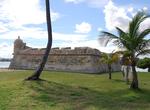
Fortín San Juan de la Cruz (Fort Saint John of the Cross), better known as el Cañuelo, is located on Isla de Cabras, Puerto Rico. The fort is part of the San Juan National Historic Site, which is listed as a UNESCO World Heritage Site and on the National Register of Historic Places. One cannot enter the fort, but one may walk around it. This fort was ori...