Give us feedback!
Our philosophy is simple. We want to encourage you to dream. BIG! Then we help you plan your trip, get the most out of it while you're traveling and help you share your experience with friends.
Join Now It's FREE
Related Categories
Dreams Still To Do
Checked-Off Dreams
Dreams Still To Do
Checked-Off Dreams
Advertisement
Explore UNESCO Sites
-
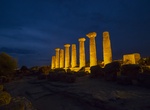
See Temple of Heracles (Agrigento), Sicily, Italy
The Temple of Heracles or Temple of Hercules (The Roman name of the hero) is a greek temple in the ancient city of Akragas, located in the Valle dei Templi in Agrigento. The building, in the archaic Doric style, is found on the hill of the temples, on a rocky spur near the Villa Aurea. The nameTemple of Heraclesis an attribution of modern scholarship, based on Cicero'... -
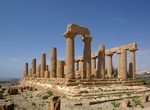
See Temple of Hera Lacinia, Agrigento, Sicily, Italy
The Temple of Hera Lacinia, or Juno Lacinia, otherwise known as Temple D, is a Greek temple in the Valle dei Templi, a section of the ancient city of Agrigentum (ancient Greek Akragas, modern Agrigento) in Sicily. It was built in the middle of the fifth century BC, about the year 450 BC, and in period and in style belongs to the Archaic Doric period. Signs of a fire w... -
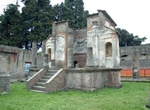
Visit Temple of Isis (Pompeii), Italy
The Temple of Isis is a Roman temple dedicated to the Egyptian goddess Isis. This small and almost intact temple was one of the first discoveries during the excavation of Pompeii in 1764. Its role as a Hellenized Egyptian temple in a Roman colony was fully confirmed with an inscription detailed by Francisco la Vega on July 20, 1765. Original paintings and sculptures c... -
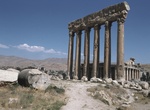
See Temple of Jupiter, Baalbek (Heliopolis), Lebanon
The Temple of Jupiter is a colossal Roman temple, the largest of the Roman world after the Temple of Venus and Roma in Rome. It is situated at the Baalbek complex in Baalbek, Lebanon, It is unknown who commissioned or designed the temple, nor exactly when it was constructed. It is situated at the western end of the Great Court of Roman Heliopolis, on a broad platform ... -
Visit Temple of Jupiter (Pompeii), Italy
The Temple of Jupiter, Capitolium, or Temple of the Capitoline Triad, was a temple in Roman Pompeii, at the north end of its forum. Initially dedicated to Jupiter alone, it was built in the mid-2nd century BC at the same time as the temple of Apollo was being renovated - this was the area at which Roman influence over Pompeii increased and so Roman Jupiter superseded ... -
See Temple of Olympian Zeus, Agrigento, Sicily, Italy
The Temple of Olympian Zeus (or Olympeion; known in Italian as the Tempio di Giove Olimpico) in Agrigento, Sicily was the largest Doric temple ever constructed, although it was never completed and now lies in ruins. It stands in the Valle dei Templi with a number of other major Greek temples. The history of the temple is unclear, but it was probably founded to commemo... -
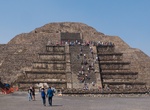
Visit Temple of the Feathered Serpent (Temple of Quetzalcoatl), Teotihuacán, Mexico
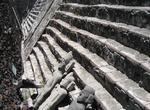
The Temple of the Feathered Serpent is the third largest pyramid at Teotihuacan, a pre-Columbian site in central Mexico (the termTeotihuacan, orTeotihuacano, is also used for the whole civilization and cultural complex associated with the site). This structure is notable partly due to the discovery in the 1980s of more than a hundred possibly sacrificial victims found... -
See Temple of the Tooth (Dalada Maligawa), Kandy, Sri Lanka (UNESCO site)
Sri Dalada Maligawa or the Temple of the Sacred Tooth Relic is a Buddhist temple in the city of Kandy, Sri Lanka. It is located in the royal palace complex which houses the relic of the tooth of Buddha. Since ancient times, the relic has played an important role in local politics because it is believed that whoever holds the relic holds the governance of the country. ... -
Visit Temples of Khajuraho, India (UNESCO site)
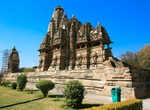
The Khajuraho Group of Monuments is a group of Hindu and Jain temples in Madhya Pradesh, India. About 620 kilometres (385 mi) southeast of New Delhi, they are one of the UNESCO World Heritage Sites in India. The temples are famous for their Nagara-style architectural symbolism and their erotic sculptures. Most Khajuraho temples were built between 950 and 1050 AD, duri... -
Visit Templo Mayor, Mexico City
Templo Mayor was the main temple of the Mexica peoples in their capital city of Tenochtitlan, which is now Mexico City. Its architectural style belongs to the late Postclassic period of Mesoamerica. The temple was called the Huēyi Teōcalli [we:ˈi teoːˈkali] in the Nahuatl language. It was dedicated simultaneously to Huitzilopochtli, god of war, and Tlaloc, god of rain... -
Explore Ténéré, Niger & Chad (UNESCO site)
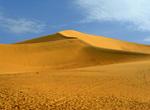
The Ténéré is a desert region in the south central Sahara. It comprises a vast plain of sand stretching from northeastern Niger into western Chad, occupying an area of over 154,440 square miles (400,000 km2). Its boundaries are said to be the Aïr Mountains in the west, the Hoggar Mountains in the north, the Djado Plateau in the northeast, the... -
Visit Tenryū-ji, Kyoto, Japan (UNESCO Site)
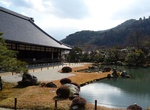
Tenryū-ji more formally known as Tenryū Shiseizen-ji is the head temple of the Tenryū branch of Rinzai Zen Buddhism, located in Susukinobaba-chō, Ukyō Ward, Kyoto, Japan. The temple was founded by Ashikaga Takauji in 1339, primarily to venerate Gautama Buddha, and its first chief priest was Musō Soseki. Construction was completed in 1345. As a temple related to both t... -
Visit Teotihuacán, Mexico (UNESCO site)
Teotihuacan – also written Teotihuacán, is an enormous archaeological site in the Basin of Mexico, containing some of the largest pyramidal structures built in the pre-Columbian Americas. Apart from the pyramidal structures, Teotihuacan is also known for its large residential complexes, the Avenue of the Dead, and numerous colorful, well-preserved murals.... -
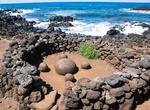
Visit Te Pito Kura, Easter Island, Chile
Te Pito Kura is a large ovoid shaped stone 80 centimeters in diameter. The expression Te Pito Kura means “navel of light”. -
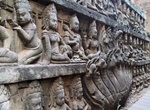
See Terrace of the Leper King, Angkor, Cambodia
Terrace of the Leper King is located in the northwest corner of the Royal Square of Angkor Thom, Cambodia. It was built in the Bayon style under Jayavarman VII, though its modern name derives from a 15th-century sculpture discovered at the site. The statue depicts the Hindu god Yama, the god of death. The statue was called the "Leper King" because discolouration and m...